Gods · Goddesses · Afterlife · Cosmology · Creatures

Egyptian Mythology: Older, stranger, and more sophisticated than you think

Egyptian mythology is the oldest continuously practised religious tradition in human history, spanning more than three thousand years from the early dynastic period to the Roman closure of the last active temple at Philae in 535 CE. What it produced in that time is not simply a collection of colourful stories about animal-headed gods. It is one of the most philosophically serious attempts any civilisation has made to answer the questions that matter most: how did existence begin, what happens after death, what does it mean to live well, and what does the universe owe us in return for living that way.

The tradition is preserved across an extraordinary range of sources: the Pyramid Texts carved in royal tombs from around 2400 BCE, the oldest religious writings in the world; the Coffin Texts that democratised the afterlife across the Middle Kingdom; the Book of Coming Forth by Day that guided the dead through the underworld; the temple inscriptions, the mythological papyri, and the theological treatises of three millennia of sustained religious thought. No other ancient tradition has left a documentary record of comparable depth or duration.

The articles below cover every major figure, event, and concept in the Egyptian tradition. Start anywhere. Each article connects to the others. The tradition rewards the reading in any order.


The Gods
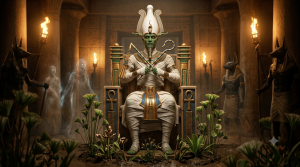
Egyptian MythologyOsiris: The Murdered King Who Became the Judge of the Dead and Why His Story Is the Foundation of Everything in Egyptian MythologyThe Osiris myth is the most important story in Egyptian mythology. Not because it is the most dramatic,…
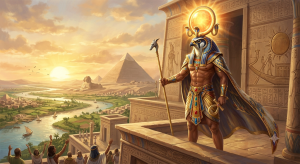
Egyptian MythologyRa: The Egyptian Sun God Who Dies Every Night and Has to Fight His Way Back to DawnRa does not simply move across the sky. Every morning he is born. Every noon he reaches the…
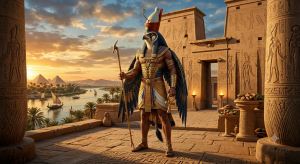
Egyptian MythologyHorus: The Falcon God Whose Left Eye Is the Moon and Whose Face Has Been on Every Pharaoh in Egyptian HistoryFor nearly three thousand years of Egyptian history, every pharaoh who took the throne took on the identity…
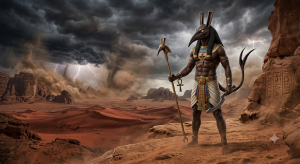
Egyptian MythologySet: The Egyptian God of Chaos Who Murdered His Brother, Defends the Sun Every Night, and Has an Animal Nobody Can IdentifySet is the villain of Egyptian mythology. He murdered his brother Osiris, dismembered the body and scattered it…
Egyptian MythologyThoth: The Egyptian God Who Invented Writing, Healed the Eye of the Moon, and Became Twice-Great and Then Three Times GreatThoth invented hieroglyphics. He also invented mathematics, medicine, science, law, and magic. He is the divine scribe who…
Egyptian MythologyPtah: The Egyptian Creator God Who Thought the World Into Existence and Spoke It Into BeingThe most philosophically sophisticated creation myth in Egyptian religion belongs to a god who is rarely the first…
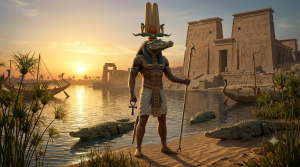
Egyptian MythologySobek: The Crocodile God of the Nile Who Was Worshipped With Live Crocodiles Adorned in GoldAt the city of Shedet in the Faiyum region of Egypt, a city the Greeks called Crocodilopolis, the…

The Goddesses

Egyptian MythologyIsis: The Most Powerful Magician in Egyptian Mythology and the Goddess Whose Worship Outlasted Ancient Egypt ItselfIsis is the most powerful magical practitioner in Egyptian mythology. This is not a matter of interpretation or…
Egyptian MythologyHathor: The Egyptian Goddess of Love and Music Who Is Also the Eye of Ra and Nearly Destroyed All of HumanityHathor is the goddess of love, beauty, music, dance, motherhood, and joy. She is the most widely worshipped…
Egyptian MythologySekhmet: The Lioness Goddess Who Was Sent to Destroy Humanity, Nearly Succeeded, and Had to Be Stopped With Seven Thousand Jars of BeerRa sent Sekhmet to punish humanity for their disobedience. He watched for a while as she killed, and…
Egyptian MythologyNephthys: The Egyptian Goddess Who Stood at the Wrong Side of Every Story and Kept Showing Up AnywayNephthys is the wife of the murderer, the sister of the victim, the mother of the embalmer, and…
Egyptian MythologyBastet: The Egyptian Cat Goddess Who Was Once a Lioness and Whose Sacred Animals Could Get You Killed for Harming ThemIn ancient Egypt, killing a cat was a capital offence. Not harming the sacred cats of a specific…

Creatures and Beings

Egyptian MythologyAnubis: The Jackal God Who Invented Mummification, Weighs Every Heart, and Was Originally More Important Than OsirisAnubis is the most recognisable figure in Egyptian mythology. The jackal head, the black fur, the scales of…
Egyptian MythologyAmmit: The Egyptian Devourer Who Was Not a God, Had No Temples, and Represented a Fate Worse Than DeathAmmit was not worshipped. This is the first and most important thing to understand about her. In a…
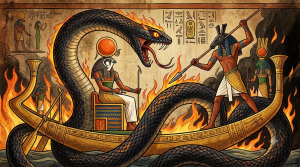
Egyptian MythologyApep: The Egyptian Chaos Serpent Who Attacks the Sun Every Night and Has Never Once WonEvery night, as the sun god Ra travels through the underworld in his solar barque, Apep attacks. Every…
Egyptian MythologyThe Sphinx: What the Great Monument of Giza Actually Was in Egyptian Belief and What Remains UnknownThe Great Sphinx of Giza is the largest monolithic statue to survive from the ancient world: 73 metres…

Myths, Cosmology and the Afterlife
Egyptian MythologyThe Osiris Myth: The Complete Story of Murder, Dismemberment, and Resurrection That Shaped Everything in Egyptian ReligionThe Osiris myth is the central narrative of Egyptian religion. It is not simply the most important story…
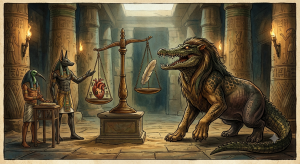
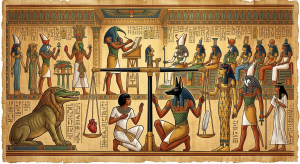
Egyptian MythologyThe Weighing of the Heart: The Egyptian Judgment of the Dead and What It Actually Meant to Have Your Soul DestroyedIn the Hall of Two Truths, after death, every Egyptian faced a judgment that determined the remainder of…
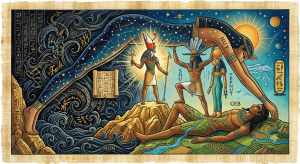
Egyptian MythologyThe Egyptian Creation Myth: How a Civilisation That Had Multiple Competing Creation Stories Was Comfortable With All of Them at OnceEgyptian mythology does not have a creation myth. It has at least three, developed in different cities, promoted…
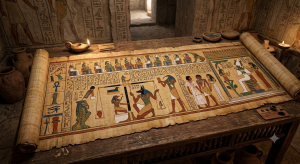
Egyptian MythologyThe Book of the Dead: What It Actually Was, What It Contained, and Why Its Real Name Is More Interesting Than the Name We UseThe Book of the Dead is not a book. It is not dead. And the name was given…
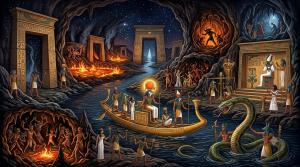
Egyptian MythologyThe Duat: The Egyptian Underworld That Was Not Hell and What the Dead Actually Encountered ThereThe Duat is the most precisely mapped afterlife realm in the ancient world. While the Greek underworld is…
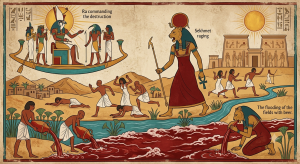
Egyptian MythologyThe Destruction of Mankind: The Egyptian Myth Where Ra Sent a Goddess to Kill Everyone and Had to Get Her Drunk to Stop HerRa made a mistake. He had ruled Egypt and all the earth for longer than anyone could remember,…

Why This Tradition Matters

Egyptian mythology shaped Western civilisation more directly than most people realise. The worship of Isis spread across the Roman Empire and her temples stood in Britain, Afghanistan, and across the Mediterranean world. The image of the divine mother nursing the divine child, ubiquitous in Egyptian funerary art for fifteen hundred years, entered Christian iconography in ways that scholars continue to debate. The concept of the soul being judged after death against a moral standard, with paradise or destruction as the outcome, influenced every subsequent tradition that wrestled with the same question.

What the tradition itself offers, read directly rather than through its influence on later cultures, is something more immediately interesting: a theology sophisticated enough to hold multiple creation myths simultaneously without resolving them, an afterlife system detailed enough to map the twelve hours of the underworld hour by hour, and a moral philosophy precise enough to identify forty-two distinct categories of wrongdoing and weigh the accumulated quality of a life against a feather.

The articles in this section treat the tradition with the seriousness it deserves. Primary sources are identified. The full three thousand year span of the tradition is respected rather than collapsed into a single snapshot. Popular misconceptions are addressed directly. The goal is Egyptian mythology as it actually existed, not as popular culture, Hollywood, or a century of adventure novels has decided it should be.

Scroll to Top
×