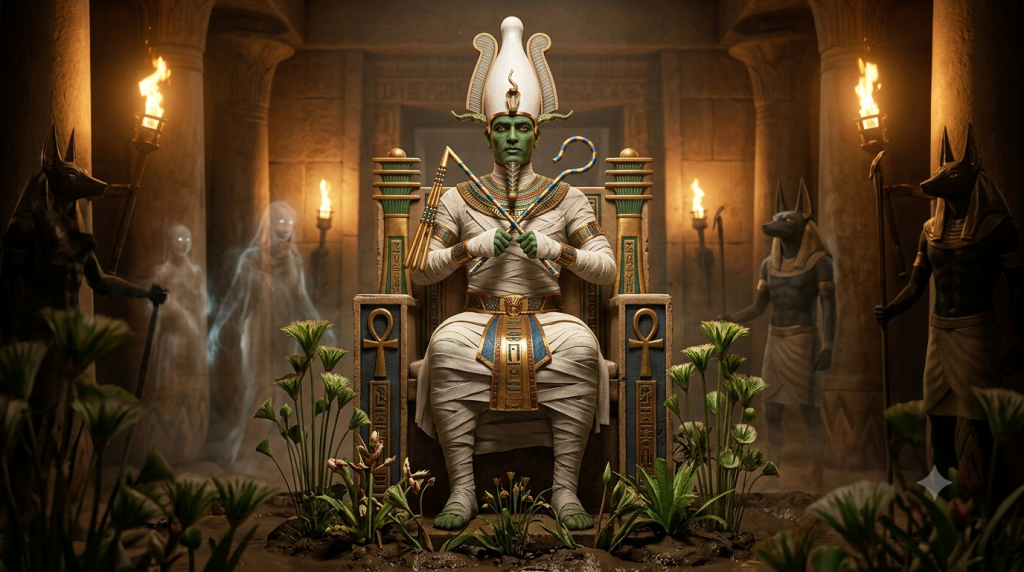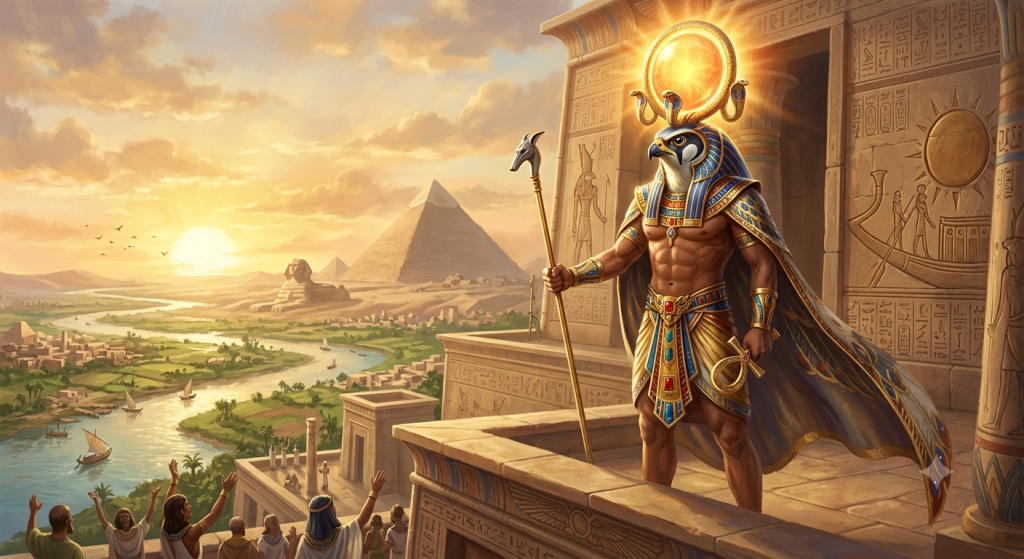
The most philosophically sophisticated creation myth in Egyptian religion belongs to a god who is rarely the first name people think of when they consider the Egyptian pantheon. Ptah of Memphis did not create the world by emerging from the primordial waters, or by masturbation, or by spitting out the first divine pair. He created it by thinking it and then saying it.
In the Memphite Theology, preserved on a black basalt monument known as the Shabaka Stone now in the British Museum, Ptah conceives creation in his heart, the seat of thought and intelligence in Egyptian anatomy, and brings it into existence through his tongue, the organ of speech. The heart forms the idea. The tongue speaks the name. The named thing exists. Every god, every creature, every city, every object in existence came to be in this way: Ptah thought it and said it and it was so.
Scholars of religion have noted for over a century that this account of creation through the divine word anticipates what the Gospel of John calls the Logos, and bears a striking resemblance to the opening of Genesis. In the beginning was the word. The Memphite Theology predates both of those texts by centuries, and the tradition it preserves may be considerably older than the stone on which it was carved. The idea that creation is fundamentally a linguistic act, that the universe is the spoken thought of a divine intelligence, is one of the most persistent and widely distributed theological ideas in human history, and Egypt got there first.
Who Ptah Was
Ptah is the chief deity of Memphis, the ancient capital of Egypt and one of the most important cities in the ancient world. His cult is one of the oldest in Egyptian religion, traceable to the very beginning of the dynastic period: the city of Memphis itself was founded by the first pharaoh Menes, and the great temple of Ptah was established there at the same time, making his worship inseparable from the founding of unified Egyptian civilisation.
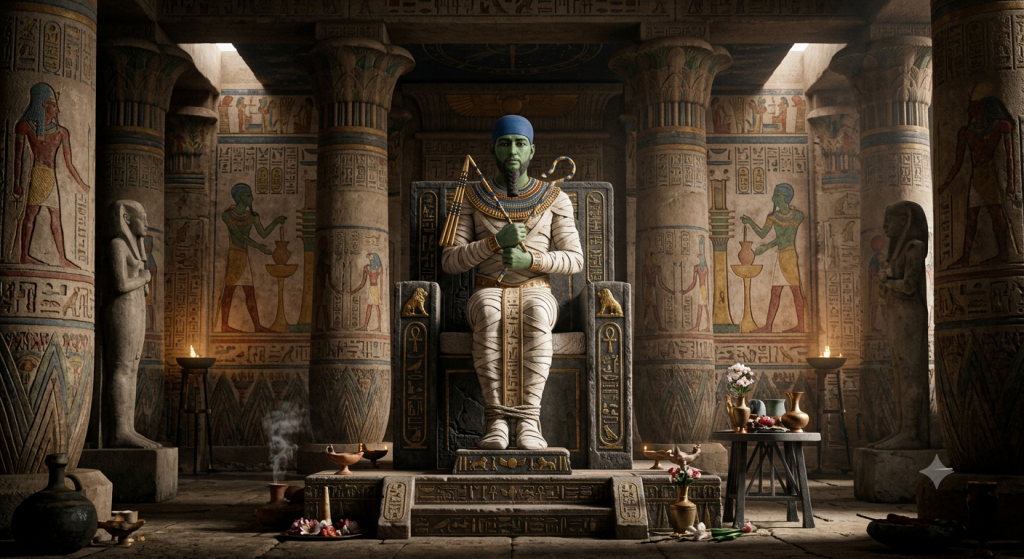
He is depicted in a form unique among the Egyptian gods: a mummified human figure, tightly wrapped so that only his hands emerge from the bandages, holding a composite sceptre that combines the djed pillar of stability, the was sceptre of power, and the ankh of life. His head is shaved and he wears a close-fitting blue cap. He stands on a plinth, immobile, contained. Where most Egyptian gods are shown in motion, Ptah is completely still.
This stillness is not passivity. It is the stillness of concentrated thought: the creator god before he speaks, the moment of conception before the word is uttered. The mummified form connects him to Osiris and to the dead, to the idea of transformation through enclosure, the same principle that makes mummification the prerequisite for resurrection. Ptah’s form holds within it the possibility of everything he will create, just as a mummy holds within it the possibility of continued existence.
His consort is Sekhmet the lioness goddess of war, and his son is Nefertum the lotus god of perfume and sunrise. The triad of Ptah, Sekhmet, and Nefertum was the divine family of Memphis, three aspects of creation, destruction, and renewal bound together in the theology of the most important city in Egypt.
The Shabaka Stone and the Memphite Theology
The Shabaka Stone was commissioned by the Nubian pharaoh Shabaka around 700 BCE to preserve the text of a much older papyrus that had been damaged by worms. He ordered the text carved onto basalt so that it would survive. The stone subsequently suffered its own damage: it was later used as a millstone, and the grinding wore away the central section of the text, creating gaps that scholars have spent over a century attempting to reconstruct.
What survives is still among the most important theological documents from ancient Egypt. It describes Ptah as the heart and tongue of the Ennead, the group of nine gods that the Heliopolitan creation tradition places at the beginning of the cosmos. The Memphite Theology does not deny the Heliopolitan account in which Atum the sun god emerges from the primordial waters and creates the first divine pair. Instead it asserts that Ptah is the intelligence behind Atum, the thought and word that preceded even that creation. Atum is what happened when Ptah spoke. The Heliopolitan gods are real, but Ptah is the reason they exist.
The text states explicitly that every god who exists, exists because Ptah gave them form through his thought and speech. Every city was founded when Ptah decided it should exist. Every statue of every god was carved to the specification that Ptah set when he created it in his mind. The god who gives life to the statues of the other gods is the god whose own statues are the most rigid and contained in the tradition: the being whose creative power flows entirely inward before it becomes outward.
Patron of Craftspeople
Alongside his role as creator god, Ptah is the patron deity of all craftsmanship: sculptors, metalworkers, carpenters, architects, and all those who make things with their hands. This connection to making is not incidental to his theological role but the expression of it in the human domain. Ptah creates through thought and word; human craftspeople create through skill and labour. Both are forms of bringing something into existence that was not there before. The human craftsperson participates, at a smaller scale and through physical means, in the same creative act that Ptah performs cosmologically.
The Greek name for Memphis was Hut-ka-Ptah, the mansion of the soul of Ptah, which was transliterated into Greek as Aigyptos, giving us the word Egypt. The country’s name in most Western languages derives from the name of Ptah’s temple in his primary city. The creator god’s house gave its name to the entire civilisation.
Ptah was identified by the Greeks with Hephaestus, the god of the forge, which captures the craftsman aspect but misses the theological depth of the creator role. The better comparison is with a philosophical concept rather than a specific deity: the Demiurge of Platonic philosophy, the divine craftsman who shapes the physical world from intelligible patterns. Plato’s Demiurge, like Ptah, is a creator who works through a combination of intellectual conception and technical execution, and the parallel has been noted by scholars of both traditions.
Ptah-Sokar-Osiris
One of the most significant divine mergers in Egyptian theology combined Ptah with Sokar, a funerary god of the Memphite necropolis, and with Osiris, the ruler of the dead. The resulting composite deity Ptah-Sokar-Osiris expressed a theological synthesis: the creator who conceives through thought, the guardian of the dead, and the prototype of resurrection, unified in a single divine figure.
Funerary statuettes in the form of Ptah-Sokar-Osiris were placed in tombs throughout the Late Period and the Ptolemaic era, expressing the hope that the deceased would participate in the creative and regenerative power of all three combined aspects. The creator god appears in death as the guarantor of resurrection, which is consistent with the deepest logic of the Memphite Theology: creation is an act of thought, and thought does not die with the body that housed it.
For more on the Egyptian tradition, the Sekhmet article covers Ptah’s consort, whose nature as the destroyer is the complement to his nature as the creator. The Osiris article covers the god with whom Ptah merges in the funerary tradition. The Egyptian Creation Myth article covers the full range of Egyptian cosmogonic traditions and how Ptah’s Memphite Theology relates to the other accounts.
Never miss a myth
Thank you for being here. The site is brand new and every subscriber genuinely means something to me. If you're here, you care about this stuff as much as I do - and that's all the reason I need to keep going. New stories, videos and dark folklore from around the world, straight to your inbox. No algorithm. Just the stories, when they're ready.