Egyptian mythology does not have a creation myth. It has at least three, developed in different cities, promoted by different priesthoods, and each claiming ultimate theological authority. The Heliopolitan account, from the city of the sun, places Atum at the origin of everything. The Memphite account, from Memphis, places Ptah before Atum and makes Atum an expression of Ptah’s thought. The Hermopolitan account, from the city of Thoth, places eight primordial beings before either of them. The Theban account eventually placed Amun before all of these.
The remarkable thing about Egyptian theology is that it was comfortable with all of these simultaneously. The different accounts were not understood as competing claims of which only one could be true. They were understood as different perspectives on a single underlying reality too large and complex to be captured by any single account. The theologians of Memphis did not argue that the Heliopolitan account was wrong. They argued that Ptah was the deeper principle behind Atum’s emergence, that Atum acted because Ptah had thought him into existence. The creation myths of different cities absorbed each other into hierarchical relationships rather than demanding that one be chosen and the others rejected.
This theological approach, which modern scholars call the theology of the multiple, allowed Egyptian religion to hold apparent contradictions without resolving them, to maintain several versions of the same truth simultaneously without experiencing this as a problem. It is one of the most intellectually distinctive features of Egyptian thought and one of the hardest for modern readers, accustomed to traditions that prize internal consistency, to understand.
What All the Myths Begin With: Nun
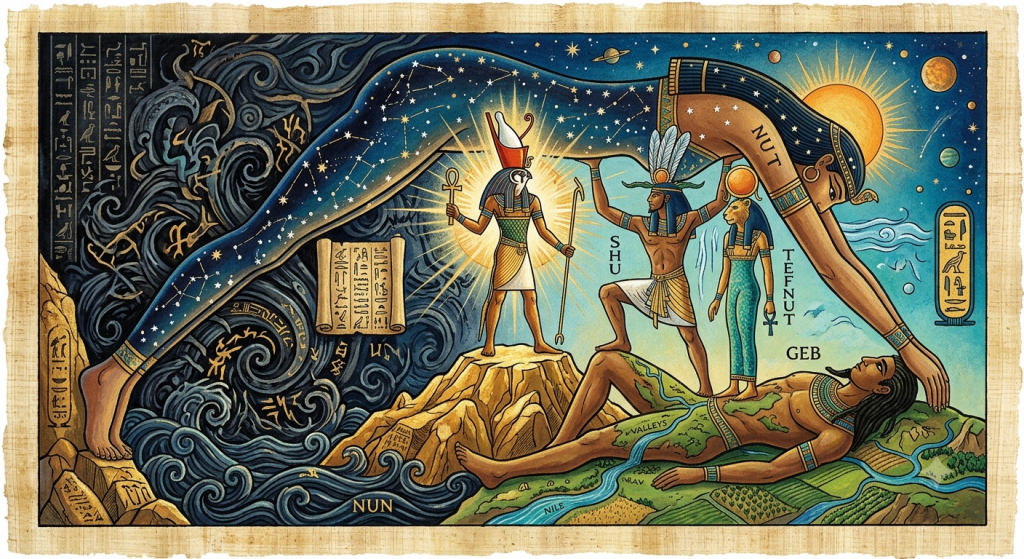
Despite their differences, all the major Egyptian creation myths begin in the same place: Nun, the primordial waters of chaos. Before creation, there was only Nun: infinite, formless, dark, and characterised by the absence of distinction, the absence of light, the absence of any quality that would allow one part of it to be distinguished from another. Nun was not simply water in the physical sense. It was the condition of undifferentiated potentiality, everything that could exist before any of it had been separated and given form.
The emergence of creation from Nun was the emergence of distinction from undifferentiation, of form from formlessness, of the ability to say this and not that from the condition in which everything was the same undifferentiated everything. The first act of creation in every Egyptian account is an act of separation: the creator separating themselves from Nun, or separating air from water, or earth from sky. Creation is defined as the imposition of distinction and order on the primordial chaos rather than as the making of something from nothing.
Nun never disappears. He persists at the edges of the created world, held back by the order the gods maintain, returning in the flood season when the Nile rises and covers the land, receding when the flood recedes. The annual inundation was understood as a temporary return to the primordial condition, and the re-emergence of the land from the flood was a miniature repetition of the original creation every year. Egypt was not simply a place where creation had happened once, long ago. It was a place where creation happened every year, visible in the landscape, its mechanism the same as the original.
The Heliopolitan Account: Atum and the Ennead
The Heliopolitan creation myth is the most extensively preserved and most widely known of the Egyptian accounts, partly because the Pyramid Texts, the oldest religious writings in Egypt, were produced by priests of the Heliopolitan tradition, and their preservation in the pyramids of the Fifth and Sixth Dynasty pharaohs gave them a durability that many other texts did not have.
In the beginning, Atum existed within Nun. The Pyramid Texts variously describe him as floating in Nun in an inert state, as being in his egg, as drifting in the undifferentiated waters waiting for the moment of emergence. What initiated the emergence is not fully explained: Atum arises from Nun by an act of self-creation, by his own will or by a primordial urgency toward being, and when he arises the primordial mound, the Benben, rises with him or he takes his stand upon it.
Atum then creates the first divine pair by an act that the Pyramid Texts describe in terms that later theological sensibility found indelicate: he creates Shu, the god of air, and Tefnut, the goddess of moisture, by masturbation or by spitting, depending on which version of the text is followed. The wordplay in the original Egyptian connects the act of spitting to the name Tefnut and the act of expectoration to the name Shu through puns that the tradition clearly intended as meaningful: the creation of the first pair is encoded in the words for what produced them.
Shu and Tefnut represent the first distinction in the created world: the separation of air and moisture, the two basic conditions required for life, from the undifferentiated Nun. They wander away into Nun and are lost. Atum sends his Eye, a divine force equivalent to his sight or his power of perception, to find them. The Eye brings them back. Atum weeps tears of joy at their return, and from his tears the first humans emerge: humanity is created from the tears of the first god’s relief at recovering his lost children.
Shu and Tefnut produce Geb, the earth god, and Nut, the sky goddess. Geb and Nut are locked in permanent embrace until Shu, the god of air, is placed between them, lifting Nut away from Geb to create the space of the world between earth and sky. This separation is one of the most important acts in Egyptian cosmology, because the space it creates is the world that everything else will inhabit. The images of Nut arched over Geb, her body the sky above the earth below, appear throughout Egyptian funerary art: the sarcophagus interior often depicted Nut on its ceiling, enclosing the dead person within the sky goddess’s body as within the cosmos itself.
Geb and Nut produce the five children whose family drama is the central narrative of Egyptian mythology: Osiris, Isis, Set, Nephthys, and Horus the Elder. With their birth, the Ennead of Heliopolis is complete: Atum, Shu, Tefnut, Geb, Nut, Osiris, Isis, Set, and Nephthys. The nine gods who between them produce and govern the created world, descended in a single lineage from the self-created god who emerged from the primordial waters alone.
The Hermopolitan Account: The Eight Before the One
At Hermopolis, the city of Thoth in Middle Egypt, a different theological tradition held that before Atum, before the Heliopolitan creator, there were eight primordial beings who preceded creation itself. These eight, the Ogdoad, existed in paired male-female couples and represented the fundamental conditions of the pre-creation state.
The four pairs were Nun and Naunet, the primordial waters and their female counterpart; Heh and Hauhet, infinity and its female counterpart; Kek and Kauket, darkness and its female counterpart; and Amun and Amaunet, the hidden or invisible force and its female counterpart. Each pair represents a quality of the primordial state, and together the eight constitute a complete description of what existed before anything else existed.
The Hermopolitan account holds that these eight primordial beings, through their collective action or simply through the interaction of the principles they embodied, created an island of order in the primordial chaos. On this island the first mound emerged, and from it either a cosmic egg appeared or a lotus flower opened on the water, and from the egg or the lotus the sun was born. The first light in the world was the birth of Ra from the egg or the opening of the lotus, and with that light creation began in earnest.
The Hermopolitan tradition preserves what may be the oldest layer of Egyptian cosmological thinking, a time before the sun god’s supremacy was established, when the fundamental forces of the pre-creation state were understood as collective rather than embodied in a single creator. The Ogdoad are not gods in the same sense as Atum or Ra. They are primordial principles, the conditions that made creation possible rather than the agents who performed it.
The Lotus and the Scarab: Creation’s Two Images
Egyptian creation mythology produced two of the most beautiful images in the ancient world’s understanding of how existence began.
The lotus flower opening on the surface of the primordial waters, revealing the sun within it, became one of the most enduring images of Egyptian art. The lotus closes at night and opens in the morning, its daily cycle a miniature of the sun’s own pattern of apparent disappearance and return. A lotus rising from the waters of Nun to reveal the first light is an image of extraordinary elegance: the most beautiful flower native to the Nile delta serving as the vessel for the birth of the most important divine force in Egyptian cosmology.
The scarab beetle, associated with Khepri the morning sun, provided the second great image of creation: the beetle rolling its ball of dung across the ground, observed by the Egyptians as analogous to the sun rolling across the sky, became the hieroglyph for becoming and transformation. The word kheper means both the scarab beetle and the concept of coming into being, making the image of the beetle not simply a metaphor for creation but a linguistic encoding of the concept itself. Creation, the idea, is the scarab in the Egyptian writing system.
What Multiple Creation Myths Tells Us
The existence of multiple creation accounts in a single religious tradition, all of which were maintained simultaneously and none of which was officially designated as the only correct one, tells us something specific and important about how Egyptian theology worked.
The Egyptians understood that the origin of everything was too large a subject for any single account to capture completely. Different cities had different perspectives, different emphasises, different theological intuitions about what the most fundamental reality was and how to describe it. Rather than requiring that one perspective be correct and the others be abandoned, the tradition treated them as complementary: each capturing something true about a reality too large for any single description.
Ptah’s Memphite Theology did not replace the Heliopolitan Ennead. It proposed that Ptah was the deeper principle behind Atum’s self-creation, placing the two accounts in a relationship where the Heliopolitan account described what happened while the Memphite account described the underlying mechanism that made what happened possible. The two stories together were more complete than either alone.
This theological posture, the willingness to hold multiple accounts simultaneously as complementary perspectives rather than competing claims, is one of the most sophisticated features of ancient Egyptian thought, and it is one of the things that makes the Egyptian tradition consistently surprising to read even three thousand years after it was fully formed.
For more on the specific creation accounts and the gods involved, the Ptah article covers the Memphite Theology and how Ptah creates through thought and word. The Ra article covers the sun god who is the culmination of the Heliopolitan lineage and the light that emerges from the lotus at the beginning of creation. The Osiris article covers the fifth-generation descendant of Atum who will go on to create the entire system of the afterlife.
Never miss a myth
Thank you for being here. The site is brand new and every subscriber genuinely means something to me. If you're here, you care about this stuff as much as I do - and that's all the reason I need to keep going. New stories, videos and dark folklore from around the world, straight to your inbox. No algorithm. Just the stories, when they're ready.