Ra does not simply move across the sky. Every morning he is born. Every noon he reaches the fullness of his power. Every evening he dies. And every night, in the darkness beneath the world, he fights his way through twelve hours of chaos, monster-haunted caverns, and the attacks of a serpent who wants to stop the sun from ever rising again.
The daily journey of the sun in Egyptian religion is not an astronomical event with a mythological explanation attached. It is a genuine death and resurrection repeated every twenty-four hours, with the continuation of the world depending on the outcome. When Ra emerges from the eastern horizon each dawn as the scarab-headed god Khepri, he has survived the night again. The world has another day because he won.
This is the most important thing to understand about Ra before anything else: the sunrise is not guaranteed. It has to be earned, every night, in the darkness.
Who Ra Was and the Problem of His Names
Ra, also written Re, was the sun god and one of the most important deities in the Egyptian pantheon across virtually the entire span of the tradition. His primary cult centre was Heliopolis, the city of the sun in the Nile Delta, where the earliest and most elaborate solar theology was developed. During the Fifth Dynasty, roughly 2494 to 2345 BCE, his importance peaked to the point where pharaohs began calling themselves sons of Ra, a title that connected divine kingship directly to the solar deity.
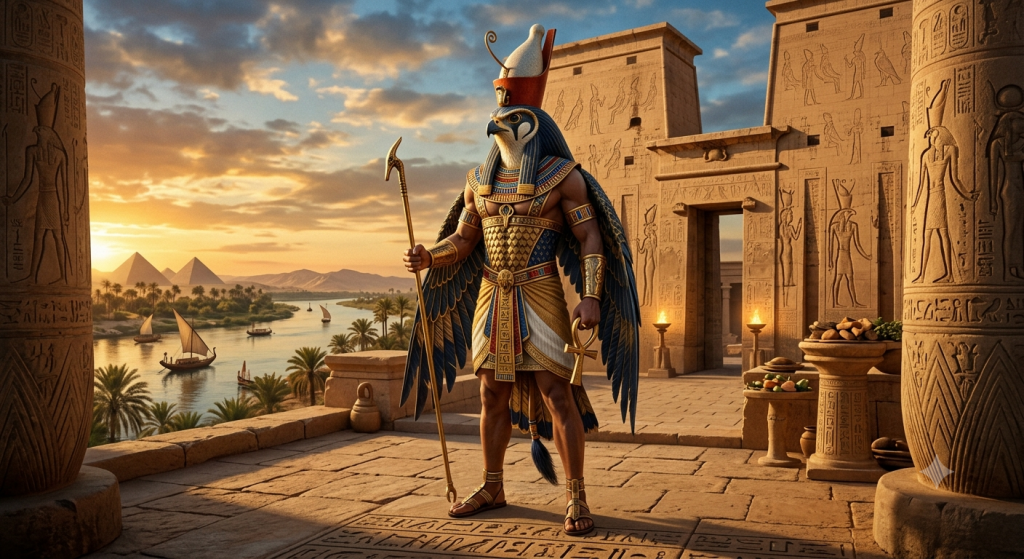
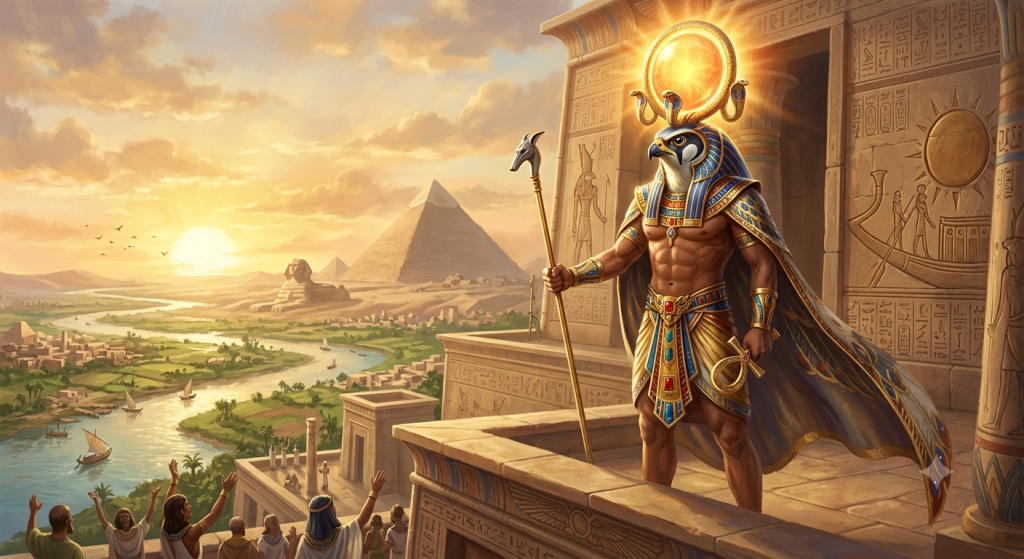
Ra exists in the tradition in multiple forms that are not separate gods but aspects of a single solar consciousness moving through the stages of the day. As Khepri, the scarab beetle, he is the morning sun: the newly born light pushing above the horizon, embodying the concept of becoming and transformation. The scarab beetle was observed rolling balls of dung across the ground, and the Egyptians saw in this behaviour a metaphor for the sun rolling across the sky, and for the regeneration of life from apparent death. As Ra in his full form, a falcon-headed man wearing the sun disc, he is the noon sun at the height of his power. As Atum, an older figure leaning on a staff, he is the evening sun: the accumulated wisdom of the completed day, about to descend into the underworld.
He also merged with other gods across the tradition’s long history. Ra-Horakhty combined him with Horus. Amun-Ra, the merger of the supreme god Amun with the sun god, became the dominant divine figure during the New Kingdom period. The capacity of Egyptian theology for divine merging, for holding the identity of two gods simultaneously in a single figure, is one of its most distinctive and most confusing features for modern readers, and Ra’s history illustrates it extensively.
The Solar Barque and the Twelve Hours
Ra travels across the sky in a solar barque, a divine boat called the Mandjet during the day and the Mesektet during the night. The barque carries not just Ra but a crew of divine beings: Ma’at the goddess of cosmic order, Thoth the scribe, Sia the personification of divine perception, Heka the god of magic, and various protective deities who help defend the barque against what attacks it.
At sunset Ra enters the western horizon and begins the night journey through the Duat, the Egyptian underworld. The Amduat, one of the most important funerary texts of the New Kingdom found in royal tombs, describes this journey in remarkable detail across twelve hours, each corresponding to a region or cavern of the underworld with its own characteristics, guardian serpents, and challenges.
In the early hours of the night journey, Ra passes through regions where the dead greet him, where his light briefly illuminates the underworld and gives comfort to those who dwell there. As the night deepens, the challenges become more severe. The barque must be towed through shallow regions where it cannot sail. Protective spells must be recited to open each gate. The crew must overcome or bypass the hostile forces that would stop the sun from completing its journey.
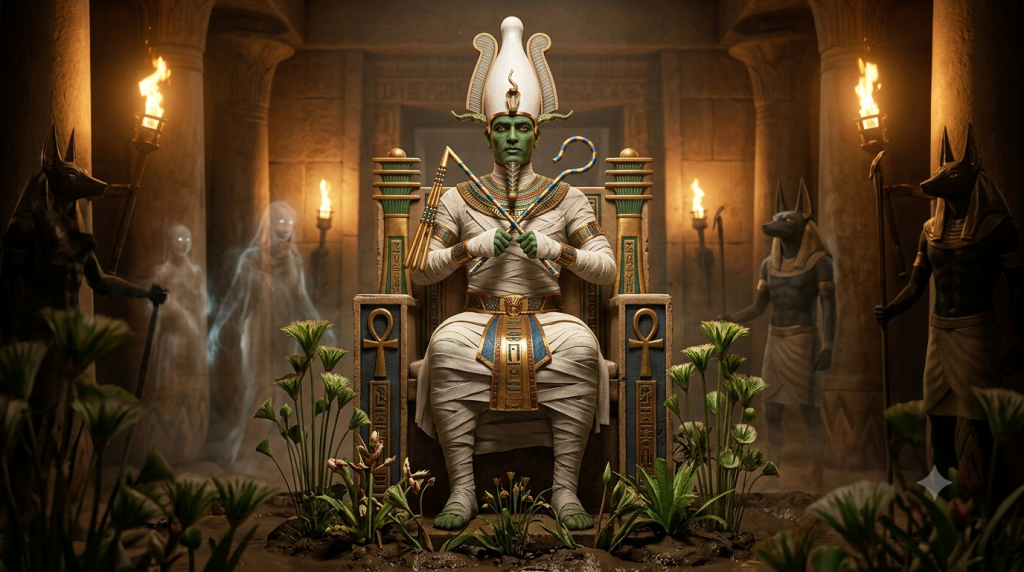
At the sixth hour, the deepest point of midnight, Ra fuses temporarily with Osiris, the ruler of the dead. This union of the sun god and the death god, Ra-Osiris, is the most philosophically charged moment in Egyptian cosmology: the living light and the dead king merge in the deepest darkness, and from that union both are renewed. Ra gains the regenerative power of Osiris. Osiris is illuminated by the light of Ra. The sun that will rise in the morning is not quite the same sun that set in the evening. It has been renewed through contact with death.
Apophis: The Enemy That Cannot Be Permanently Defeated
The great serpent Apophis, also called Apep, attacks the solar barque every night. He is the embodiment of chaos and non-existence, the force that opposes the ordered cosmos Ra represents, and he is enormous: the funerary texts describe him as stretching for miles, as large as the darkness itself.
The attack on the barque is the crisis of each night journey, and Set, despite his role as the murderer of Osiris and the villain of that mythology, plays a crucial role here. At the prow of the barque during the night journey, Set stands with a spear and drives it into Apophis, holding the serpent at bay while the barque passes. The god who is the agent of chaos and disorder in the myth of Osiris is also the only being strong enough to defend the sun against the greater chaos of non-existence. This dual role of Set is one of the clearest illustrations of how Egyptian theology understood the necessity of forces that from one perspective are purely destructive.
Apophis cannot be permanently defeated. He regenerates. Each night he attacks again, and each night the crew of the barque must defeat him again. The Egyptians maintained temple rituals designed to assist Ra in this nightly battle: priests would recite spells against Apophis, spit on images of him, and symbolically destroy him through ritual action. The battle was understood as genuinely requiring human participation to be won. The cosmos was a collaborative project between the gods and the humans who worshipped them, and the sun rising each morning was partly the result of those ritual efforts.
Ra’s Age and the Destruction of Mankind
One of the most significant myths about Ra describes the period when he ruled on earth as a human-form pharaoh. As he grew old, his body became frail and his power diminished, and the humans who had once revered him began to mock him and disobey his laws. Ra called a council of the elder gods to decide what should be done.
The council recommended sending his Eye, a destructive female aspect of himself sometimes identified with Hathor or Sekhmet, to punish humanity. The Eye went out and began to slaughter humans with such enthusiasm that she could not be stopped. Ra eventually repented of the decision and needed to end the destruction before humanity was completely wiped out. The solution was to flood the land with red-dyed beer, which the Eye mistook for blood and drank until she fell into a stupor, ending the massacre.
This myth is covered in detail in the Destruction of Mankind article on this site, but its significance for understanding Ra is worth noting here: it presents the sun god as capable of error, of regret, and of needing to outwit rather than simply command his own creation to end a catastrophe he himself set in motion. The all-powerful creator of the Egyptian tradition is also the old man who made a terrible decision and had to trick a drunken goddess to undo it.
Ra and the Pharaoh
From the Fifth Dynasty onward, the pharaoh was the son of Ra in Egyptian royal theology, and this connection ran through every aspect of royal life and death. The pharaoh was conceived by Ra himself, born as a divine son, and ruled Egypt as Ra’s representative on earth. The solar disc above the pharaoh’s head in countless temple reliefs and tomb paintings is not decorative. It is a theological statement about the nature of royal authority.
The Khufu ship, a full-size ceremonial vessel excavated in 1954 from a pit beside the Great Pyramid at Giza, is one of the most tangible pieces of evidence for the solar barque mythology. Buried alongside the pharaoh for his use in the afterlife, it is understood by most Egyptologists as a solar barque intended to carry the deceased pharaoh in Ra’s company through the night journey. The boat is 43 metres long, made of cedar, and preserved in remarkable condition. It is currently displayed in the Grand Egyptian Museum at Giza.
For more on the Egyptian tradition, the Osiris article covers the ruler of the dead with whom Ra merges at the deepest hour of the night journey. The Set article covers the god whose spear defends Ra’s barque against Apophis each night despite his villainous role in the Osiris mythology. The Apophis article covers the serpent of chaos who attacks the barque and what the tradition’s rituals against him actually meant.
Never miss a myth
Thank you for being here. The site is brand new and every subscriber genuinely means something to me. If you're here, you care about this stuff as much as I do - and that's all the reason I need to keep going. New stories, videos and dark folklore from around the world, straight to your inbox. No algorithm. Just the stories, when they're ready.