For nearly three thousand years of Egyptian history, every pharaoh who took the throne took on the identity of Horus. Not symbolically. Not metaphorically. In Egyptian royal theology, the reigning king was the living Horus, the falcon god of the sky made flesh, governing Egypt as his divine right and his cosmic function simultaneously. When that king died, he became Osiris. His successor took the throne as the new Horus. The cycle repeated at every transition of power from the earliest dynasties to the Roman period.
No other deity in Egyptian mythology maintained such a direct and continuous connection to the living political order of the civilization. Horus was not simply worshipped. He was embodied, incarnated in every pharaoh who ever ruled, wearing the double crown of Upper and Lower Egypt as the god himself wore it in the mythology when he finally defeated Set and claimed what was rightfully his.
Understanding Horus means understanding what the Egyptians believed kingship actually was.
The Problem of the Multiple Horus Figures
One of the most immediately confusing things about Horus in the sources is that there is not simply one. The Egyptian tradition developed multiple distinct Horus figures across different periods and different cult centres, and the sources do not always make the distinctions clear.
Horus the Elder, or Haroeris, appears in some sources as a son of Geb the earth god and Nut the sky goddess, making him a sibling of Osiris, Isis, Set, and Nephthys. He is a primordial sky and sun god associated with divine authority rather than with the specific drama of the Osiris myth.
Horus the Younger, the son of Isis and Osiris, is the figure most prominent in the Osiris myth and the one most directly connected to the pharaoh. He is the avenger of his father, the child protected by Isis in the marshes of the Nile Delta while Set ruled, the youth who grew to challenge his uncle for the throne and eventually won.
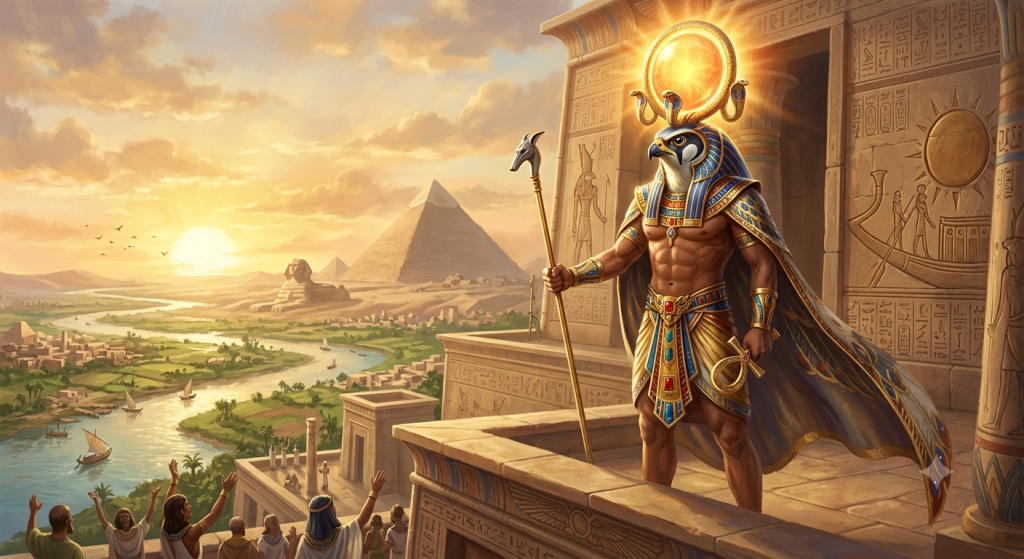
Ra-Horakhty, Horus of the Two Horizons, merges Horus with Ra as a solar deity associated with both the sunrise and sunset horizons. This merger reflects the theological synthesis that was a constant feature of Egyptian religious thought: rather than competing, major divine figures were absorbed into increasingly comprehensive theological constructions.
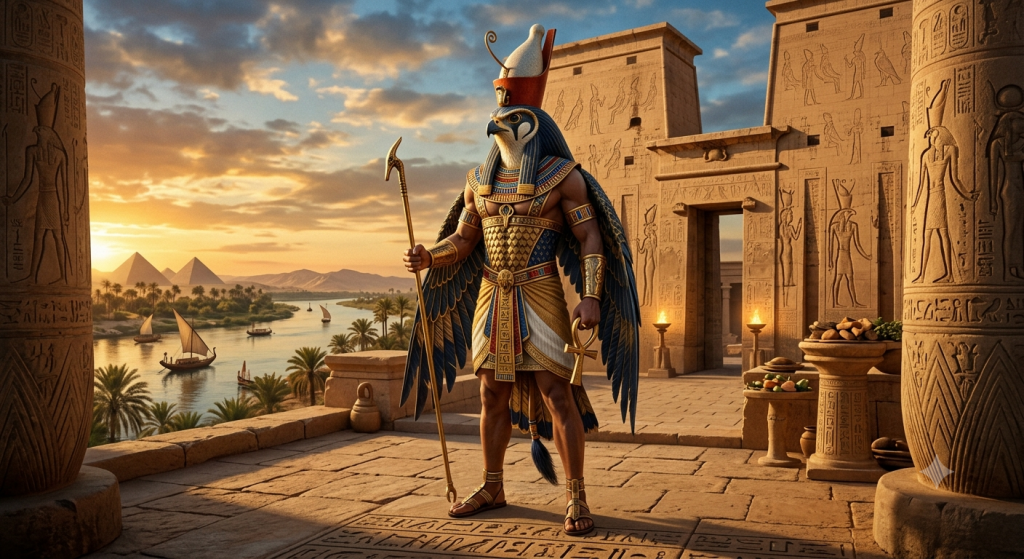
For practical purposes in most discussions of the mythology, Horus means the son of Isis and Osiris, the falcon-headed god who avenged his father and became the divine prototype for every Egyptian king. That is the figure this article primarily addresses.
The Eyes of Horus
Horus’s right eye represents the sun and his left eye represents the moon. This is not simply a detail of his iconography but a cosmological claim: the two great lights in the sky are the eyes of the falcon god who soars above the world.
The left eye, the moon, was damaged during Horus’s conflict with Set. Set tore it out or damaged it during one of their battles. Thoth, the god of wisdom and magic, healed the eye and restored it, and the restored eye became the wedjat, the Eye of Horus, one of the most powerful protective symbols in Egyptian culture. Wedjat amulets were placed in mummy wrappings to protect the dead. They were painted on the bows of ships to help them find their way. They were worn by the living as protective charms. The image of the restored eye was simultaneously a symbol of healing, protection, and wholeness.
The mathematics of the Egyptian system of fractions was encoded in the parts of the wedjat eye, with each element of the eye representing a different fraction. This connection between the healed eye of the sky god and the practical mathematics of measurement is characteristic of Egyptian religious thought: the sacred and the practical are not separate categories.
The Conflict With Set
The Contendings of Horus and Set, preserved in a New Kingdom papyrus now known as Papyrus Chester Beatty I, is the most extensive and most entertaining account of the conflict between the two gods for the throne of Egypt. It reads quite differently from the solemn tone of the funerary texts: the gods argue, scheme, insult each other, and occasionally behave in ways that are frankly undignified, and the divine tribunal that arbitrates the dispute seems consistently unable to reach a decision.
The conflict involves a series of contests and trials rather than a single definitive battle. There are boat races in which each contestant must build a boat from stone, which Horus navigates by disguising his wooden boat with plaster while Set actually builds a stone vessel that promptly sinks. There is a hippopotamus contest. There are incidents that the papyrus describes with considerable explicitness involving sexual assault and Thoth’s intervention to prevent Set’s attempt at humiliating Horus from succeeding. The hearings of the divine tribunal stretch over eighty years by some accounts without reaching a verdict.
The conflict is not simply about which god is stronger. It is about which claim is legitimate. Horus claims the throne as his father’s heir. Set claims it by right of strength and by his own power. The tribunal must determine which principle of succession governs: inheritance or might. The eventual verdict, after all the contests and deliberations, is that inheritance prevails. Horus is confirmed as king. Set is compensated with a position in the sky as the god of storms, where his destructive energy is useful rather than destabilising.
The political theology encoded in this resolution is significant: legitimate authority in Egypt comes through proper succession rather than through force, and the cosmos endorses inheritance over conquest. This was a useful mythology for a tradition of dynastic succession, and it was retold and reinforced at every royal transition for three thousand years.
Horus the Child: Harpocrates
The image of Horus as a vulnerable child, hidden in the papyrus marshes of the Nile Delta by his mother Isis while Set ruled, became one of the most widely circulated divine images in the ancient world. The Greeks called this figure Harpocrates, from the Egyptian Har-pa-khered, Horus the Child, and depicted him as a naked boy with a finger to his lips in the gesture of childhood that the Greeks interpreted as a sign of silence and secrecy.
This interpretation made Harpocrates the god of secrets and silence in the Greco-Roman world, a reading that was not what the original Egyptian tradition intended but which resulted in the child Horus becoming one of the most popular divine figures across the Mediterranean during the Roman period. The image of the divine child protected by a powerful mother while threatened by a powerful enemy resonated across cultures in ways that the original Egyptian mythology had not entirely anticipated.
The myths of the child Horus in the marshes describe him being bitten by scorpions, stung by venomous creatures, and afflicted with various dangers that Isis had to heal through her magic. These stories served a practical ritual function: they provided the template and the authority for healing spells used by Egyptian physicians and magical practitioners. If Isis could heal the divine child of scorpion stings, her spells could heal ordinary children of the same injuries.
The Living Horus and the Dead Osiris
The pharaoh’s identification with Horus was total and perpetual during his lifetime. His official name included a Horus name, the first and oldest element of the royal titulary. Temple reliefs showed the pharaoh as a falcon or with a falcon behind him, the divine presence of Horus embodied in the king. His authority to rule was not a grant from the gods but an identity with one of them.
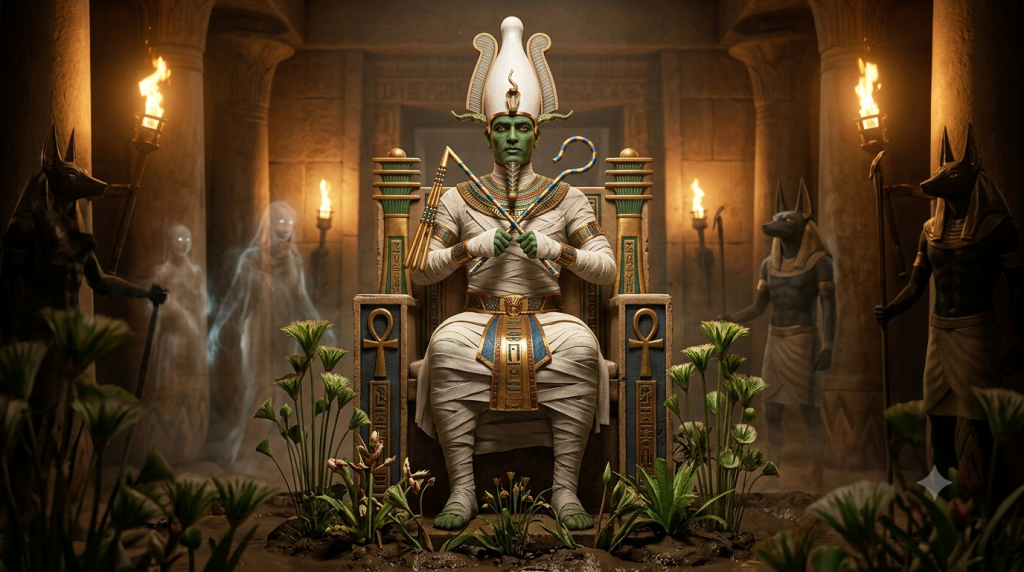
At death, the pharaoh became Osiris, and his heir took the throne as the new living Horus. The coronation was not simply a political ceremony but a theological transformation: one divine identity replaced another, and the continuity of cosmic order was maintained through the succession. The son performing the funeral rites for his father was simultaneously Horus burying Osiris, re-enacting the foundational myth at every royal funeral.
This theology meant that the pharaoh existed in two registers simultaneously: as a human ruler governing a human kingdom and as a divine being embodying cosmic principles. His decisions were both political acts and divine acts. His failures were both human failures and cosmic disturbances. The weight of that dual identity was the weight every Egyptian pharaoh carried from the moment of coronation to the moment of death.
For more on the Egyptian tradition, the Osiris article covers the father whose death Horus must avenge and whose mythology Horus completes. The Isis article covers the mother who protected Horus through his vulnerable childhood and whose magic made his existence possible. The Set article covers the uncle whose murder of Osiris and contest with Horus defines the most important power struggle in Egyptian mythology.
Never miss a myth
Thank you for being here. The site is brand new and every subscriber genuinely means something to me. If you're here, you care about this stuff as much as I do - and that's all the reason I need to keep going. New stories, videos and dark folklore from around the world, straight to your inbox. No algorithm. Just the stories, when they're ready.