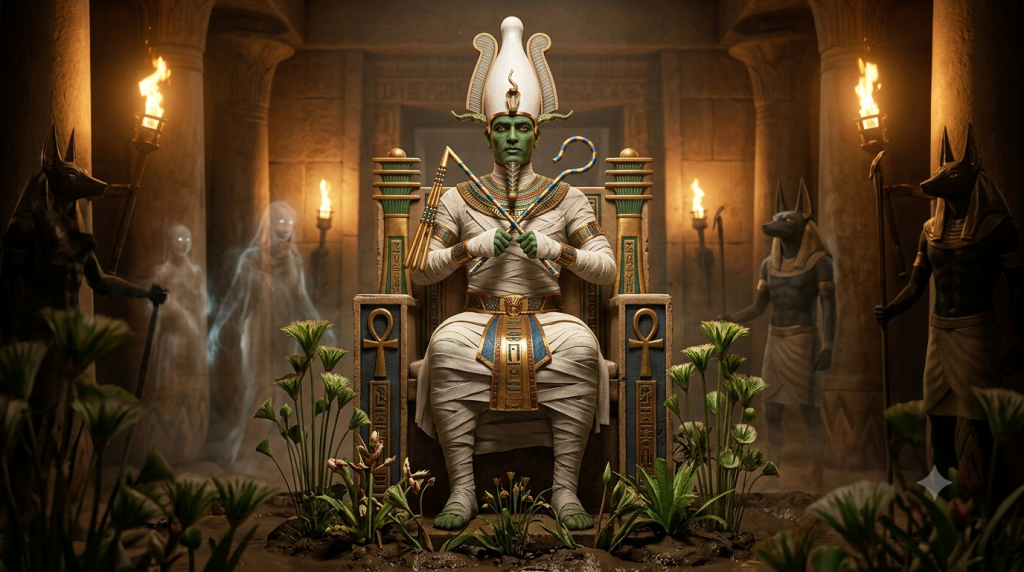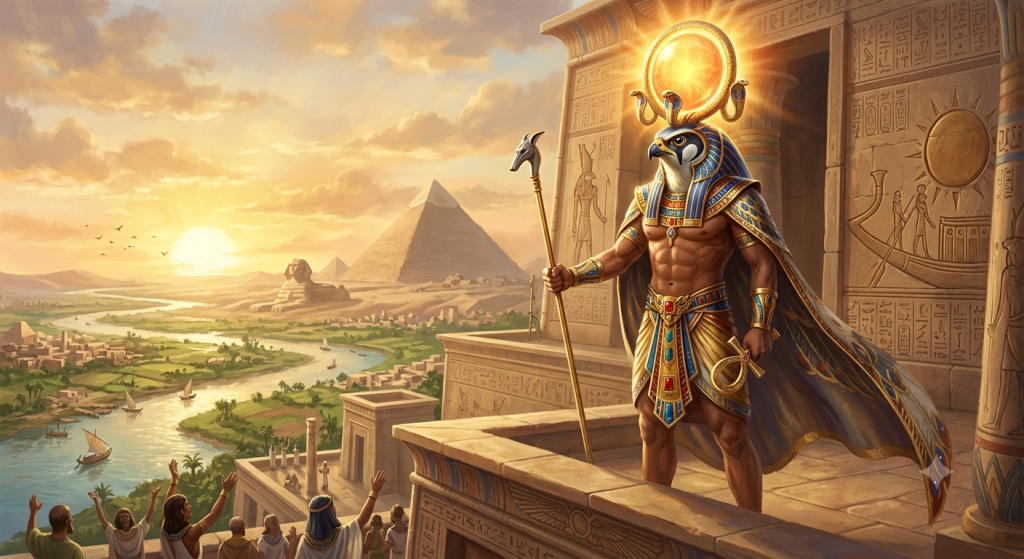
Set is the villain of Egyptian mythology. He murdered his brother Osiris, dismembered the body and scattered it across Egypt, usurped the throne of the gods, and spent eighty years contesting his nephew Horus’s right to reclaim it. There is no question about this. The tradition is explicit on all counts.
Set is also the being who stands at the prow of Ra’s solar barque every night and drives his spear into the great serpent Apophis, holding the chaos monster at bay while the sun completes its journey through the underworld. Without Set at the prow, Apophis would stop the sun. Without Set, there would be no sunrise. The god who murdered the beloved king of Egypt is also the defender of the cosmic order that makes life possible.
The Egyptians held both of these things simultaneously without apparent difficulty, because their theological tradition was sophisticated enough to understand that the forces which destroy are sometimes also the forces which protect, and that the universe requires both order and the chaos that makes order necessary. Set is the most intellectually demanding figure in Egyptian mythology precisely because he cannot be reduced to a simple category.
Who Set Was
Set is the son of Geb the earth god and Nut the sky goddess, and the brother of Osiris, Isis, and Nephthys. He is the husband of Nephthys, though their marriage is described as largely without affection in the tradition. His domains are the desert, storms, disorder, violence, and foreign lands: the things that lie outside the ordered world of the Nile valley and press against its edges.
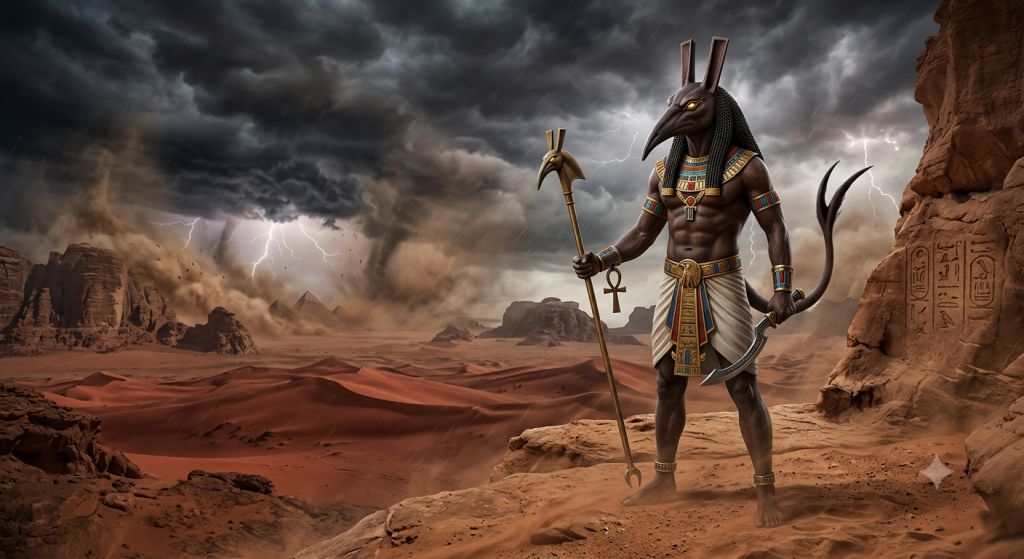
He is depicted with the head of an animal that has been the subject of scholarly debate for over a century. The Set animal, sometimes called the sha, has a long curved snout, tall rectangular ears, slanting eyes, a canine body, and a stiff forked tail held upright. No living animal matches this description. Some scholars have proposed it represents an extinct creature, possibly an Abyssinian wolf or a saluki dog stylised beyond recognition. Others have argued that it is deliberately composite, a mythological creature rather than a real one, designed to visually represent the uncanny and untameable nature of the god it depicts. No consensus has been reached, which is itself significant: Set is the only major Egyptian deity whose animal form remains unidentified, as if the tradition deliberately kept him in a category that cannot be pinned down.
His colour is red, associated with the desert, with blood, with the hostile sun of high summer. The Egyptians associated red with dangerous forces generally, and Set’s identification with the colour encoded his nature in visual terms: he is the red desert that surrounds the black fertile land, the storm that damages the crops, the foreign enemy at the borders.
The Murder of Osiris
Set’s murder of Osiris is the central act of Egyptian mythology, covered in detail in the Osiris article on this site. From Set’s perspective, the act was motivated by jealousy of his brother’s kingship and his popularity, and by a desire for the throne that Osiris held. The tradition gives him multiple motives across different sources without fully reconciling them: personal jealousy, political ambition, and a more cosmic role as the necessary agent of disorder are all present at different points.
The chest trick, the dismemberment, the scattering of the body: all of these are Set’s actions. They are not presented as accidents or as acts of passion but as calculated plans. Set is not the chaos of random violence but the directed intelligence of strategic disorder, which makes him more dangerous and more interesting than a simple monster would be.
After killing Osiris and taking the throne, Set ruled Egypt for the period during which Horus grew to adulthood under Isis’s protection. The tradition does not describe this rule as particularly benevolent, but it does not describe it as catastrophically destructive either. Set governed. The world continued. The cosmic order was disrupted but not destroyed. This is consistent with how the tradition understands him: he is necessary, even in his destructive aspect, and the world can survive him even when he is at his worst.
The Contest With Horus
The Contendings of Horus and Set, the long mythological dispute over the throne of Egypt, is the most extended portrayal of Set as a character in the surviving tradition. He is not simply villainous in this text. He is clever, persistent, capable of genuine cunning, and occasionally funny in his failures. His stone boat sinking promptly while Horus’s disguised wooden boat sails is a moment of comic defeat that the tradition preserves with evident pleasure.
The sexual assault attempts that Set makes against Horus during the conflict, and Thoth’s intervention to neutralise them, are among the most disturbing episodes in the text but also among the most important for understanding what Set represents. His methods are not simply violent but transgressive: he attempts to humiliate and dominate rather than simply to win, which is consistent with his nature as the god of disorder and boundary violation.
His eventual defeat and the award of a position in the sky as storm god is not a straightforward punishment. It is a placement: Set’s energy directed toward the function where it is most useful. The Egyptians understood that you cannot eliminate the principle of chaos. You can only find the appropriate channel for it. Storms at sea, the violence of battle, the force of the desert wind: all of these are Set, directed appropriately rather than annihilated.
The Protector of Ra
The nightly role of Set at the prow of Ra’s solar barque is the clearest illustration of the tradition’s understanding that chaos and order require each other. Apophis, the great serpent of non-existence, is too powerful a chaos force for the ordered gods of the barque to repel. It requires Set, the god of chaos himself, to fight chaos at its most extreme. Order cannot defeat absolute chaos. Only a controlled form of chaos can.
Set stands at the prow, spear in hand, and drives the weapon into Apophis each night. The imagery is striking: the murderer of the beloved king, standing guard over the sun that gives life to the world, performing every night the act without which there would be no dawn. Set defending Ra is not a contradiction of his nature but its most useful application.
The Ramesside pharaohs of the 19th and 20th dynasties particularly favoured Set, and several took his name as part of their throne names. Seti I and Seti II, whose names mean man of Set, ruled during one of the most militarily successful periods of Egyptian history. The pharaohs who most identified with Set were the ones who fought the most wars and expanded Egypt’s territory most aggressively. The god of the desert and foreign lands was the appropriate patron for campaigns into those territories, and his ferocity was a quality that warrior-kings found worth claiming as their own.
The Decline of Set
Set’s reputation deteriorated significantly during the later periods of Egyptian history. The Hyksos, foreign rulers who controlled Lower Egypt during the Second Intermediate Period roughly 1650 to 1550 BCE, adopted Set as their primary deity, which permanently associated him with foreign invasion and illegitimate rule in the Egyptian imagination. After the Hyksos were expelled, Set’s association with foreigners became increasingly negative rather than simply descriptive.
In later periods, particularly during the 1st millennium BCE and into the Ptolemaic period, Set was increasingly demonised: his animal was killed in rituals rather than venerated, and the tradition that had held his dual nature in complex balance shifted toward a simpler reading of him as a force of pure evil. The same process that made Loki simpler in popular retellings of Norse mythology made Set simpler in later Egyptian retellings: the tradition flattened a complex figure into a villain because complexity is harder to maintain over time than clear moral categories.
The original tradition was more honest. Set did terrible things. Set also did necessary things. The world contains both, and the Egyptians, for most of their history, were wise enough to acknowledge it.
For more on the Egyptian tradition, the Osiris article covers the brother whose murder Set commits and whose resurrection undoes Set’s usurpation. The Horus article covers the nephew whose eighty-year contest with Set determines who rightfully governs the cosmos. The Ra article covers the sun god whose nightly journey Set defends against the one force greater than himself.
Never miss a myth
Thank you for being here. The site is brand new and every subscriber genuinely means something to me. If you're here, you care about this stuff as much as I do - and that's all the reason I need to keep going. New stories, videos and dark folklore from around the world, straight to your inbox. No algorithm. Just the stories, when they're ready.