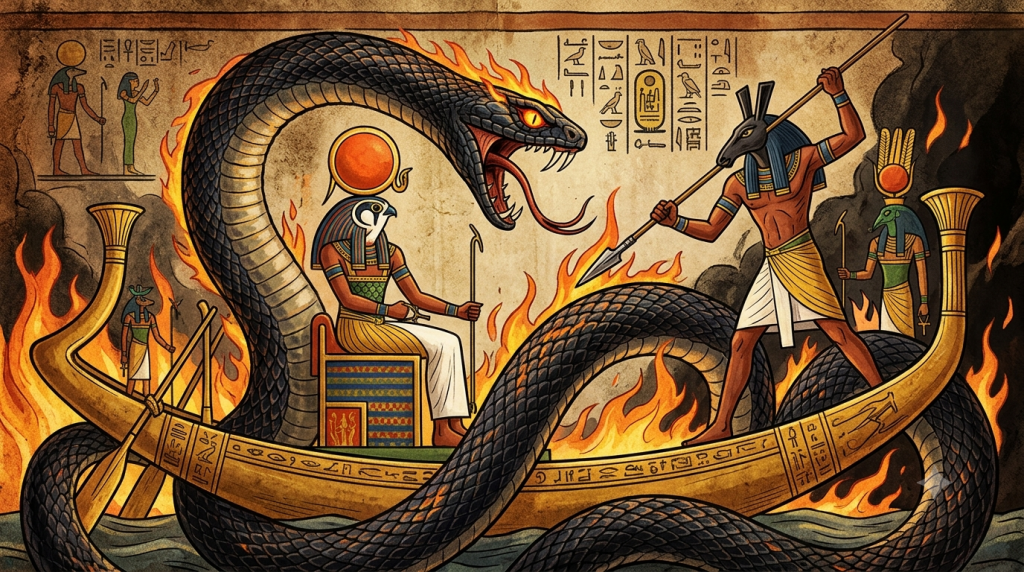
Every night, as the sun god Ra travels through the underworld in his solar barque, Apep attacks. Every night, the gods on the barque fight him off. Every night, Apep is driven back, wounded, bound, and destroyed. And every night, he regenerates, because a being made of chaos cannot be permanently ordered into death.
Every morning the sun rises, which means every night Ra wins. Apep has attacked the solar barque every night since the creation of the world and has never succeeded in stopping the sun. This is not a story about a chaotic force that was defeated once, long ago, in a founding myth. It is a story about a battle that is still happening, that was happening last night, that will happen tonight. The Egyptians understood the sunrise not as an astronomical fact but as the daily proof of a battle’s outcome, and they understood themselves as participants in that battle through the rituals they performed to assist Ra against his enemy.
Apep is the most philosophically interesting figure in Egyptian mythology precisely because he cannot be defeated permanently. His existence is the existence of chaos itself, and chaos cannot be destroyed, only contained.
The Name
The original Egyptian name is Apep, sometimes written Apepi or Apophis in the Greek transliteration that became standard in Western scholarship. The asteroid 99942 Apophis, which made headlines in the early 21st century when astronomers calculated a small but non-zero probability of it striking Earth, was named after this entity: the astronomers chose the name of the Egyptian chaos serpent for a space rock that briefly appeared to threaten catastrophic destruction, which is exactly the kind of naming that makes mythology feel immediately relevant.
The name Apep carries the sense of a roaring or unrestrained force. His epithets in temple texts include the Great Roarer, the Eater of the Dawn, and He Who Encircles the World. These names describe his function: he is noise before silence, consumption before light, encirclement before the freedom of the solar journey.
What He Was
Apep is not a god in the conventional Egyptian sense. He had no temples, no cult, no worshippers, no festivals in his honour. He was never propitiated or asked for favour, because he had no favour to give and would not give it if he did. He existed entirely outside the divine order that the Egyptian pantheon maintained, not as a god of chaos within that order but as the principle of chaos that the order was created to oppose.
Egyptian theology distinguished between the forces that maintained maat, the cosmic principle of truth, justice, and order, and the forces of isfet, chaos, injustice, and disorder. The gods maintained maat. Apep embodied isfet in its most absolute form: not the controlled chaos of Set, who could be directed toward useful purposes, but pure undirected dissolution, the anti-creation that would dissolve everything back into the void from which the world emerged if it were ever allowed to succeed.
He is described in the funerary texts as enormously large, in some accounts stretching for miles, as vast as the darkness itself. He inhabits the underground Nile that Ra’s barque must navigate during the night hours, coiling in the deepest and darkest reaches of the Duat where no light has ever penetrated. He is not simply an obstacle in the underworld. He is, in some sense, what the underworld would be if the solar barque were not passing through it: pure darkness, pure chaos, permanent night.
The Nightly Battle
The Amduat, the Book of What Is in the Underworld, describes Ra’s twelve-hour night journey in considerable detail, and Apep features in the account as the crisis of the journey rather than simply one of its obstacles. The barque navigates through twelve regions, each with its own character and challenges, and in multiple accounts the encounter with Apep is the moment when the entire journey is at greatest risk.
Apep’s attack takes different forms in different sources. He tries to swallow the barque whole. He attempts to stop the underground Nile’s flow so the barque cannot move. In some accounts he has a gaze so powerful that it freezes the entire crew in place, every god aboard the barque paralysed and unable to defend themselves. The paralysing gaze is particularly threatening because it removes the crew’s ability to respond, and the one being capable of acting against it is Set, who stands at the prow with his spear.
Set’s role in the nightly battle is one of the clearest illustrations of how Egyptian theology understood the relationship between order and chaos. The god of storms and disorder, the murderer of Osiris and the principle of chaotic force within the divine community, is also the only being capable of fighting the chaos serpent. This is not a paradox for the tradition. It is a statement about what chaos is for: controlled and directed toward the protection of the cosmic order, it is the most powerful defensive force available. Apep cannot be fought by the orderly gods. He can only be fought by the god who shares something of his nature.
The Rituals Against Apep
The most remarkable aspect of Apep’s mythology is what it required from ordinary Egyptians. The gods fought him every night on the barque. But Egyptian theology held that the battle was not purely divine: human ritual participation was required to ensure the outcome.
Temple priests performed daily rituals against Apep. They would recite specific spells from a text called the Book of Overthrowing Apep, which instructed them to make a wax effigy of the serpent, write his name on it, spit on it, ritually mutilate it, and burn it. The rituals were performed in the morning, at noon, and in the evening, at each transition point in the sun’s daily cycle when the danger from Apep was understood to be greatest. By taking the gods’ side symbolically through these acts, the living believed they contributed to Ra’s victory and helped force each sunrise into being.
This is one of the most direct expressions in any ancient religion of the idea that human ritual action has cosmic consequences. The priests did not believe their rituals were merely symbolic. They believed that burning a wax effigy of Apep genuinely weakened him, that spitting on his name genuinely damaged him, that the cumulative effect of these daily acts was part of what kept the sun rising. They were participants in the cosmic battle, not observers of it.
Ordinary Egyptians could also perform these rituals at home, with simpler materials, for the same purpose. Apep was the one figure in Egyptian religion against whom it was not merely permitted but actively encouraged to direct aggressive ritual. The tradition’s ritual violence, which was otherwise carefully circumscribed, was fully licensed against Apep because he was not a god who could be offended. He was chaos itself, and every human act against him was a contribution to order.
Eclipses and the Moments He Almost Won
Solar eclipses were understood by the Egyptians as moments when Apep had partially succeeded: he had swallowed part of the sun, and the darkness across the sky was the partial victory of chaos before Ra and the other gods drove him back. The temporary darkness of the eclipse was not an astronomical phenomenon to be explained but a divine crisis to be responded to. When an eclipse occurred, the response was intensified ritual action against Apep: more spells, louder incantations, the maximum available ritual force directed at the serpent who had momentarily gained the upper hand.
The fact that the sun always returned from an eclipse confirmed the theology: every time Apep appeared to win, he was defeated again. Every eclipse ended. Every morning came. The nightly battle’s record was perfect, not because Apep was weak but because the forces against him, the gods and the human rituals that supported them, were sufficient to the task every time.
Apep himself could never be destroyed permanently, and the tradition knew this and accepted it. The fight would continue forever. The battle would be won every night and Apep would regenerate every dusk. This was not cause for despair. It was cause for vigilance, for ritual, for the daily acknowledgment that order was not the natural state of things but an achievement requiring continuous effort. The sun rising in the morning was not guaranteed. It was earned, every night, against an enemy who never gave up and never could be made to.
For more on the Egyptian tradition, the Ra article covers the sun god whose nightly journey through the underworld Apep attacks and whose victory each dawn Apep cannot prevent. The Set article covers the chaos god who stands at the prow of Ra’s barque and drives his spear into Apep each night, the only being powerful enough to hold him back. The Duat article covers the Egyptian underworld through which Ra’s barque travels and in which Apep makes his nightly home.
Never miss a myth
Thank you for being here. The site is brand new and every subscriber genuinely means something to me. If you're here, you care about this stuff as much as I do - and that's all the reason I need to keep going. New stories, videos and dark folklore from around the world, straight to your inbox. No algorithm. Just the stories, when they're ready.