At the city of Shedet in the Faiyum region of Egypt, a city the Greeks called Crocodilopolis, the priests of Sobek kept a sacred crocodile in a temple pool. The crocodile was named Petsuchos, meaning son of Sobek, and it was considered the living embodiment of the god himself. It wore golden jewellery. Priests fed it choice food. Pilgrims came from across Egypt to watch it be fed and to offer it gifts. When it died, it was mummified with full religious honours and a new sacred crocodile was installed in its place.
This was not an eccentric local custom. It was an expression of a theology that understood the crocodile as the most direct visible manifestation of one of the most powerful forces in Egyptian life: the Nile itself. Sobek was the god of the Nile’s waters, the lord of the river on which Egyptian civilisation depended, embodied in the animal that the Nile produced in greatest abundance and that Egyptians both feared and revered in equal measure. To honour Sobek was to honour the river. To propitiate the crocodile god was to propitiate the floods that brought the fertile silt that made Egypt’s agriculture possible.
The gold jewellery on the sacred crocodile was not decoration. It was acknowledgment.
Who Sobek Was
Sobek is one of the oldest deities in Egyptian religion. He appears in the Pyramid Texts, the oldest sacred writings in the world, where he is mentioned in connection with the primordial waters and with the protection of the dead. A seal from the time of King Narmer, one of the earliest rulers of a unified Egypt around 3100 BCE, depicts crocodiles facing a shrine in what is almost certainly an early reference to his worship. Sobek was present at the very beginning of Egyptian civilisation and remained a significant deity for three thousand years thereafter.
He is depicted as a crocodile or as a human figure with a crocodile’s head, typically shown wearing a headdress that combines the sun disc, the double plume, and the ram’s horns that indicate his solar and kingly aspects. His primary epithets include Lord of the Waters, Lord of Faiyum, and the Rager, the last of which captures the ferocity that made the crocodile both a threat and a power worth invoking.
In some traditions he is the son of Neith, the primordial goddess of creation and war, which places his origins in the deepest layer of Egyptian theology. In the Book of the Faiyum, a Roman-era religious text describing the theology of the Faiyum region, Sobek-Ra emerges from the primordial waters of Nun to create the Nile itself: his sweat forms the river’s current. The god of the Nile is not simply associated with the river. In this tradition he is its source.
The Dual Nature: Feared and Beloved
The Nile crocodile is one of the most dangerous animals that existed in the ancient world, capable of killing a human being in seconds. The sacred crocodile was an immense creature. Temple pools that housed crocodiles at Sobek’s cult sites were not safe places, and the tradition records that crocodile attacks in the vicinity of temples were interpreted not as accidents or tragedies but as blessings: those killed by a temple crocodile were understood as having been taken by Sobek himself, which was a form of divine distinction rather than simply a death.
This theology required considerable sophistication to maintain. The Egyptians who lived and worked along the Nile encountered crocodiles regularly, and crocodile attacks were a genuine source of mortality and danger. The response was not to pretend the danger did not exist but to incorporate it into the divine order: the thing that killed you was Sobek claiming you, and that was meaningful rather than merely terrible. The same god who threatened you from the water also protected you, if properly honoured, from the other dangers that the water presented.
Sobek’s temples had pools where crocodiles lived and were fed by priests. At Crocodilopolis and at Kom Ombo in Upper Egypt, these crocodiles were mummified when they died, with the mummification following the same procedures used for elite humans. Thousands of crocodile mummies have been found in the necropolises associated with Sobek’s temples, ranging from tiny hatchlings barely larger than a hand to massive adults several metres long. In 2020, a mitochondrial DNA analysis of mummies from these sites found that the sacred crocodiles used for the most important offerings were a different species from the Nile crocodile that inhabited the river: they were sacred crocodiles, a species now extinct, that the Egyptians appear to have specifically bred for their religious purposes.
Sobek and the Osiris Myth
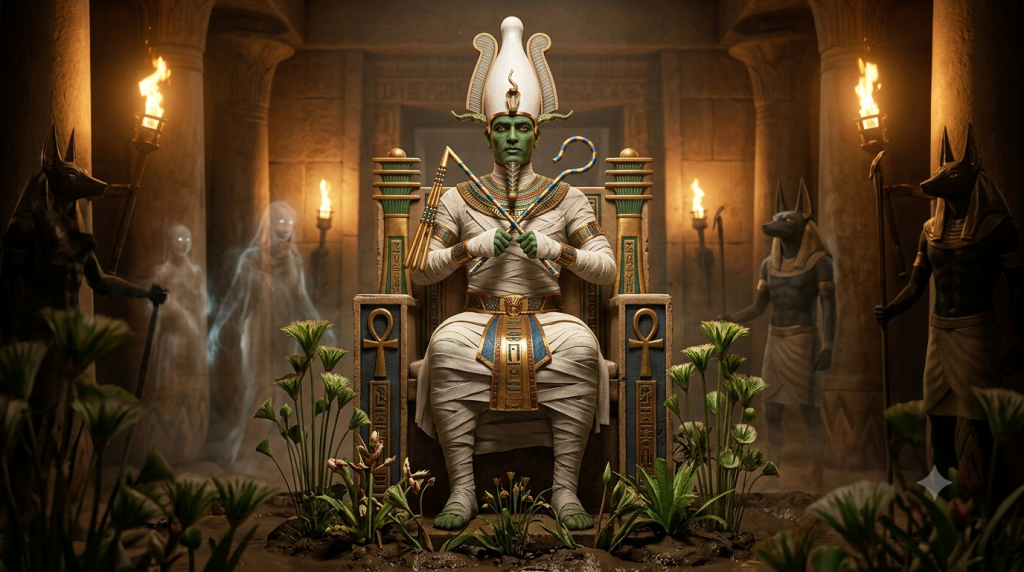
Sobek appears in the mythology surrounding Osiris in a role that connects his nature as a water deity to the most important narrative in Egyptian religion. In some accounts, it was Sobek who rescued the pieces of Osiris’s dismembered body from the Nile after Set scattered them, gathering them in a net or on his back and bringing them to Isis and Nephthys for reassembly. In others, he rescued the four sons of Horus when they rose from the primordial waters in a lotus bloom, netting them and bringing them safely to land.
These rescue roles cast Sobek in the position of helper rather than threat, the fierce power of the Nile placed in service of divine order rather than chaos. The crocodile who takes people from the water can also save things from the water: the same nature applied to the service of maat rather than against it. This is consistent with how Egyptian theology generally understood the most dangerous forces: they are not purely destructive but require appropriate direction.
Sobek-Ra and the Solar Merger
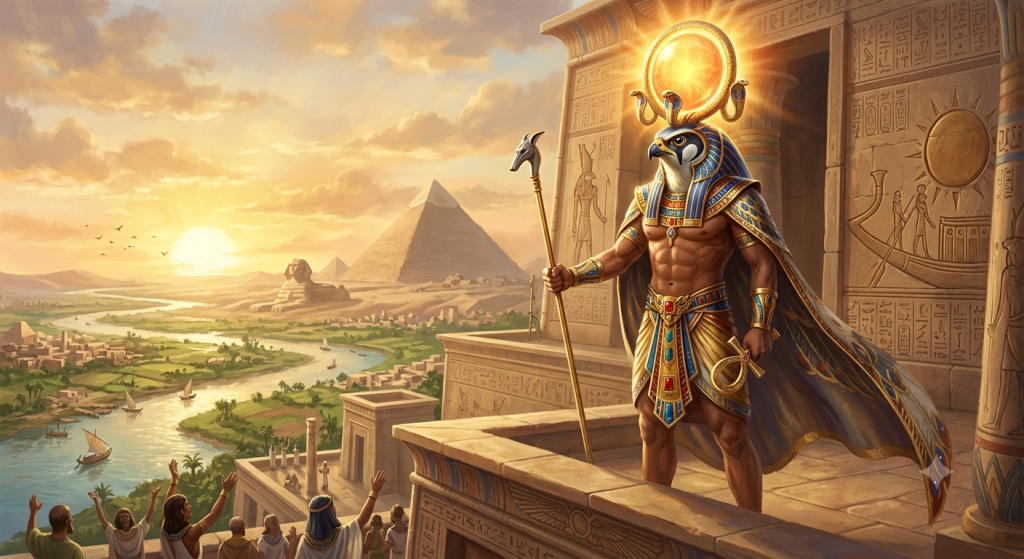
During the Middle Kingdom period, roughly 2030 to 1650 BCE, Sobek underwent a significant theological development through his merger with Ra, the sun god. Sobek-Ra combined the crocodile’s dominion over the primordial waters with the sun god’s dominion over the sky, producing a deity who ruled both the element from which the world emerged and the light that sustained it. Pharaohs of this period took names incorporating Sobek, signalling their alignment with his power, and the Faiyum region where his worship was strongest became one of the most prosperous and heavily settled areas in Egypt.
The combination of Sobek with Horus produced Sobek-Horus, the crocodile-falcon composite that appears at Kom Ombo. The double temple at Kom Ombo, one of the most beautiful and best-preserved temple complexes in Egypt, was built during the Ptolemaic period with an unusual architectural design: two identical temples joined together, the southern half dedicated to Sobek-Ra and the northern to Horus, served by separate priesthoods but sharing the same sacred space. Crocodile mummies found in pits near the temple demonstrate that the worship continued right through the Ptolemaic period and into the Roman era.
Crocodilopolis: The City of Crocodiles
The Greek name for Shedet, Crocodilopolis, is one of the more vivid place names in the ancient world, and the city earned it. The Faiyum oasis, fed by a branch of the Nile that the ancient Egyptians called the waterway of Joseph in later periods, was lake country: a lush region of waterways and agriculture that supported large crocodile populations in a landscape where the crocodile could thrive. Sobek’s worship there was not an imposition from the theological centre at Memphis or Heliopolis but an organic development from a community that lived in close and dangerous proximity to the animal the god embodied.
The ancient traveller Strabo, writing in the 1st century BCE, described the rituals of Petsuchos the sacred crocodile in detail: how it was fed bread and meat and wine, how it wore earrings of gold and glass in its ears and bracelets on its front feet. He was writing about something that was genuinely extraordinary even by the standards of an ancient world with no shortage of unusual religious practices, and his tone conveys the genuine strangeness of encountering a religion that had built its most sacred ritual around feeding jewellery-wearing crocodiles in a pool.
The priests who maintained this practice, and the pilgrims who came to watch it, understood something that Strabo did not: this was the Nile itself, wearing gold because the Nile deserved gold, being fed because the Nile needed to be propitiated, alive and present in the pool because the Nile was alive and present in its channel. The crocodile in the temple was not a symbol of Sobek. It was Sobek, as fully as any physical form could be.
For more on the Egyptian tradition, the Osiris article covers the god whose scattered body Sobek helped recover from the Nile. The Ra article covers the sun god with whom Sobek merged to form the Sobek-Ra composite. The Horus article covers the falcon god with whom Sobek shares the double temple at Kom Ombo.
Never miss a myth
Thank you for being here. The site is brand new and every subscriber genuinely means something to me. If you're here, you care about this stuff as much as I do - and that's all the reason I need to keep going. New stories, videos and dark folklore from around the world, straight to your inbox. No algorithm. Just the stories, when they're ready.