In ancient Egypt, killing a cat was a capital offence. Not harming the sacred cats of a specific temple, which would obviously be serious. Any cat, anywhere, including accidentally. Herodotus, the Greek historian writing in the 5th century BCE, reported that Egyptians would rush into a burning building to save the cats before saving the household goods, and that when a cat died of natural causes the family shaved their eyebrows in mourning. He was writing about a religious relationship between a civilisation and an animal that had no parallel in the ancient world.
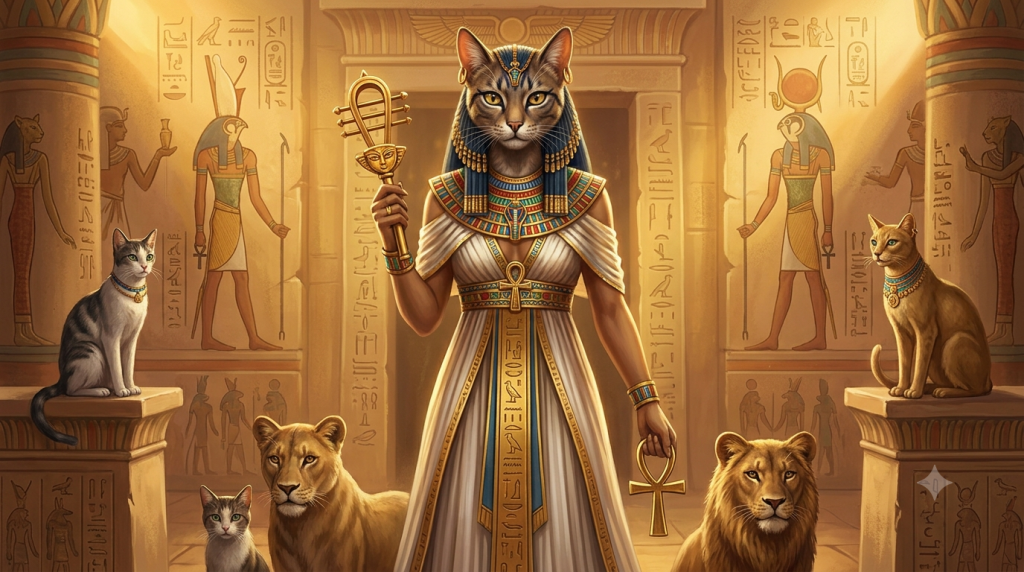
The goddess at the centre of this relationship was Bastet, and understanding her requires starting with what she was before she was the cat goddess, because that earlier form explains why the cats were so important.
Bastet began as a lioness. In the earliest images and texts, she is depicted with a lion’s head, fierce and protective, associated with the scorching power of the sun and with the violent protection of the pharaoh. She was the Eye of Ra in her original form, the same destructive female aspect of the sun god that later became associated with Sekhmet. Over several centuries, as the domestic cat became increasingly central to Egyptian agricultural life and eventually to Egyptian domestic life, Bastet gradually transformed. The lioness became a cat. The fierce protector became the gentle guardian. But she never entirely lost the lioness, and the tradition held both aspects in tension throughout her long history.
The Cat and the Grain
The domestic cat arrived in Egypt somewhere around 4000 BCE, likely through the process of wild cats being drawn to the grain stores of early agricultural settlements by the rodents that the grain attracted. The cats that came for the mice stayed for the food. The humans who benefited from the rodent control stayed for the cats. It is one of the least dramatic moments of domestication in human history and one of the most consequential for the relationship between humans and animals.
In a civilisation built on agriculture, in which the annual Nile flood determined whether there would be enough food, and in which grain storage was the essential technology that made settled life possible, the animals that protected the grain stores from vermin had genuine economic and existential importance. The cat that killed the mice in the granary was not a pet in the modern sense. It was a working animal whose work was the difference between adequate food supply and crop loss.
Bastet’s association with protection of the home emerged from this practical reality. The animal that protected the grain was the manifestation of the goddess who protected the household, and the household’s relationship with its cats was therefore a religious relationship rather than simply a domestic one. Treating the cat well was honouring the goddess. Harming the cat was offending the goddess. The severity of the punishment for harming a cat, death, was proportionate to the severity of the offence in religious terms: not simply cruelty to an animal but an attack on the divine protector of the Egyptian home.
The Festival at Bubastis
Bastet’s primary cult centre was at Bubastis, called Per-Bastet in Egyptian meaning the House of Bast, in the Nile Delta. The annual festival held there in her honour was described by Herodotus as the largest and most joyful festival in Egypt, with 700,000 people attending in his account, which may be an exaggeration but gives a sense of the scale involved.
The festival was characterised by music, dancing, wine, and a general holiday atmosphere. People travelled to Bubastis on boats, singing and playing instruments. The festival included elements that Herodotus describes as decidedly uninhibited, with women lifting their skirts at towns along the riverbank as the boats passed. The goddess of the domestic hearth presided over one of the most enthusiastically celebrated festivals in the Egyptian calendar, which is entirely consistent with a tradition that understood joy as sacred and celebration as a form of worship.
The excavations at Bubastis have uncovered enormous quantities of cat mummies, ranging from tiny kittens to large adults, preserved and buried as votive offerings to Bastet. The cats were mummified using the same careful procedures applied to human mummies, with linen wrappings, resin, and sometimes miniature cat-shaped outer coffins. The scale of cat mummification at Bastet’s sites suggests an industrial religious practice: cats bred specifically for the purpose, killed at the appropriate age, mummified, and sold to pilgrims as offerings. The animal sacred to the goddess was also a commercial product of her temples, which is either a contradiction or a very practical expression of the same theology, depending on your perspective.
The Loyal Instructions and the Dual Nature
A 12th dynasty text called the Loyalist Instructions describes the ideal king in terms that capture Bastet’s dual nature precisely: he is Bastet who protects the two lands, and he is Sekhmet against he who transgresses his order. The same figure, at the same moment, is both the protective cat and the destructive lioness depending on whether you are under his protection or in violation of his authority.
This duality is not a contradiction in Egyptian theological terms. The fierce and the gentle are aspects of the same protective power, expressed differently depending on what the situation requires. Bastet in her cat form protects those she guards with the attentiveness, the nimbleness, and the domestic presence of a household cat. Bastet in her lioness form destroys those who threaten what she guards with the precision and ferocity of a predator who has identified its target.
The tradition never entirely resolved which of these was the more fundamental nature. Sekhmet took over the fiercer aspects of the lioness role as the theology developed, leaving Bastet more thoroughly associated with the domestic and protective, but the Loyalist Instructions show that even in the Middle Kingdom the two aspects were understood as interchangeable expressions of the same underlying divine quality: the absolute commitment to protecting what belongs to her, by whatever means are required.
Bastet and the Eye of Ra
Like Hathor and Sekhmet, Bastet is one of the goddesses who serves as the Eye of Ra in different contexts of the tradition. The Eye of Ra is the destructive female aspect of the sun god, the divine force that goes out into the world to enforce Ra’s will and that sometimes exceeds his original intention. The fact that three goddesses share this role without the tradition finding this problematic illustrates the Egyptian comfort with divine fluidity: these are not three separate beings serving the same function but three aspects or expressions of the same divine force, each emphasising different characteristics of the Eye while embodying the same essential relationship to Ra.
There is a myth in which Bastet went to Nubia as a lioness, spent time there in exile from Egypt giving vent to her rage, and eventually returned to Egypt transformed from the fierce lioness into the gentler cat form. This myth of the Distant Goddess who leaves and returns is a recurring pattern in the tradition, and each goddess who follows this pattern, Hathor, Sekhmet, Bastet, Tefnut, embodies the same theological principle: the dangerous female power of the sun that must be lured back to Egypt, its ferocity transformed through the journey into a gentler but still protective form.
Sacred Cats and Sacred Status
The elevation of cats to sacred status in Egypt had consequences that extended beyond the religious. When the Persian general Cambyses II invaded Egypt in 525 BCE, one account describes his soldiers using cats as shields or releasing them in front of the Egyptian forces, knowing that the Egyptians would not fight for fear of harming the sacred animals. Whether or not this is historically accurate, it reflects how thoroughly the sacredness of cats was understood by Egypt’s neighbours as a defining characteristic of Egyptian culture.
The export of cats from Egypt was prohibited. They were considered state property, and smuggling them out of the country was illegal. When cats were eventually found across the Mediterranean world, they had made their way out of Egypt through unofficial channels, and the spread of the domestic cat across Europe and Asia was partly the consequence of a religious prohibition that could not be entirely enforced.
For more on the Egyptian tradition, the Sekhmet article covers the lioness goddess who absorbed the fiercer aspects of Bastet’s original nature and who embodies the destructive form of the Eye of Ra. The Hathor article covers the other great goddess of joy and protection with whom Bastet shares multiple domains and theological characteristics. The Ra article covers the sun god whose protective Eye Bastet serves as in her fiercer aspect.
Never miss a myth
Thank you for being here. The site is brand new and every subscriber genuinely means something to me. If you're here, you care about this stuff as much as I do - and that's all the reason I need to keep going. New stories, videos and dark folklore from around the world, straight to your inbox. No algorithm. Just the stories, when they're ready.