Anubis is the most recognisable figure in Egyptian mythology. The jackal head, the black fur, the scales of justice, the association with death and the weighing of the heart: this image has a visual clarity and a psychological weight that no other Egyptian deity quite matches. He appears in more tomb paintings and funerary texts than almost any other god in the tradition, and he has maintained a presence in popular culture that most Egyptian deities have not.
What most popular accounts miss is how ancient he is and how much his role changed over time. Anubis was not always the supporting character in Osiris’s mythology. In the earliest period of Egyptian religion, he was the primary god of the dead, the ruler of the underworld, the lord of the necropolis. He held the position that Osiris later took over. Understanding why his role changed and what he retained after the change is the most interesting question in his mythology.
The Animal and Its Meaning
The animal associated with Anubis is most commonly called a jackal in the tradition, but recent molecular biology has complicated this identification. The canids that the ancient Egyptians knew in their desert landscape are now understood by zoologists to be not jackals but African wolves, Canis lupaster, a species distinct from the golden jackal that the term usually implies. Whatever the correct zoological classification, the Egyptians chose this animal for Anubis because jackals or wolves were observed near cemeteries and burial grounds, where they would scavenge on the dead.
This is the most elegant theological move in Egyptian funerary religion: the animal that threatened to eat the dead became the divine protector of the dead. By making Anubis the patron of this scavenging animal, the Egyptians transformed the greatest threat to the physical integrity of a burial into the guardian of that integrity. The jackal that might violate the grave now protected it, because the god of the jackal was the god of the grave. The theology converted the threat into a defence through the act of making it divine.
Anubis is depicted with black colouring, which in Egyptian iconography does not represent darkness or evil. Black was the colour of fertile Nile silt, of the rich soil that made Egyptian agriculture possible, of the regeneration that followed inundation. Black was the colour of rebirth, and the black jackal god of the dead was therefore the god not of death-as-ending but of death-as-transformation, the divine presence that accompanied the transition from one form of existence to another.
The Original Lord of the Dead
In the earliest Egyptian religious texts, the Pyramid Texts carved on the walls of royal pyramids from around 2400 BCE, Anubis is invoked as the lord of the necropolis and the presider over the funerary rites of the king. He is the god who holds the dead together, who ensures the preservation of the body, who guides the soul through the darkness. Osiris appears in these texts too, but in a different register: as a dead king seeking resurrection rather than as the ruler of an underworld that Anubis governs.
By the Middle Kingdom period, roughly 2055 to 1650 BCE, Osiris had absorbed the role of ruler of the underworld and lord of the dead. Anubis was not displaced but repositioned: from the top of the funerary hierarchy to its most essential practitioner. He became the one who embalmed, the one who weighed, the one who guided, while Osiris judged and ruled. The transition gave Osiris the throne and kept Anubis as the indispensable operator of everything that made the throne meaningful.
This repositioning is one of the most instructive processes in Egyptian theological history, because it shows how the tradition absorbed and reorganised its own material without simply eliminating what it had previously held. Anubis did not disappear when Osiris became more important. His roles became more specific and more practically significant, and his presence in the funerary tradition remained constant throughout the entire span of Egyptian religion.
The Embalming of Osiris
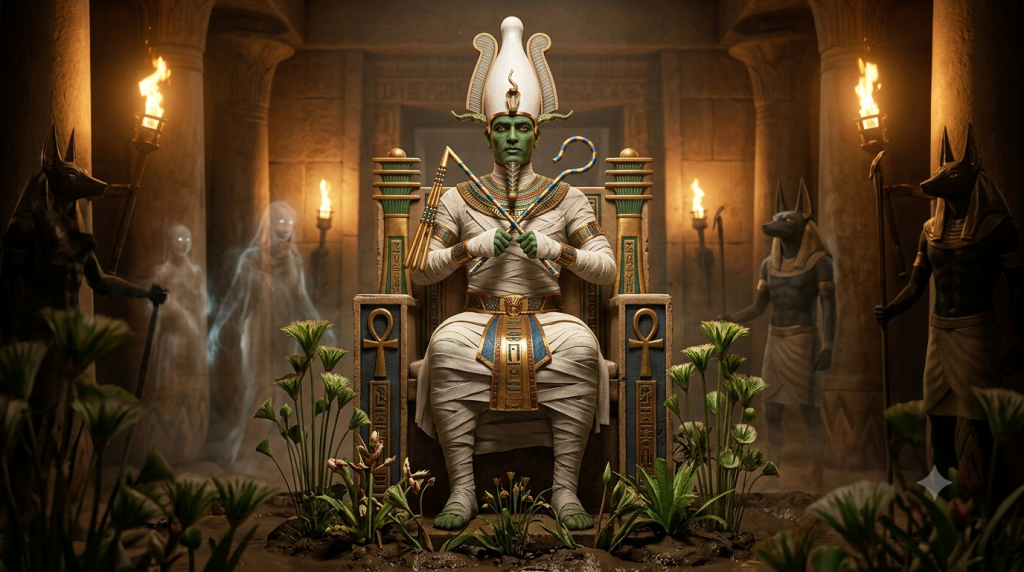
The myth that most clearly establishes Anubis’s role and his connection to the Osiris mythology is his embalming of Osiris after Set’s murder. When Isis and Nephthys had gathered the scattered pieces of Osiris’s body, it was Anubis who performed the actual preservation. He cleaned the body, removed the organs for placement in the canopic jars, applied natron salt to desiccate the tissues, anointed the dried body with resins and oils, and wrapped it in linen bandages. He created the first mummy.
This act established the prototype for all Egyptian mummification. Every mummy that was ever made in Egypt was made by the same procedure that Anubis first performed on Osiris, and every priest who performed the embalming wore a jackal mask or invoked Anubis to make the procedure sacred and effective. The Opening of the Mouth ceremony, performed on the finished mummy to restore the dead person’s faculties for the afterlife, was performed by a priest wearing Anubis’s mask, embodying the god in the ritual.
The theology encoded in this is precise: Anubis’s embalming of Osiris is what made Osiris’s resurrection possible. Without the preservation of the body, the soul had nowhere to return to. Without Anubis, there would be no Osiris as ruler of the dead, and therefore no afterlife as the Egyptians understood it. The god who became secondary in the divine hierarchy is also the god without whose specific technical expertise the primary god’s existence in the afterlife would be impossible.
The Weighing of the Heart
In the Hall of Two Truths, the judgment chamber of the Egyptian underworld, it is Anubis who operates the scales. He removes the heart from the dead person, places it on one side of the balance, places the feather of Maat on the other, and reads the result. Thoth records it. Osiris presides. But Anubis is the one whose hands are on the scales, whose judgment of the balance is the operative judgment on which everything turns.
The heart is weighed rather than any other organ because the Egyptians understood the heart as the seat of consciousness, memory, and moral character. The brain was not important in Egyptian physiology: it was removed during mummification and discarded, while the heart was preserved in the body or in a heart scarab placed over the chest. Everything that made a person who they were was located in the heart, and the heart therefore carried the accumulated weight of every moral choice made across a lifetime.
A heart lightened by a life lived in accordance with maat, with truth, justice, and proper behaviour, would balance with or be lighter than the feather. A heart weighed down by wrongdoing would be heavier. The scales were not symbolic. They produced an actual result, and Anubis read that result, and based on that reading, every person who had ever died either went to paradise or was destroyed.
The Book of the Dead contains extensive material designed to help the deceased navigate this judgment: spells to speak to the heart commanding it not to speak against its owner, lists of the forty-two judges who observed the weighing, and the Negative Confession in which the deceased declared all the things they had not done wrong. All of this material was aimed at the moment Anubis placed the heart on the scales, because that moment was the most important event in any Egyptian’s existence.
The Parentage Question
Anubis’s parents are a matter of genuine complexity in the sources. In the earliest period he was considered a son of Ra and a goddess called Hesat, associated with Hathor. After his incorporation into the Osiris mythology, the most common tradition made him the son of Osiris and Nephthys, conceived when Nephthys disguised herself as Isis and seduced Osiris. Nephthys then abandoned him out of fear of Set, and Isis found him and raised him.
This parentage serves several theological functions simultaneously. It makes Anubis a member of the divine family at the centre of Egyptian mythology. It gives him a father in Osiris, whose body he will later embalm, which makes the embalming a son’s duty to his father as well as a divine function. And it makes Isis his adoptive mother, connecting him to the most powerful magical practitioner in the tradition and explaining why his embalming procedures are both practically effective and magically potent: he was raised by Isis.
For more on the Egyptian tradition, the Osiris article covers the murdered king whose embalming Anubis performs and whose afterlife rule depends on Anubis’s preservation work. The Nephthys article covers the mother who conceived Anubis with Osiris and then abandoned him for Isis to raise. The Weighing of the Heart article covers the judgment ceremony at which Anubis operates the scales in full detail.
Never miss a myth
Thank you for being here. The site is brand new and every subscriber genuinely means something to me. If you're here, you care about this stuff as much as I do - and that's all the reason I need to keep going. New stories, videos and dark folklore from around the world, straight to your inbox. No algorithm. Just the stories, when they're ready.