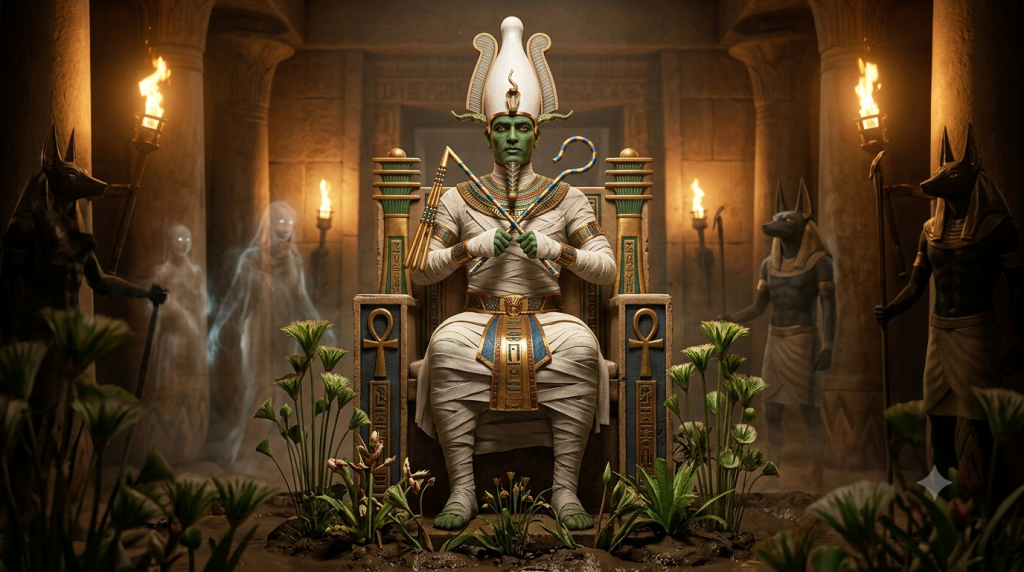
Nephthys is the wife of the murderer, the sister of the victim, the mother of the embalmer, and the loyal companion of the goddess who holds the tradition together. She is present at every major event in the most important myth in Egyptian religion and she is almost never the one people talk about afterward. Her name means Mistress of the House, and she is the one who keeps the house in order while everyone else is doing the things that get remembered.
She is the youngest of the five children of Geb and Nut: the siblings are Osiris, Isis, Set, Horus the Elder, and Nephthys, in that order. Osiris rules Egypt. Isis supports him. Set murders him. Horus the Elder watches over the sky. Nephthys is married to Set, the murderer, which places her in a position of impossible loyalty from the moment the mythology begins. She chose Isis. She chose to help gather the pieces of Osiris that her husband had scattered across Egypt, to help reassemble and embalm the body, to mourn beside her sister in the form of a kite bird with wings spread in the gesture of protection over the dead. She chose against Set every time it mattered, and the tradition records this without particular drama, as simply what she did.
This makes her one of the most morally precise figures in Egyptian mythology: a goddess who did what was right in a situation where what was right was also what was personally costly.
The Marriage to Set
Nephthys’s marriage to Set is described in the tradition as largely without affection on either side. The couple had no children together in most accounts. Nephthys is described as living in fear of her husband, which is consistent with what Set represents: not simply a personal antagonist but the embodiment of the forces of chaos and disorder that threaten the ordered world. Being married to the principle of chaos is not a comfortable domestic situation, and the tradition does not pretend it was.
The marriage appears to be primarily structural rather than romantic in the theological sense. The five children of Geb and Nut form a cosmological family in which the pairing of siblings encodes a theological principle: Osiris and Isis are the pairing of fertile rule and magical power, the order and intelligence of the living world. Set and Nephthys are the pairing of destructive chaos and protective containment, the forces that threaten and the forces that guard, bound together in a marriage that the tradition presents as inherently unstable but cosmologically necessary.
Nephthys’s betrayal of Set in favour of Isis is therefore not simply a personal choice. It is a theological statement about which principle she represents more fundamentally: not chaos, despite her marriage to it, but protection, which ultimately aligns her with order against the disorder her husband embodies.
The Affair With Osiris and the Birth of Anubis
In some versions of the tradition, Nephthys disguised herself as Isis and seduced Osiris, conceiving the jackal-headed god Anubis as a result. She then abandoned the child in the wilderness, afraid of what Set would do if he discovered the infidelity. Isis, who appears to have been a more reliable parent than the various circumstances in her mythology allowed her to be, found the infant Anubis and raised him.
The theological significance of this story is considerable. Anubis, the god of embalming and the conductor of the weighing of the heart, was born from the union of Osiris and Nephthys, raised by Isis, and became the being who embalmed Osiris after Set’s murder and who oversees the judgment of every dead person who comes to the Hall of Two Truths. The most practically important god in Egyptian funerary religion is the son of the murdered king and the murderer’s wife, raised by the murdered king’s widow. The family dynamics of Egyptian mythology are not straightforward.
The World History Encyclopedia notes that some scholars have questioned the seduction narrative, suggesting it may be a later addition to the mythology, but the connection between Nephthys and Anubis as mother and son is present across multiple sources and appears to represent a genuine strand of the tradition.
The Mourning and the Embalming
Nephthys’s defining role in the tradition is as the companion mourner of Isis over the body of Osiris. The two sisters are depicted together at every stage of the funerary process: the search for the scattered body parts, the reassembly, the embalming, the mourning vigil. In temple reliefs and funerary papyri they appear together so consistently that they function almost as a paired figure rather than two separate individuals.
The Lamentations of Isis and Nephthys, a ritual text from the Late Period used in funerary ceremonies, presents the two goddesses as calling to Osiris alternately, their voices interweaving in a dialogue of grief and summoning that was performed by two priestesses in the funerary rites of important individuals. This ritual use of Nephthys as the pairing of Isis is one of the clearest illustrations of how she functions in the tradition: not as an independent character with her own narrative arc but as the completion of Isis, the other half of the mourning pair without which the funerary ritual is incomplete.
Both sisters take the form of kites in the embalming mythology, the kite being a bird whose cry the Egyptians associated with mourning. Nephthys as a kite hovers over the dead with wings spread in the protective gesture that appears throughout Egyptian funerary art: the outstretched wings of the goddess covering the deceased, holding the body within the space of divine protection. Every mummy wrapped in linen and laid in a coffin was understood as being held within that gesture.
The Funerary Function
Nephthys guards the canopic jar containing the lungs of the deceased. The four canopic jars that held the embalmed organs of the dead were each protected by one of four specific deities: Isis guarded the jar of Imsety which held the liver, Nephthys guarded the jar of Hapy which held the lungs, Neith guarded the jar of Duamutef which held the stomach, and Serqet guarded the jar of Qebehsenuef which held the intestines. At the four corners of the coffin and the four sides of the sarcophagus, Nephthys appears as one of the four guardians of the dead body in its entirety.
Her association with the lungs is theologically appropriate: the lungs are the organ of breath, and breath in Egyptian religious thought was the most fundamental sign of life. The goddess who represents the threshold between life and death guards the organ whose activity marks that threshold most directly. When the lungs stop, life ends. Nephthys guards the jar that holds the preserved lungs of the dead, maintaining their integrity for the afterlife where they will be needed again.
She is also associated with the night, with darkness, and with the liminal spaces between things: the boundary between the living world and the dead one, between the ordered cosmos and the chaos that surrounds it, between the loyalty she owed her husband and the loyalty she gave her sister. Every threshold she guards in the funerary tradition is an expression of the boundary position she occupies in the mythology itself.
For more on the Egyptian tradition, the Isis article covers the sister alongside whom Nephthys performs every important funerary act in the tradition. The Osiris article covers the murdered king whose reassembly Nephthys assists and whose death creates the situation that defines her mythology. The Anubis article covers the son she conceives with Osiris and abandons, who is then raised by Isis and becomes the most important funerary god in Egyptian religion.
Never miss a myth
Thank you for being here. The site is brand new and every subscriber genuinely means something to me. If you're here, you care about this stuff as much as I do - and that's all the reason I need to keep going. New stories, videos and dark folklore from around the world, straight to your inbox. No algorithm. Just the stories, when they're ready.