The Osiris myth is the central narrative of Egyptian religion. It is not simply the most important story in the tradition. It is the story that made every other element of the tradition possible: the authority of the pharaoh, the hope of resurrection, the judgment of the dead, the meaning of mummification, the annual flooding of the Nile. Every significant belief and practice in Egyptian religious life connects to this myth, and understanding it properly is the foundation for understanding everything else.
This article tells the full story from beginning to end, drawing on all the major sources, noting where they differ and why those differences matter. The Osiris article elsewhere on this site covers the god himself in depth. This article covers the narrative: what happened, in what order, why it happened, and what it meant.
Before the Beginning: The Divine Family
The story begins before the killing, with a family. The sky goddess Nut and the earth god Geb had five children: Osiris, Isis, Set, Nephthys, and Horus the Elder. The births were unconventional: Ra had cursed Nut, forbidding her from giving birth on any day of any month. The god Thoth solved the problem by gambling with the moon and winning enough extra time to create five additional days outside the regular calendar, the epagomenal days on which the five children were born. Osiris was born on the first, at the moment of his birth a voice was heard proclaiming that the lord of creation had arrived. Set came last, impatient, tearing through his mother’s side rather than waiting.
Osiris became king of Egypt and ruled during a golden age of peace and civilisation. He taught his people agriculture, law, and the arts of civilised life. He gave them the gifts that made a good life possible and they loved him for it. Isis ruled beside him as his queen and sister-wife, her magic supporting his governance. Set, his brother, chafed at his exclusion from power. Nephthys, Set’s wife, found her husband difficult and kept her distance from him.
The First Murder: The Chest
The most complete account of how Set killed Osiris comes from Plutarch’s De Iside et Osiride, written in the 1st century CE. No single Egyptian source provides the full narrative: the Egyptian texts assume familiarity with the story rather than telling it from the beginning, so Plutarch’s synthesised account remains the most complete version available even though it was written by a Greek author two thousand years after the events it describes.
Set had a magnificent chest built to the precise measurements of Osiris’s body, without letting Osiris know the purpose. At a feast where Osiris was present, Set displayed the chest and announced that whoever it fit perfectly could keep it. Seventy-two guests tried and none fit. Osiris lay down in it and fit perfectly. Set and his conspirators immediately slammed the lid, sealed the chest with molten lead, and threw it into the Nile.
The chest floated down the Nile, out to sea, and eventually came to rest at Byblos on the coast of what is now Lebanon. A tamarisk tree grew around it, enclosing the chest within its trunk. The king of Byblos had the tree cut down to use as a pillar in his palace, the chest still inside it. The pillar stood in the palace, the dead god sealed within, while the world went on.
Isis searched. She questioned everyone she met, following rumours and divine instinct, until she reached Byblos. She sat by a well and befriended the queen’s handmaidens, and eventually became the nursemaid to the queen’s infant son. She nursed the child by placing him in fire each night, removing his mortality gradually through this process. The queen discovered what was happening and cried out in horror, interrupting the procedure and costing the child his chance at immortality. Isis revealed her identity and asked for the pillar. The king and queen gave it to her. She opened it and found her husband.
The Dismemberment
Isis brought the body back to Egypt and hid it in the marshes of the Nile Delta while she prepared to restore her husband. Set found the body while hunting by moonlight. He recognised it and this time he was thorough. He dismembered the body into pieces, scattering them across Egypt so that nothing could be reassembled.
Different sources give different numbers for the pieces: fourteen in the Pyramid Texts, forty-two in later accounts, one for each nome or administrative district of Egypt. The number forty-two connects the dismemberment to the forty-two judges who observe the weighing of the heart in the Hall of Two Truths, suggesting a cosmological significance to the number beyond simple arithmetic. Egypt’s political divisions are written into the distribution of the god’s body: every part of the country contains a piece of Osiris, which makes the whole country sacred in a specific and distributable way.
The Search and the Reassembly
Isis and Nephthys searched Egypt together, and this is where the story’s moral texture becomes most complex. Nephthys was Set’s wife. She helped search for the pieces of the man her husband had murdered and scattered. The tradition presents this without extensive comment as simply what she did, because what her husband had done was wrong and helping her sister undo it was the right response regardless of her marriage.
They found each piece and gathered it. They were helped in some accounts by Anubis, the jackal-headed god who would become the patron of embalming, and by Thoth, who provided the magical knowledge required for what came next. One piece was missing: the phallus, which had been swallowed by a Nile fish. Isis fashioned a substitute from gold and attached it to the reassembled body.
Then she worked the greatest magic ever performed in Egyptian mythology. She spread her wings over the body, the form she took in this moment being that of a kite rather than a woman, and she breathed life back into the dead god with the wind of her wings and her magical words. The body briefly became animate. Long enough for Isis to conceive a child.
Horus was conceived posthumously, the heir of a dead king, carried to term by a goddess who was also a widow who had just reassembled her husband from pieces scattered across a country. She gave birth to him in secret in the marshes of the Nile Delta, hiding from Set, and raised him in conditions of careful concealment while he grew toward the size and power required to challenge his uncle for his father’s throne.
Osiris in the Underworld
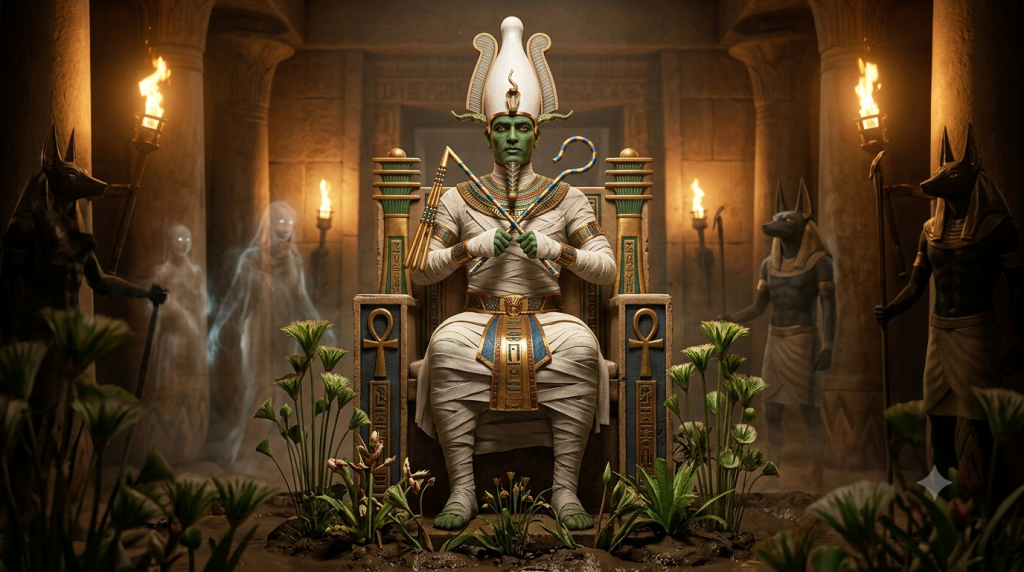
The resurrection was real but incomplete. Osiris did not return to the world of the living as a living king. He had been dead, and death had changed him. He descended to the Duat, the Egyptian underworld, and became its ruler: the first being to undergo death and be transformed into divine afterlife existence on the other side. His throne in the underworld was more permanent and more cosmologically significant than his throne in Egypt had been. The king of the living became the king of the dead, and in doing so created the category into which every subsequent dead person would enter.
This transformation is the theological centre of the myth. Osiris did not simply survive death or return from it unchanged. He was changed by it into something that had not existed before, a divine ruler of a divine realm that his death had created. Every Egyptian who died after Osiris died into a world that had a ruler and a structure and a system of judgment because Osiris had gone there first and organised it. The murdered king’s second kingdom was the larger one, and every Egyptian hoped to enter it.
The Childhood of Horus
While Osiris ruled the dead, Isis raised Horus. The texts describing his childhood, the Metternich Stele and related magical papyri, present a series of dangers that the child survived through his mother’s magical intervention: scorpion stings, dangerous animals, illness. Each danger that threatened the divine child and was overcome by Isis’s magic provided the precedent and the authority for healing spells used by Egyptian practitioners on human children facing the same dangers. If Isis’s magic could protect the divine Horus, the same magic could protect an ordinary child.
Set knew Horus existed and sought to kill him. The marshes of the Delta provided concealment: a liminal landscape, neither fully cultivated nor fully wild, where the heir of the dead king could be hidden until he was ready. Isis was his only protection, and she never left his side.
The Contest for the Throne
When Horus was grown he presented his claim to the divine tribunal: the council of the gods who governed the cosmos. Set presented his counter-claim based on his own power and seniority. The tribunal argued for eighty years without reaching a verdict, an indeterminate period that the tradition uses to indicate both the difficulty of the case and the genuine complexity of the principles at stake.
The contests between Horus and Set during this period include boat races in stone vessels, hippopotamus combats in the Nile, and various acts of magical sabotage and counter-sabotage. In the most dramatically intense episode, Set sexually assaulted Horus in an attempt to humiliate him. Thoth intervened and reversed the assault through magical means, redirecting the outcome of Set’s act against Set himself at the tribunal, which produced one of the most extraordinary scenes in Egyptian mythology: the seed of Set emerging from the surface of the Nile in the form of a golden disc, which Thoth placed on his own head as a crown.
Eventually, through a combination of tribunal deliberation, the intervention of other gods, and the eventual involvement of Osiris himself who sent an angry letter from the underworld threatening to send the dead after the gods if they did not stop delaying, the verdict was given for Horus. He was confirmed as the rightful king of Egypt, the heir of Osiris, and Set was given other domains and other functions where his considerable power could be directed productively.
What the Myth Established
The Osiris myth is not simply a story. It is the founding document of the entire Egyptian theological, political, and funerary system, and understanding what it established is understanding what made Egypt Egypt.
It established that legitimate power passes through lineage rather than through force: Horus won not because he was more powerful than Set but because he was Osiris’s son, and the tribunal ultimately recognised that inheritance outweighed might. This principle governed every royal succession in Egyptian history: the new king was Horus, the dead king was Osiris, and the mythological pattern repeated at every transition.
It established that death is not the end but a transformation into a different kind of existence. Osiris was murdered and dismembered and was not destroyed. He was reassembled, reanimated, and became the ruler of a realm more permanent than the one he had lost. Every Egyptian who died could follow the same path because Osiris had walked it first.
It established that resurrection requires preservation of the body, magic of sufficient power, and the love of someone who will not give up searching. The mummification that every Egyptian wanted applied to their dead was the human equivalent of what Isis and Anubis and Thoth had done for Osiris. The bandages, the canopic jars, the embalming resins: all of it was the attempt to give the dead person what Osiris had been given, so that what had happened to Osiris could happen to them.
And it established that morality has cosmic consequences. Set’s murder of Osiris was not simply a crime that went unpunished. It disrupted the cosmic order and required the entire divine community to work for eighty years to restore it. The principle that wrong acts have consequences extending beyond the immediate is written into the foundational narrative of Egyptian religion, and the weighing of the heart at the judgment of the dead is its ultimate expression.
For more on the individual figures in this story, the Osiris article covers the murdered king in depth. The Isis article covers the wife whose magic makes the resurrection possible. The Set article covers the killer whose dual nature is one of the most complex questions in Egyptian mythology. The Horus article covers the son whose victory completes the myth’s resolution.
Never miss a myth
Thank you for being here. The site is brand new and every subscriber genuinely means something to me. If you're here, you care about this stuff as much as I do - and that's all the reason I need to keep going. New stories, videos and dark folklore from around the world, straight to your inbox. No algorithm. Just the stories, when they're ready.