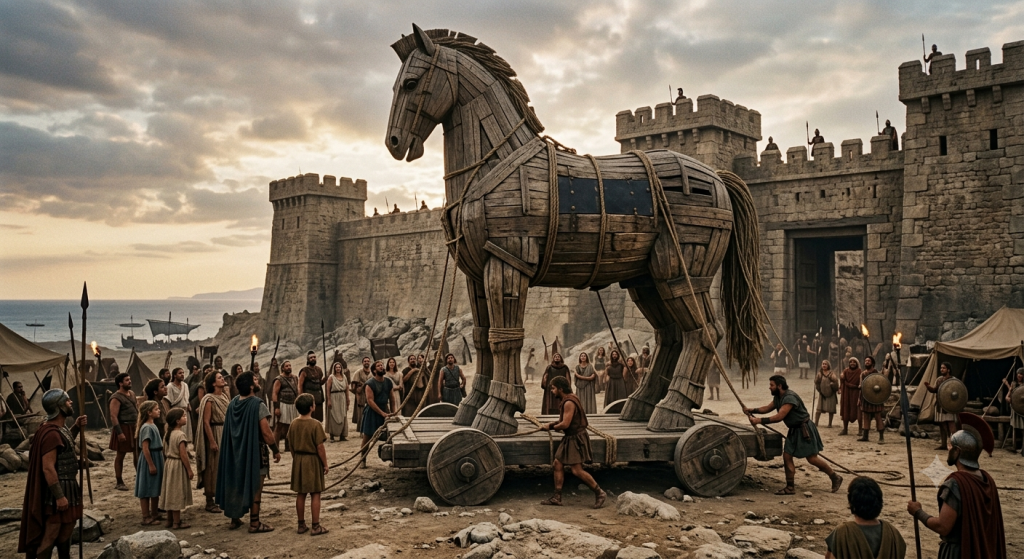
The Odyssey is the story of the man who invented the Trojan Horse. Odysseus is identified in the poem as the architect of the plan that ended the ten-year siege of Troy and brought about the city’s fall. The wooden horse filled with hidden warriors is his greatest achievement, the culmination of all the cunning and resourcefulness that define him as a hero, and it is the reason the war ended when it did rather than continuing indefinitely.
Homer mentions it in the Odyssey in approximately twelve lines. He describes it twice: once when the bard Demodocus sings about the fall of Troy at the Phaeacian court, and once when Odysseus asks Demodocus to sing specifically about the horse episode and weeps while listening. In neither instance does Homer describe the horse in detail, explain how the Greeks got inside it without being noticed, or tell the reader anything about the deception used to convince the Trojans to bring it into the city. He assumes his audience already knows the story.
That assumption tells you something important about when the Trojan Horse story actually entered Greek culture. By the time Homer composed the Odyssey, probably in the 8th century BC, the wooden horse was already so well known that a poet could reference it without explaining it. The detailed version of the story, the one with Sinon and Laocoon and the debate among the Trojans, comes primarily from Virgil’s Aeneid, written in the 1st century BC, seven centuries after Homer. Understanding what the tradition actually contains requires knowing which parts come from where.
Interested in Greek Mythology? Check out my YouTube channel below
What Homer Does and Does Not Tell Us
Homer’s references to the horse in the Odyssey are brief but specific. He identifies the builder as Epeius, a craftsman who worked with Athena’s guidance. He identifies Odysseus as the man who led the warriors inside it. He describes the horse as sitting in the place of assembly of the Trojans, which the Greeks had filled with soldiers. He mentions that the Greeks eventually came out of it and sacked Troy.
What he does not mention at all is Sinon, the Greek soldier who stayed behind and convinced the Trojans to bring the horse inside the city. Sinon does not appear in the Iliad or the Odyssey. He is a post-Homeric addition to the tradition, appearing first in Virgil’s Aeneid and in other later sources. His absence from Homer is significant because it means the version of the story most people know, the one with the deliberate deception and the volunteer soldier who fools an entire city, is not the original version. It is an elaboration that accumulated over the centuries the story was told.
The Iliad, which covers the earlier part of the Trojan War rather than the return home, does not mention the horse at all. The horse belongs to the period between the Iliad’s ending and the Odyssey’s beginning, in the lost territory of what scholars call the Epic Cycle: a series of poems that covered the entire arc of the Trojan War, of which only fragments survive. The Little Iliad and the Sack of Troy were the poems that dealt with the horse episode in detail, and both are lost. We have only references to them in other sources and a few surviving lines.
The Mykonos Vase and the Dating Problem
The earliest known visual representation of the Trojan Horse is the Mykonos Vase, a storage vessel decorated with relief images that was found on the island of Mykonos and dated to approximately 675 to 650 BC. The vase shows a large horse with openings in its side, from which Greek warriors are visible. Some of the warriors are already emerging. Others are still inside. The image is detailed and specific and demonstrates beyond any doubt that the story of the wooden horse filled with warriors was well established in Greek visual culture by the 7th century BC, within a century or so of when Homer is believed to have composed the Iliad and the Odyssey.
This means the story was circulating in some form at least as early as Homer and probably earlier. The Epic Cycle poems that dealt with the fall of Troy, now lost, were almost certainly the source for the visual tradition on the Mykonos Vase, and they predated or were contemporary with Homer’s own poems. The horse was not something Homer invented. It was something he inherited from an older oral tradition and referenced briefly because his audience already knew it thoroughly.
The Corinthian Aryballos from around 560 BC and the Attic Red-Figure Krater Fragment from around 400 BC show the tradition developing visually over several centuries. By the time Virgil wrote the Aeneid in the 1st century BC and provided the most detailed literary account of the horse episode, the story had been circulating in various forms for at least six hundred years. What Virgil added was not the horse itself but the specific mechanics of the deception: Sinon’s role, Laocoon’s warning, the debate among the Trojans, and the famous line that Virgil put in Laocoon’s mouth.
Sinon and the Architecture of the Deception
In Virgil’s account, the deception works at two levels simultaneously. The horse itself is too large to fit through Troy’s gates, which means the Trojans have to actively choose to bring it in by demolishing part of their own walls. And they make that choice not simply because they see a large wooden horse on the beach but because a Greek soldier named Sinon is there to explain it to them.
Sinon’s story, as Virgil tells it, is that he was left behind by the Greek fleet when it appeared to sail away. He claims to be a deserter from the Greek army, abandoned by his companions after narrowly escaping a sacrificial death. The Greeks, he tells the Trojans, built the horse as an offering to Athena to ensure their safe voyage home, and they deliberately made it large enough that the Trojans could not bring it inside the city, because if the Trojans gained the horse’s blessing they would have divine protection against any future Greek attack. By telling the Trojans this, Sinon transforms the Trojans’ desire to keep the horse outside into a desire to bring it in: they demolish their walls to drag it through, thinking they are seizing an advantage from their enemies.
The elegance of the deception is that it works not despite the Trojans’ intelligence but because of it. They are not fooled by a clumsy lie. They are fooled by a sophisticated one that gives them a reason to do exactly what the Greeks want them to do while believing they are outwitting the Greeks. This is the kind of trick the tradition consistently associates with Odysseus: not brute force, not obvious deception, but a manipulation of what the other side already believes and wants.
Laocoon, the Trojan priest of Apollo, sees through it. His warning, rendered by Virgil as I fear Greeks, even those bearing gifts, is one of the most famous lines in Latin literature and the origin of the English phrase beware of Greeks bearing gifts. He even throws a spear at the horse’s flank. But before his warning can take effect, two sea serpents emerge from the water and crush him and his sons to death, which the Trojans interpret as divine punishment for impiety against a sacred offering. Having watched their most vocal doubter killed by the gods, the Trojans drag the horse inside.
Was It Real?
The question of whether the Trojan Horse actually existed has a more interesting answer than a simple no. Archaeological evidence confirms that a city at Hisarlik in northwestern Turkey, identified as Troy, was violently destroyed around 1180 BC. The destruction is real. The mechanism of that destruction is what the evidence cannot confirm.
No archaeological evidence of a giant wooden horse has been found at Hisarlik or anywhere else, and given the nature of wooden objects in the archaeological record this is exactly what you would expect whether the horse was real or not. Wood decays. A thousand years of subsequent occupation at the same site would destroy any physical evidence of a horse even if one had stood there.
Several alternative theories have been proposed for what the horse might represent or what real event might underlie the story. The most compelling, and the one that connects most directly to the mythology around it, involves Poseidon. The horse was sacred to Poseidon, the god of both horses and earthquakes. The city of Troy VI, the layer immediately below the one that shows signs of violent destruction, was destroyed by an earthquake. It is possible that what the tradition remembers as a wooden horse is a metaphorical description of an earthquake: the earth-shaking, horse-associated god Poseidon striking Troy and opening it to assault.
Another theory proposes that the horse was a siege engine, possibly a battering ram with a horse’s head, of the kind known to have been used in Bronze Age warfare. A third suggests it was a ship: Poseidon was also god of the sea, horses were associated with the sea through the white-horse imagery of breaking waves, and a ship full of warriors beached at Troy under cover of night is a plausible military operation that could have been mythologised into the wooden horse story over centuries of retelling.
The most intellectually honest position is that something happened at Troy around 1180 BC that involved both military defeat and a deception of some kind, that the tradition preserved a memory of this event in the form of the wooden horse story, and that the specific details of how the deception worked were elaborated over centuries of oral transmission until they reached the form Virgil recorded. The horse may be metaphor, may be misremembered military technology, may be a genuine tradition of an actual large wooden structure, or may be all three at different layers of the tradition.
Odysseus’s Role and What It Reveals
The consistent attribution of the horse to Odysseus across every version of the tradition is significant. The Iliad, which ends before the horse episode, establishes Odysseus as the Greeks’ most valuable strategic asset, the man they turn to when strength alone is insufficient. The Odyssey places him inside the horse and makes his plan’s success the premise of the entire poem. Every source that mentions the horse credits Odysseus with its invention.
This consistency reveals something about how the tradition understood both Odysseus and the war. A ten-year siege ended not by the greatest warrior, Achilles, who died before the city fell, but by the greatest strategist. The horse is the ultimate expression of what Odysseus is: not the strongest or the fastest or the most divinely favoured, but the cleverest, the one who found the solution that ten years of fighting had failed to produce.
It is also, from the perspective of the Trojans, the most morally ambiguous victory in Greek mythology. The horse works because it exploits hospitality, religious belief, and the fundamental human tendency to see what we want to see rather than what is actually there. The Trojans bring destruction through their own gates because someone they trusted told them a convincing story. The Greeks win the war not through courage or divine favour but through a lie.
The tradition is not uniformly comfortable with this. Virgil, writing from the perspective of the Trojans’ descendants, the Romans, treats the Greek deception with a moral seriousness that Homer does not. Sinon in the Aeneid is a figure of calculated treachery. The Trojans are not simply fooled. They are betrayed. The difference in emphasis reflects the difference in perspective: the Greeks saw the horse as Odysseus’s greatest achievement, the Romans saw it as the Greeks’ greatest crime.
The 2026 Film and Nolan’s Changes
Christopher Nolan’s Odyssey opens with the fall of Troy and the wooden horse, establishing the event that haunts Odysseus throughout the film. Early reports indicate that Nolan makes a significant departure from the tradition in his treatment of Sinon: in the film, Sinon is given the mission of presenting the horse to the Trojans but is not told what is inside it, ensuring that his ignorance makes his deception more convincing. When the Trojans become suspicious regardless, Sinon is killed.
This is a substantial change from both Homer and Virgil. In the tradition, Sinon is a knowing and willing participant in the deception, a skilled liar who volunteers for a dangerous mission and executes it brilliantly. Nolan’s version makes him an unwitting instrument, which shifts the moral weight of the deception onto Odysseus more directly: not only does he design the trick, he uses a man who does not know what he is being used for. The film’s Odysseus is haunted by the war in ways Homer’s Odysseus is not, and the change to Sinon’s role is consistent with that framing.
Whether the change improves or diminishes the story is a matter of interpretation. What it does is make the film’s version of the horse episode more about Odysseus’s moral burden and less about Sinon’s cleverness, which is a defensible reading of what the tradition prioritises even if it contradicts the specific details that Virgil preserved.
Further Reading
If this article sparked your interest, these are the books worth reading next.
The Iliad — Homer (Penguin Classics)
by Homer — the primary source for everything in this article, and still the most vivid account of the Trojan War ever written.
The Odyssey — Homer (Emily Wilson translation)
by Homer, translated by Emily Wilson — the best modern English translation, and the book that contains Odysseus’s own account of the horse.
The Trojan War: A Very Short Introduction
by Eric Cline — the clearest and most up to date account of what archaeology actually tells us about Troy and whether any of it happened.
For more on the Greek tradition, the Judgement of Paris article covers the beauty contest that started the war the Trojan Horse ended. The Achilles article covers the greatest warrior of the war who died before the horse was built. The Zeus article covers the god whose sacred law of hospitality Paris violated when he took Helen. The Hera article and the Athena article cover the goddesses whose sustained hostility to Troy shaped the war’s outcome. The Greek Mythology hub page has every article in the cluster.
Never miss a myth
Thank you for being here. The site is brand new and every subscriber genuinely means something to me. If you're here, you care about this stuff as much as I do - and that's all the reason I need to keep going. New stories, videos and dark folklore from around the world, straight to your inbox. No algorithm. Just the stories, when they're ready.