Poseidon is the reason the Odyssey exists. Without his sustained, implacable opposition to Odysseus’s return, Homer’s poem would be a story about a man who sailed home from Troy in a few weeks. Everything that happens in the poem, every monster, every delay, every lost ship and drowned sailor, is downstream of one decision: Odysseus blinded Polyphemus the Cyclops, who was Poseidon’s son, and Poseidon decided that the man responsible would not reach home easily or quickly or with anyone left alive to sail beside him.
The god is present in almost every disaster in the Odyssey without appearing directly in any of them. He does not confront Odysseus. He does not appear to him in a dream. He raises storms, wrecks ships, and lets the sea do what the sea does when a god who controls it wants a specific man to suffer. He is the antagonist of the poem in the way that weather is an antagonist: impersonal, implacable, and not particularly interested in the feelings of the person it is destroying.
Understanding Poseidon requires understanding both what he is in the Odyssey and what the tradition makes of him more broadly, because he is a considerably stranger and more complex deity than his role as the sea god of popular culture suggests.
Interested in Greek Mythology? Check out my YouTube channel below
The Name and What It Means
The name Poseidon has generated centuries of scholarly debate and no settled conclusion. The two most commonly cited etymologies translate it as husband of the earth or lord of the earth, neither of which has any obvious connection to the sea. This has led several scholars to argue that Poseidon was not originally a sea god at all, that his association with the ocean was a later development in the tradition, and that his original domain was the earth itself, specifically the violent, unpredictable movement of the earth that the Greeks experienced as earthquakes.
Herodotus, writing in the 5th century BC, claimed that the name and worship of Poseidon was imported to the Greeks from Libya. Modern scholars are more inclined to see him as a deity of Pelasgian origin, one of the pre-Greek peoples of the Aegean whose traditions were absorbed into the developing Greek religious system. Whatever his origin, his most important epithets are not about the sea. He is Enosichthon, the earth-shaker. He is Ennosigaios, the one who shakes the earth. He is Gaieocho, the holder of the earth. These titles suggest a deity whose primary domain was the unstable ground beneath human feet rather than the unstable water around them.
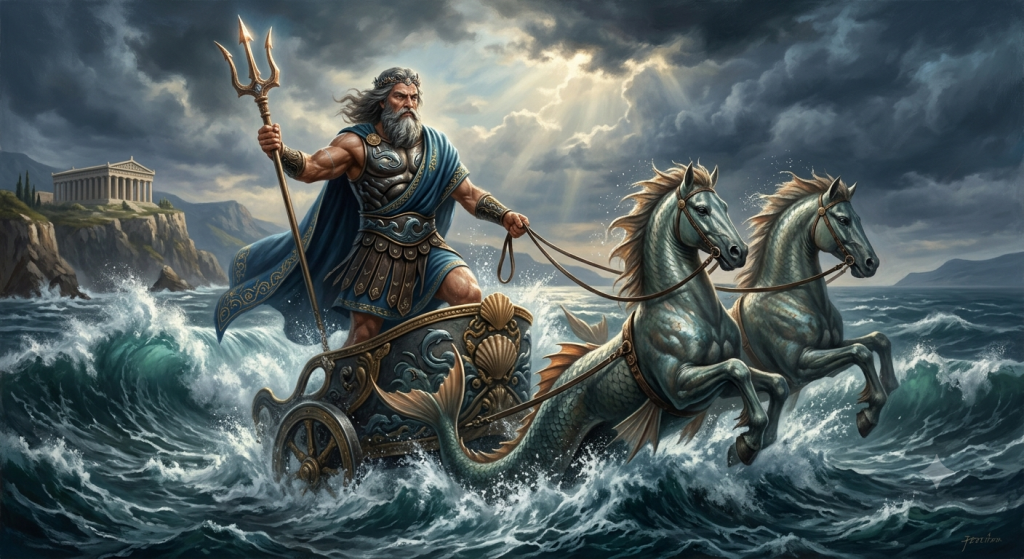
The horse connection is even older than the sea connection in some parts of the tradition. In the Peloponnese, certain cults worshipped Poseidon specifically as a horse god. He is credited in various myths with creating the first horse, either by striking rock with his trident or through his union with Demeter when both had taken equine form. He is the father of Pegasus, through his relationship with Medusa. The great horse races held at his sanctuaries were among the most important in the Greek world. His association with horses is so deep and so geographically widespread that scholars believe it predates his association with the sea, which only came to dominate his identity as the Greeks became increasingly maritime.
The connection between horses and the sea is not as paradoxical as it looks. The Greeks described the white crests of breaking waves as white horses, and the same English phrase is still in use. The galloping power of the sea, the unpredictable surge and withdrawal of the water, the way a storm-driven wave moves like a cavalry charge: these make the horse an intuitive symbol for marine force in a way that is consistent with both domains being governed by the same deity.
His Place in the Pantheon
Poseidon was the son of Cronus and Rhea, swallowed by his father along with his siblings Hades, Demeter, Hestia, and Hera, and eventually disgorged when Zeus forced Cronus to regurgitate them. The division of the cosmos that followed the Olympians’ overthrow of the Titans gave Zeus the sky, Hades the underworld, and Poseidon the sea. The earth and Olympus were held in common.
In terms of raw power, Poseidon was second only to Zeus in the divine hierarchy. This is not a small thing. He controls the sea, which in the Greek world was both the primary medium of commerce and travel and the most immediately lethal natural force most people ever encountered. He controls earthquakes, which in a seismically active region like the eastern Mediterranean were a constant and unpredictable threat to everything humans had built. He is worshipped across the entire Greek world, with particular strength in maritime city-states like Corinth and in the regions where earthquake risk was most keenly felt.
His relationship with Zeus is one of equals who operate under a clear hierarchy. Poseidon obeys Zeus when Zeus commands him directly, but he does not defer to Zeus spontaneously or without resentment. In the Iliad he argues with Zeus about the conduct of the Trojan War and has to be reminded of the divine order of precedence before he backs down. He participates in the divine council but he is not simply a subordinate. He is a king in his own domain, and the relationship between him and Zeus is more like two powerful rulers who have agreed to operate under a shared constitution than like a god and his subordinate.
His Relationship with Odysseus
The incident that defines Poseidon’s role in the Odyssey is not something Odysseus could have avoided. He needed to escape from Polyphemus’s cave. Blinding the Cyclops was the only viable method. The problem is not that Odysseus did it but what he did afterward: as his ships pulled away from the island, he called back to Polyphemus to tell him his name. He could not resist letting the Cyclops know who had outwitted him.
Polyphemus called out to his father Poseidon and asked him to ensure that Odysseus either never reached home, or reached it late, alone, on a foreign ship, to find trouble waiting for him. Poseidon heard. The prayer was within what a god could reasonably grant a son, and Poseidon granted it.
What follows is ten years of sustained divine hostility from the second most powerful deity in the Greek pantheon, directed at a single mortal. Poseidon does not do this continuously and directly. He raises storms when Odysseus is at sea. He wrecks the raft Calypso helps Odysseus build. He is present in every disaster involving water, which in a poem about a man trying to sail home means he is present in almost everything. When he is absent, which he is for extended periods because he is away at a feast given by the Ethiopians, Athena takes the opportunity to arrange Odysseus’s release from Calypso’s island. The entire first movement of the plot depends on Poseidon being temporarily elsewhere.
The divine hostility ends when Odysseus finally reaches Ithaca. Poseidon’s last act against him is to punish the Phaeacians for helping Odysseus home: he turns their ship to stone as it returns to harbour, fulfilling an old prophecy about the fate of the Phaeacian people if they ever helped a stranger. It is a sideways punishment, directed at the people who aided Odysseus rather than at Odysseus himself, which suggests that even Poseidon recognised that the prayer had been fulfilled. Odysseus had reached home late, alone, on a foreign ship, to find trouble waiting. The terms of the curse had been met.
The Contest with Athena
The myth of Poseidon’s competition with Athena for the patronage of Athens is the story that most clearly establishes his character in the tradition. Both gods want the city. Both offer gifts. Poseidon strikes the rock of the Acropolis with his trident and produces a spring of saltwater. Athena plants an olive tree. The citizens choose the olive.
Poseidon’s response to losing is immediate and disproportionate. He floods the surrounding plains. The gesture accomplishes nothing practical, does not change the result, and alienates the people he was trying to win. It is an expression of pure divine rage that achieves only destruction, which is the characterisation the tradition consistently gives him: immensely powerful, easily offended, prone to violent responses to situations that call for something more measured.
In some versions of the story, the citizens of Athens vote rather than simply being offered the gifts. The women, who outnumber the men by one, vote for Athena’s olive tree. Poseidon’s anger at losing is directed partly at this: the city chose a female deity over a male one, which from his perspective compounds the insult. The response, flooding the plains, may be connected to a real memory of the kind of coastal inundation that happens when a sea god is displeased. Poseidon’s floods in the tradition are not metaphors. They are what happens when the god of the sea and earthquakes decides to make a point.
Medusa and the Temple
Poseidon’s relationship with Medusa is one of the more uncomfortable aspects of his mythology and the one that most popular treatments handle least well. Medusa was originally a beautiful woman, one of the three Gorgon sisters, mortal where her sisters were immortal. In the version of the story that Britannica and most ancient sources follow, Poseidon assaulted her in Athena’s temple. Athena, rather than punishing Poseidon for the act, transformed Medusa into the snake-haired monster who turns anyone who looks at her to stone.
The injustice of this response has been noted by readers across centuries and has generated considerable modern commentary. Athena punishes the victim rather than the perpetrator, which seems inconsistent with her role as a goddess of wisdom and justice. The ancient tradition does not appear troubled by the inconsistency, which says something about how the Greeks understood the relationship between divine power and divine morality: the gods are not required to be just in their dealings with mortals, and the anger of one god at a situation created by another god is not constrained by any expectation of fairness to the humans involved.
The offspring of Poseidon and Medusa, Pegasus and Chrysaor, are born from her blood when Perseus cuts off her head. The winged horse emerging from the severed neck of the Gorgon is one of the more striking images in Greek mythology, and it connects Poseidon’s horse domain to his relationship with Medusa in a way that suggests the tradition understood the connection as meaningful rather than accidental.
The Earth-Shaker in the Real World
The Greek world that worshipped Poseidon was seismically active in ways that made earthquakes a regular and terrifying feature of life. The Aegean region sits on a complex of tectonic plates whose interactions produce earthquakes, volcanic activity, and tsunamis with a frequency that the ancient world experienced directly and repeatedly. Thera, the volcanic island whose eruption around 1600 BC may have contributed to the collapse of Minoan civilisation, is in the heart of Poseidon’s sea. The earthquakes that periodically destroyed Greek cities were his work in the understanding of the people living through them.
This gives his character in the tradition a weight that the sea god role alone does not fully explain. A god of the sea is frightening to sailors. A god who shakes the earth is frightening to everyone, because the ground beneath your feet is the one thing you rely on absolutely, and Poseidon can make it move. The earth-shaker title is not a minor epithet. It is the description of a deity whose power extends to the most fundamental assumption of physical existence: that the ground will stay still.
The Temple of Poseidon at Cape Sounion, on the southernmost tip of Attica, is one of the most dramatically situated religious buildings in the ancient world. Visible from the sea for miles, it was the last thing Athenian sailors saw as they left home and the first thing they saw when they returned. Prayers offered there were offered with the full understanding of what the god could do if displeased, and with the hope that what had been given would be sufficient to keep his attention benevolent. Whether it was or not depended entirely on Poseidon, who like the sea itself was consistent only in his inconsistency.
Further Reading
If this article sparked your interest, these are the books worth reading next.
The Iliad — Homer (Penguin Classics)
by Homer — the primary source for everything in this article, and still the most vivid account of the Trojan War ever written.
The Odyssey — Homer (Emily Wilson translation)
by Homer, translated by Emily Wilson — the best modern English translation, and the book that contains Odysseus’s own account of the horse.
The Trojan War: A Very Short Introduction
by Eric Cline — the clearest and most up to date account of what archaeology actually tells us about Troy and whether any of it happened.
For more on the Greek tradition, the Zeus article covers the brother who drew the sky in the same lottery that gave Poseidon the sea. The Hades article covers the third brother who drew the underworld. The Medusa article covers the figure Poseidon’s assault on in Athena’s temple set in motion. The Jason and the Argonauts article covers the heroes who navigated Poseidon’s seas on the greatest quest of the generation before Troy. The Greek Mythology hub page has every article in the cluster.
Never miss a myth
Thank you for being here. The site is brand new and every subscriber genuinely means something to me. If you're here, you care about this stuff as much as I do - and that's all the reason I need to keep going. New stories, videos and dark folklore from around the world, straight to your inbox. No algorithm. Just the stories, when they're ready.