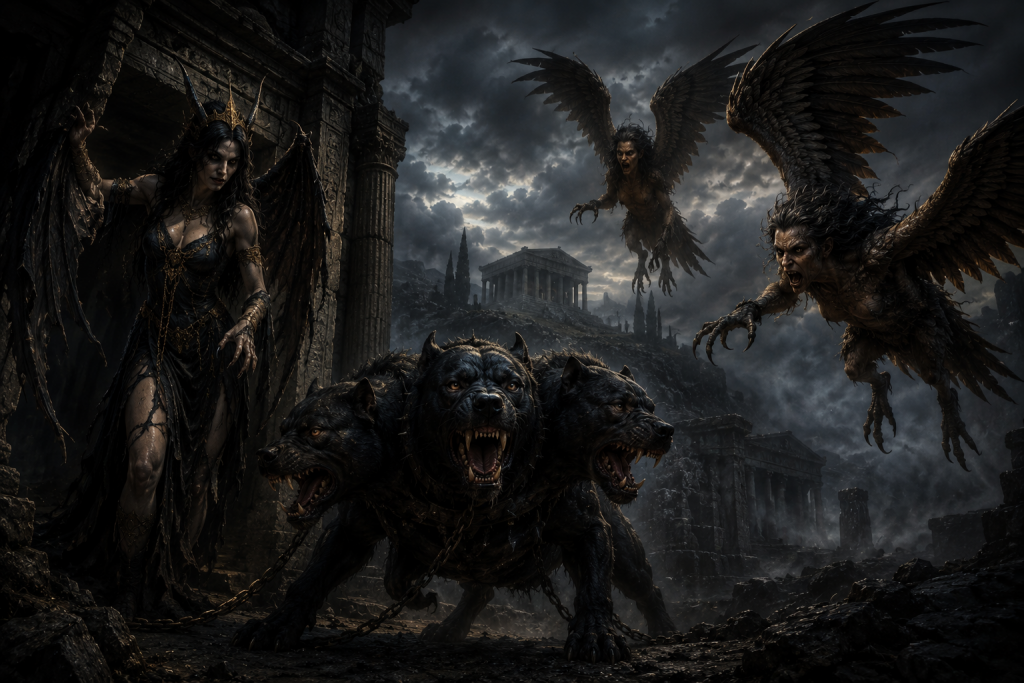
In Aristophanes’s comedy The Frogs, written in 405 BC, the god Dionysus is travelling to the underworld with his servant Xanthias when they encounter something on the road. Xanthias sees it first and describes it in a rapid series of changing forms: a cow, a mule, a beautiful woman, a dog. Dionysus, terrified, grabs his servant and hides behind him. Xanthias eventually identifies it: an Empusa, one of the shape-shifting demons associated with Hecate.
The encounter in The Frogs is played for comedy, but it reveals something important about how the ancient Athenian audience understood the Empusa. Aristophanes could use her as a joke because his audience already knew who she was, what she looked like in her various forms, and why encountering one on a road at night was precisely the kind of thing that should make a god hide behind his servant. The comedy depends on the familiarity, and the familiarity tells you that the Empusa was a genuine and well-established figure in the supernatural landscape of ancient Greece rather than an obscure variant that appears in only one text.
She appears across multiple ancient sources, which is unusual for a creature of her specific type: a predatory shapeshifter who hunts humans by taking beautiful forms and who belongs to the court of a goddess associated with magic and the night. The consistency of her core characteristics across those sources gives her a more solid grounding in the tradition than many equally famous figures from Greek mythology.
What She Was
The Empusa belongs to a category of Greek supernatural beings associated with Hecate, the goddess of magic, crossroads, the moon, and the spaces between the world of the living and the world of the dead. Hecate’s court in the ancient sources included various supernatural beings who shared her liminal qualities: things that operated at thresholds, in the dark, and in the spaces where the ordinary rules of the world did not quite apply.
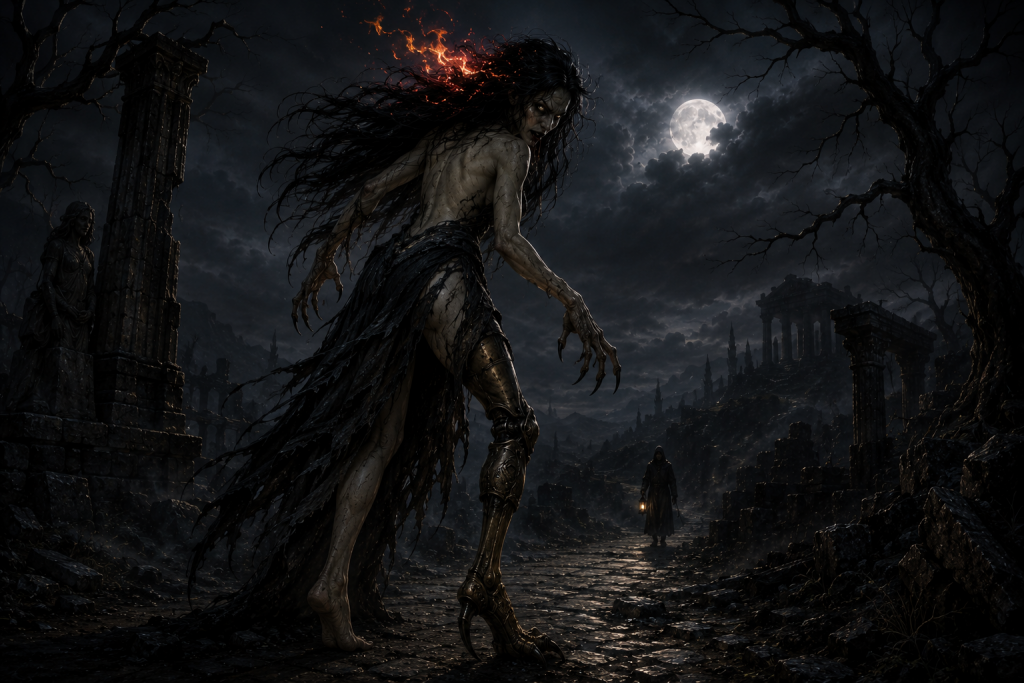
The Empusa’s name has been connected etymologically to the Greek word for foot, which relates to one of her most distinctive physical characteristics: mismatched legs. One leg is described as made of bronze and the other as the leg of a donkey, or alternatively one leg is human and the other is bronze, depending on the source. This physical asymmetry is her tell, the detail that reveals her non-human nature to anyone who knows what to look for, in the same way that the Baobhan Sith’s deer hooves betray her beneath her green dress or the Kelpie’s wet mane reveals its nature to the observant traveller.
In some ancient texts the Empusa is described as a single specific being, one of Hecate’s particular servants. In others, including the Philostratus account discussed below, the Empusai are a category of being rather than an individual: a class of shapeshifting predators who operate under Hecate’s authority and share a set of characteristics without being identical to each other. This ambiguity between individual and category is common in the ancient supernatural tradition, which did not always distinguish between named individuals and types of being with the clarity that modern readers sometimes expect.
What She Did
The Empusa hunted at night and at crossroads, both of which are Hecate’s domain in the ancient tradition. Crossroads were understood in the ancient world as places where different paths and different possibilities met, and that liminality gave them a supernatural charge that made them both dangerous and appropriate for ritual. Offerings to Hecate were left at crossroads. Encounters with supernatural beings happened at crossroads. The Empusa waiting at a crossroads after dark was positioned at the most dangerous possible convergence of the geography of the supernatural.
Her method was shapeshifting. She could take the form of a beautiful young woman, which was her primary hunting form, but also animals: a dog, a cow, a mule. In The Frogs, Xanthias sees her cycling through forms rapidly, which suggests that the shapeshifting was not perfectly stable or perfectly controlled, or alternatively that she was displaying her range to frighten rather than to deceive. In her hunting form, the beautiful woman, the deception was more deliberate and more sustained.
The nature of what she did to her victims varies across the sources. Draining blood and flesh are mentioned. Draining life energy or vitality is mentioned in terms that sound like what later traditions would call a succubus rather than a conventional predator. The Philostratus account is the most specific and the most interesting about the mechanism, and it is worth examining in detail.
Apollonius and the Lamia of Corinth
The most extended ancient account of a creature of the Empusa type appears in Philostratus’s Life of Apollonius of Tyana, written in the early 3rd century AD. It is the story that Keats later used as the basis for his 1820 poem Lamia, and it is considerably stranger than either the poem or most popular summaries of it suggest.
A young philosopher named Menippus became involved with a beautiful woman in Corinth. She was wealthy, she lived in a fine house, and she appeared devoted to him. Apollonius of Tyana, a philosopher and miracle-worker whose biography is the subject of Philostratus’s book, became suspicious when he met Menippus and was introduced to the woman. He told Menippus directly that the woman was not human: she was a Lamia, a term Philostratus uses more or less interchangeably with Empusa in this context, and she was fattening him for consumption the way a farmer fattens livestock.
The confrontation came at the wedding feast that Menippus and the woman held. Apollonius appeared uninvited and demanded that the gold and silver plate, the servants, the food, the wine, and the house itself be examined. As he challenged each element, they disappeared. The woman, confronted directly, admitted that she was a Lamia and that she had intended to devour Menippus after keeping him comfortable for as long as possible. Her specific reason, she said, was that fine young men made the best eating.
The detail of the disappearing house and possessions is the element that makes the story genuinely unsettling rather than simply a supernatural seduction narrative. The Empusa or Lamia in this account is not simply a predator wearing a human face. She is a creator of environments, able to generate an entire social context, a house, a household, a persona with history and connections, that exists only to make the deception sustainable. The illusion has depth and duration. It is dismantled not by strength or by a specific counter-ritual but by someone asking the right questions about whether what appears to be real actually is.
The Bronze Leg and What It Signifies
The Empusa’s mismatched legs are the most consistently reported physical characteristic across the ancient sources, and they are worth dwelling on because they are not an arbitrary detail.
Bronze in the ancient world was the primary material for weapons and armour before the widespread adoption of iron. It was also associated with the divine and with things that did not decay: the golden age was followed by the silver age and then the bronze age, and bronze objects were understood as more permanent and more valuable than organic materials. A leg made of bronze is a leg that cannot be hurt, that does not tire, that does not bleed if cut. It is the leg of something that has one foot in the world of perishable flesh and another in the world of indestructible metal.
The donkey’s leg in the alternative description carries different associations. Donkeys in the ancient world were associated with Dionysus and with the underworld, with the carrying of burdens, and with a kind of stubborn persistence that was understood as both valuable and disreputable. A creature with a donkey’s leg has something of the underworld and of the chthonic tradition in its body, which connects the Empusa once again to Hecate’s domain at the boundary between the living and the dead.
In both versions of the leg description, the point is the same: one leg is human and one is something else entirely. The Empusa exists in two registers simultaneously, and the mismatched legs are the physical expression of that dual existence.
Where She Fits in the Vampire Tradition
The question of whether the Empusa is a proto-vampire is one that the ancient sources do not raise and that modern commentators raise constantly, which tells you something about what the question is actually about. The ancient Greeks did not need the category of vampire to understand what the Empusa was: she was a demon of Hecate’s court, a shapeshifter who hunted at crossroads, a creature that drained the life from young men. The category was sufficient.
The connection to the vampire tradition that later writers have drawn is genuine in terms of the overlapping characteristics: the beautiful appearance used to lure victims, the nocturnal hunting, the draining of vitality, the shapeshifting. These features appear in the Empusa tradition before they appear in the Eastern European vampire tradition, which has led some scholars to suggest a line of influence from Greek to later European supernatural belief.
Whether that line of influence is direct or whether similar features appear independently in different traditions as responses to similar anxieties, the Empusa is among the oldest documented examples of the specific type of supernatural predator that later becomes the vampire: a being that looks human enough to get close, that drains rather than simply kills, and that targets the young and vital. The difference is that the Empusa is a demon rather than an undead human, which places her in a different category theologically but produces similar narrative outcomes for the people who encounter her.
For more on the ancient Greek tradition she belongs to, the 10 Darkest Creatures of Greek Mythology article covers her alongside the other major figures of the tradition. For more on the vampire tradition she prefigures, the Vampires section has coverage of blood-drinking beings from across the world including the Upyr and the Abhartach. The Greek Mythology section has more on the supernatural world she inhabited.
Further Reading
If this article sparked your interest, these are the books worth reading next.
The Iliad — Homer (Penguin Classics)
by Homer — the primary source for everything in this article, and still the most vivid account of the Trojan War ever written.
The Odyssey — Homer (Emily Wilson translation)
by Homer, translated by Emily Wilson — the best modern English translation, and the book that contains Odysseus’s own account of the horse.
The Trojan War: A Very Short Introduction
by Eric Cline — the clearest and most up to date account of what archaeology actually tells us about Troy and whether any of it happened.
Never miss a myth
Thank you for being here. The site is brand new and every subscriber genuinely means something to me. If you're here, you care about this stuff as much as I do - and that's all the reason I need to keep going. New stories, videos and dark folklore from around the world, straight to your inbox. No algorithm. Just the stories, when they're ready.