

Cynocephali: The Dog-Headed Men Who Appeared on Medieval Maps and Were Taken Completely Seriously
The Cynocephali are human beings with the heads of dogs, and they appeared on the edges of medieval world maps,
Legendary Creatures · Werewolves
The werewolf is one of the oldest and most widely distributed supernatural figures in human tradition. It appears in ancient Mesopotamian texts, in Greek mythology, in the sagas of northern Europe, in the legal records of 16th century German courts, and in the folk belief of communities from the Scottish islands to the forests of Eastern Europe. Every culture that has ever lived alongside wolves has developed some version of the story of the human who becomes one, and the consistency of that story across traditions that had no contact with each other says something important about what the werewolf is actually for.
The version most people know from popular culture is a relatively recent construction. The full moon trigger, the silver bullet, the involuntary transformation that the sufferer cannot control: these are largely inventions of 20th century cinema, built on a foundation of 19th century Gothic fiction, which was itself built on a much older and considerably more varied tradition. The werewolf of the actual folklore is different in almost every particular from the movie monster, and it is more interesting in almost every way.
This section covers werewolf belief from its ancient origins through to the documented legal cases of early modern Europe, with attention to the specific traditions that resist the standard narrative. Not all werewolves in folklore are predatory. Not all transformations are involuntary. Not all of them are even particularly frightening to the communities that developed the belief. The Wulver of Shetland will give you a fish if you treat it with respect. The werewolves of the Livonian trial of 1692 believed they were fighting the devil on behalf of God. The tradition is stranger and more morally complex than the cinema version has ever managed to convey.
The werewolf tradition has roots older than most people assume. The Epic of Gilgamesh, one of the oldest surviving works of literature, contains an incident in which a man is transformed into a wolf by a goddess who has tired of him. The Greek myth of Lycaon, the king transformed into a wolf by Zeus as punishment for serving human flesh at a divine banquet, is one of the foundation stories of the lycanthropy tradition and gives the condition its technical name. The Norse berserkers, warriors who fought in states of animal frenzy wearing wolf skins, belong to a tradition of ritual identification with the wolf that predates the medieval werewolf concept by centuries.
What connects these disparate origins is the same underlying anxiety: the boundary between human and animal is not as fixed as civilised life requires it to be, and certain conditions, divine punishment, ritual practice, extreme states of mind, or simple bad luck depending on the tradition, can dissolve it. The werewolf is the embodiment of that dissolution, the human being who has crossed a line that should not be crossable and become something that the community no longer recognises as one of its own.
Between the 15th and 17th centuries, people were tried and executed across France, Germany, and the Baltic states for the crime of lycanthropy. Not for pretending to be werewolves, not for wearing wolf skins, but for the actual crime of transformation and the murders committed in wolf form. The courts that heard these cases were not uniquely credulous. They were operating within a coherent theological framework in which the devil could facilitate physical transformation through a human accomplice, and in which confession, even tortured confession, was the queen of proofs.
The Werewolf Trials article in this section covers the documented cases in specific detail: Peter Stumpp in 1589, whose confession described twenty-five years of murders in wolf form and whose execution was one of the most brutal public spectacles of its era; Gilles Garnier in 1573, whose case involved independent witnesses as well as confession; and old Thiess of Livonia in 1692, who freely admitted to being a werewolf but insisted he was fighting for God rather than the devil, leaving a court so confused it sentenced him to ten lashes and sent him home. The trials ended not because the courts concluded werewolves did not exist but because the intellectual climate shifted. The werewolf returned to fiction. For a century and a half it had been something considerably more dangerous.
The Wulver of Shetland is the creature in this section that refuses to fit the standard narrative, and it is worth including for exactly that reason. Half human and half wolf, known to specific locations on the Shetland islands, the Wulver is described in the tradition as fundamentally benevolent: a creature that leaves fish on the windowsills of poor families, that can be encountered without danger if you treat it with the respect its nature deserves, and that has none of the predatory hostility of the werewolf tradition’s more famous cases.
The Wulver raises a question that the werewolf tradition rarely asks: what does it mean that some wolf-human hybrids in folklore are helpers rather than hunters? The answer probably lies in the ambivalent relationship that human communities in Scotland and the Northern Isles had with actual wolves, which were simultaneously dangerous predators and ecologically necessary animals, feared and respected in equal measure. The Wulver encodes that ambivalence in a form that does not resolve it, which is more honest than the straightforwardly monstrous version of the tradition usually allows.
Browse the articles below. The werewolf you think you know has a considerably stranger history than the cinema gave it.
The Cynocephali are human beings with the heads of dogs, and they appeared on the edges of medieval world maps,

The Bouda is the specific Ethiopian name for the werehyena figure associated with blacksmiths, potters, weavers, and other artisan castes

The werehyena is one of the oldest shapeshifter traditions in the world and one of the least known outside Africa.
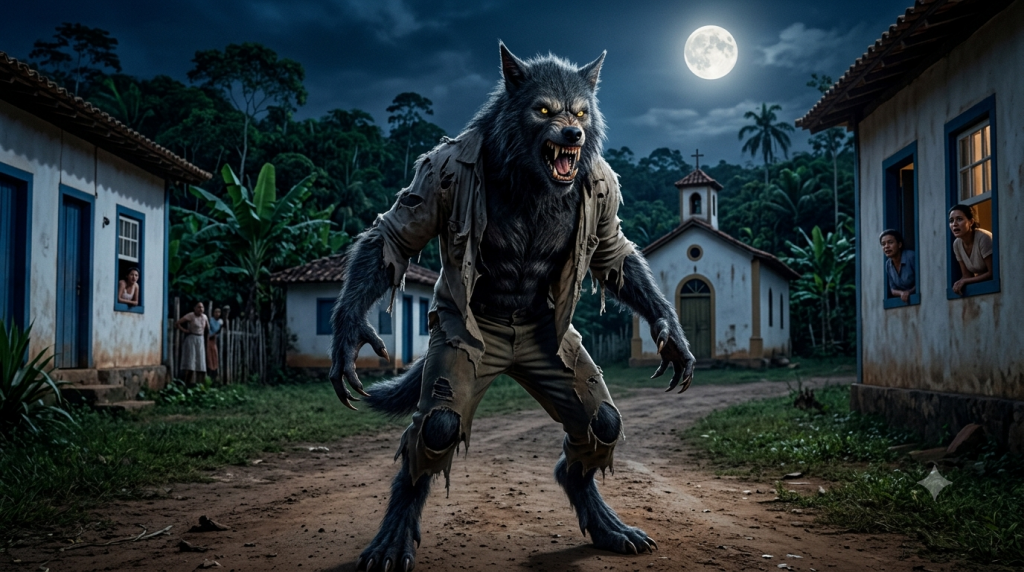
The Lobisomem is the werewolf of Brazilian folklore, brought to the Americas by Portuguese colonists and adapted over centuries to

The Nahual is one of the oldest shapeshifter traditions in the Americas, rooted in pre-Columbian Mesoamerican belief and still present

The Rougarou is the werewolf of Louisiana’s Cajun communities, descended directly from the French Loup-Garou that French colonists brought with

The Skinwalker is a figure from Navajo tradition and it requires a different kind of introduction from most of the

In the twelfth century, the Welsh clergyman Gerald of Wales recorded one of the most detailed and most unusual werewolf

Bisclavret is a lai, a short narrative poem, written by the Anglo-Norman poet Marie de France around 1170, and it

The Vukodlak is one of the most linguistically and conceptually interesting figures in European supernatural folklore because the same word,