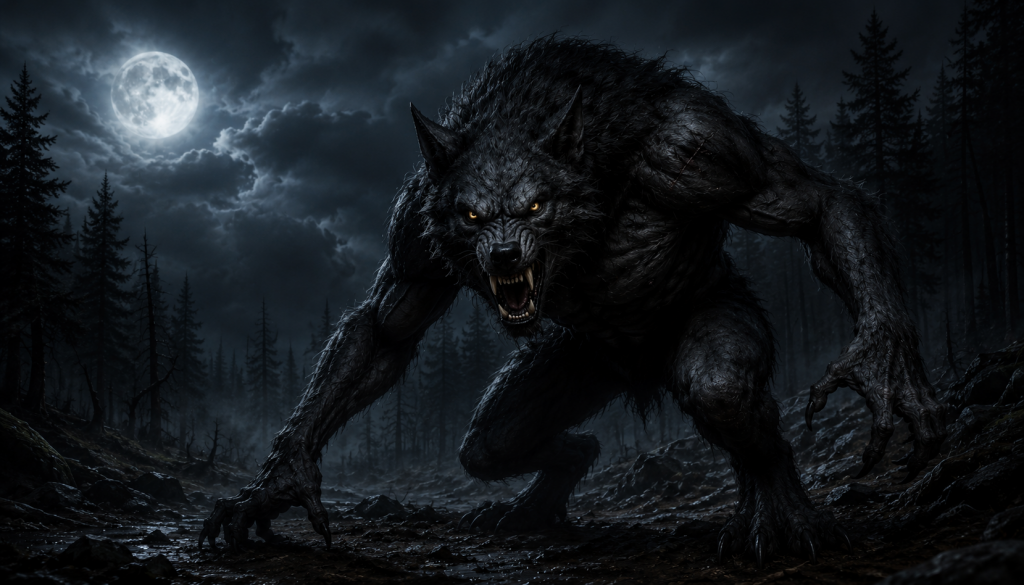
The Rougarou is the werewolf of Louisiana’s Cajun communities, descended directly from the French Loup-Garou that French colonists brought with them to the Americas in the seventeenth and eighteenth centuries, and adapted over generations to the specific landscape and culture of the Louisiana bayou. It haunts the swamps and sugarcane fields rather than the forests of provincial France, it enforces specifically Cajun and Catholic moral expectations rather than French ones, and it remains a genuinely living tradition in a way that most European werewolf beliefs no longer are.
Ask a child in Terrebonne Parish about the Rougarou and they will tell you it is real. Ask their grandparents and they will tell you the same thing, often with specific stories about specific encounters, specific locations, specific people who saw it or heard it or narrowly avoided it. The Rougarou is not a historical curiosity in Louisiana. It is a present-tense creature.
The Transformation
The causes of Rougarou transformation in the Louisiana tradition are consistent with the Loup-Garou tradition that produced it: breaking Lent for seven consecutive years is the most commonly cited trigger. Failing to observe the forty days of Lenten fasting transforms a person into the Rougarou, a wolf-headed creature with a human body that haunts the swamps at night hunting for humans, particularly for other Catholics who are failing in their religious duties.
This targeting of the religiously negligent is one of the most socially functional aspects of the tradition. The Rougarou enforces community standards of Catholic observance not through human social pressure but through supernatural threat. The person who considers skipping Lent is reminded that the Rougarou is out there looking specifically for people like them. The creature is, among other things, a mechanism of religious conformity.
The transformation can also be passed on. A Rougarou who draws human blood transfers its curse to the person it has attacked, and the original Rougarou is released from the curse and returns to human form. This transmission mechanism gives the tradition a specifically epidemic quality that connects it to the vampire traditions of Eastern Europe: one person’s transformation can propagate through the community.
The Swamp Landscape
The Louisiana bayou is one of the most atmospherically appropriate settings for any werewolf tradition. The cypress swamps, the hanging Spanish moss, the water that reflects the sky without revealing its depth, the sounds at night that carry across still water with unusual clarity and unusual distortion — this is a landscape that produces unease naturally and that gives the Rougarou a specific physical environment it inhabits as convincingly as the Loup-Garou inhabits the forests of provincial France.
The sugarcane fields that cover much of the southern Louisiana landscape have their own quality of threat: tall enough to conceal anything, extensive enough to get lost in, cut at harvest time to reveal whatever has been hiding there. The Rougarou moves through both landscapes and the accounts of encounters often use the specific geography of Louisiana to anchor the supernatural in the recognisably local.
The Rougarou Today
The Rougarou Festival is held annually in Houma, Louisiana, celebrating the creature with costumes, music, and community events that reflect how thoroughly the Rougarou has been absorbed into Louisiana’s cultural identity. The festival is both a genuine celebration of Cajun supernatural tradition and an acknowledgement that the Rougarou has become one of Louisiana’s most recognisable cultural exports alongside the food and the music.
The festival coexists with the genuine belief. The communities that celebrate the Rougarou in October are the same communities where grandparents tell their grandchildren in all seriousness not to stray near the swamp at night. The creature is simultaneously a folk tradition, a community identity marker, and a genuine supernatural belief, depending on who in Louisiana you are asking and in what context.
Further Reading
If this article sparked your interest, these are the books worth reading next.
The Beast of Gévaudan
by Jay M. Smith — the most thorough historical investigation into the creature that terrorised southern France between 1764 and 1767, and what the historical record actually reveals about what it was.
The Werewolf Book: The Encyclopedia of Shape-Shifting Beings
The most comprehensive reference on the werewolf tradition across world cultures — every regional variant, every historical case, every folkloric and literary expression of the shape-shifting being.
The Werewolf in Lore and Legend
by Montague Summers — the classic scholarly treatment of werewolf belief, drawing on primary sources from across Europe. Dense, serious, and still the best single academic treatment of the tradition.
For more on the werewolf tradition, the Loup-Garou article covers the French werewolf tradition that the Rougarou descended from. The Skinwalker article covers the Native American shapeshifter tradition that developed in the same North American landscape. The Dark Origins of the Werewolf article covers the broader history of werewolf belief.
Never miss a myth
Thank you for being here. The site is brand new and every subscriber genuinely means something to me. If you're here, you care about this stuff as much as I do - and that's all the reason I need to keep going. New stories, videos and dark folklore from around the world, straight to your inbox. No algorithm. Just the stories, when they're ready.