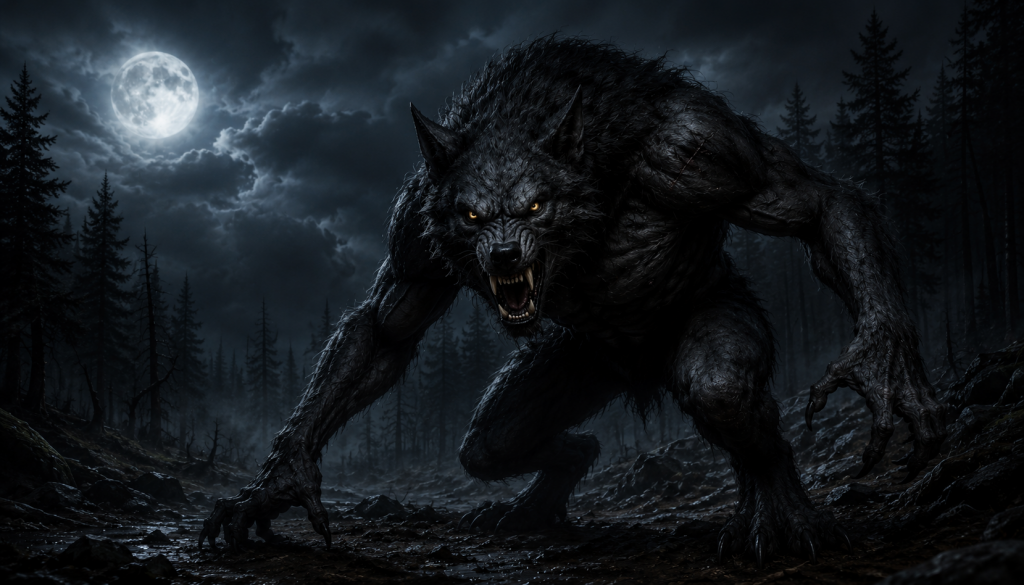
The Nahual is one of the oldest shapeshifter traditions in the Americas, rooted in pre-Columbian Mesoamerican belief and still present in Indigenous communities across Mexico and Central America today. It is not straightforwardly a werewolf tradition, though it overlaps with the werewolf concept in significant ways, and understanding what distinguishes it from the European tradition is as important as understanding what it shares.
In the broadest terms, a Nahual is a person who has a spiritual animal counterpart, an animal double whose fate is bound to theirs, and in some traditions the ability to transform into that animal or to send their consciousness into it. The animal associated with a person is determined at birth by the Mesoamerican calendar, and the relationship between a person and their Nahual animal is understood as a fundamental aspect of their identity and their spiritual condition.
In the narrower and more specifically witchcraft-related sense, a Nahual is a sorcerer who has developed the ability to fully transform into their animal form, and who uses this ability for malevolent purposes. This is the sense most commonly encountered in popular accounts and most relevant to the werewolf tradition comparison.
The Calendar and the Animal Double
The Mesoamerican calendar, used across the Aztec, Maya, and other cultures of the region, assigned specific animals to specific day signs, and a person born on a particular day was understood to share a spiritual connection with the animal of that day. This animal was their Nahual in the original sense: not a transformation but a counterpart, a spiritual parallel whose wellbeing and fate were linked to theirs.
A powerful ruler or warrior might have a powerful Nahual animal, a jaguar or an eagle. An ordinary person might have a more modest one. The connection was not chosen but assigned by the circumstances of birth, which gave the tradition a fatalistic quality: your Nahual was what it was, and its nature influenced your nature and your fate.
The sorcerer who fully transforms into their Nahual animal represents the extreme development of this tradition, the person whose connection to their animal double has become so complete that the boundary between them dissolves entirely. This transformation is understood as requiring specific knowledge and specific practices, and in the witchcraft-related sense of the tradition, those practices are understood as harmful and antisocial.
The Wolf Nahual
The wolf is not the primary Nahual animal in Mesoamerican tradition: the jaguar holds that position, as the most powerful predator in the region and the animal most associated with rulership, warfare, and the night. But wolves are present in the tradition, particularly in regions where wolf populations made them significant in local ecology, and the wolf Nahual shares the basic structure of the jaguar tradition: a person who transforms into a wolf and uses that transformation for malevolent purposes against the community.
The Mexican Lobisomem tradition, where European werewolf beliefs brought by Spanish and Portuguese colonists merged with existing Nahual traditions, produced hybrid figures that drew on both systems. The wolf as a shapeshifter form in modern Mexican folk belief carries both the pre-Columbian Nahual tradition and the post-Conquest European werewolf tradition in layers that are not always easy to separate.
The Nahual Today
The Nahual tradition remains active in Indigenous communities across Mexico and Guatemala, and the distinction between the benign animal-double sense and the malevolent sorcerer sense is maintained in contemporary belief. An ordinary person having a Nahual animal is not threatening. A sorcerer who has developed the ability to transform is dangerous and should be approached with caution.
Contemporary Mexican folk art frequently represents Nahual figures, the half-human half-animal forms that express the transformation, and the tradition has been absorbed into Mexican national identity in ways that reflect both its pre-Columbian depth and its post-Conquest adaptation. The Nahual is simultaneously ancient, syncretic, and alive.
Further Reading
If this article sparked your interest, these are the books worth reading next.
The Beast of Gévaudan
by Jay M. Smith — the most thorough historical investigation into the creature that terrorised southern France between 1764 and 1767, and what the historical record actually reveals about what it was.
The Werewolf Book: The Encyclopedia of Shape-Shifting Beings
The most comprehensive reference on the werewolf tradition across world cultures — every regional variant, every historical case, every folkloric and literary expression of the shape-shifting being.
The Werewolf in Lore and Legend
by Montague Summers — the classic scholarly treatment of werewolf belief, drawing on primary sources from across Europe. Dense, serious, and still the best single academic treatment of the tradition.
For more on the shapeshifter traditions of the world, the Skinwalker article covers the Navajo shapeshifter tradition from North America. The Lobisomem article covers the Brazilian werewolf tradition that shares roots with the Nahual through the Iberian colonial influence. The Dark Origins of the Werewolf article covers the broader history of werewolf belief.
Never miss a myth
Thank you for being here. The site is brand new and every subscriber genuinely means something to me. If you're here, you care about this stuff as much as I do - and that's all the reason I need to keep going. New stories, videos and dark folklore from around the world, straight to your inbox. No algorithm. Just the stories, when they're ready.