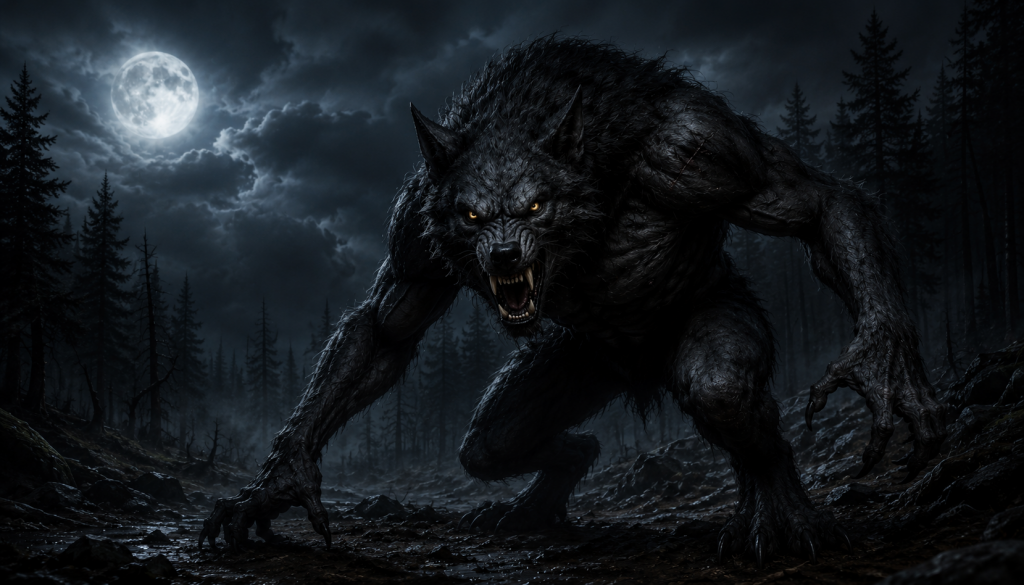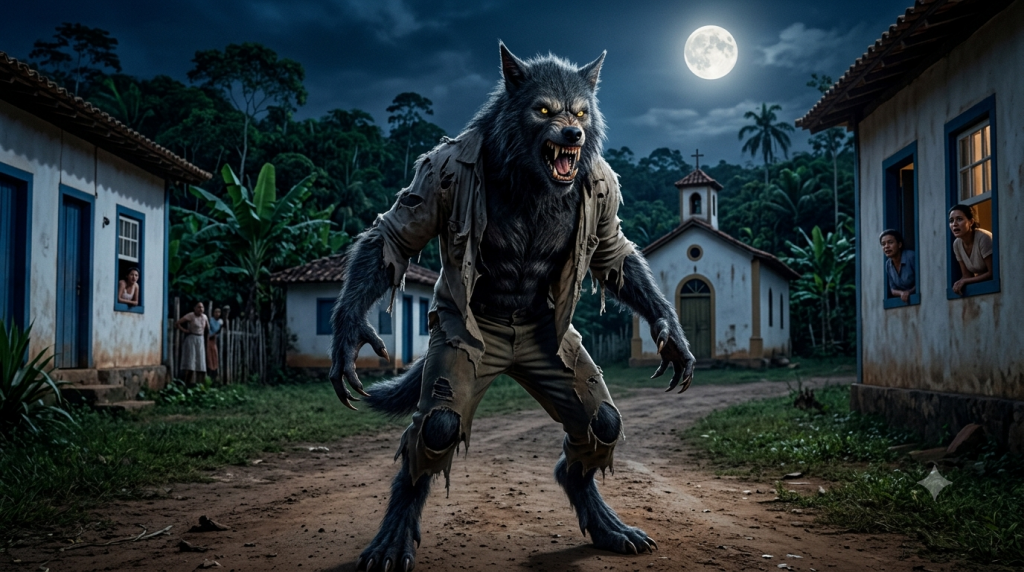
The Lobisomem is the werewolf of Brazilian folklore, brought to the Americas by Portuguese colonists and adapted over centuries to the Brazilian landscape and culture. The name derives directly from the Portuguese lobisomem, which combines lobo, wolf, with homem, man, and the creature it names sits at the intersection of Iberian werewolf tradition, African supernatural belief brought by enslaved people, and indigenous Brazilian folk belief, producing a figure specific to the Brazilian context while retaining clear connections to its European roots.
The most distinctive element of the Brazilian tradition is the seventh son rule: the seventh consecutive son born to a family, with no daughters breaking the sequence, is fated to become a Lobisomem. This is not a punishment for sin, not a diabolical pact, not a curse placed by a saint or a witch. It is simply the consequence of being the seventh son. The child has done nothing wrong. The transformation will come regardless.
The Seventh Son
The seventh son tradition in Brazil is old enough and serious enough that it influenced actual practice: families with six sons sometimes delayed or avoided having a seventh child, and the birth of a seventh son in some communities prompted specific protective rituals to be performed immediately. The child was understood to be at risk from birth, and the community’s response was protective rather than accusatory.
The transformation typically begins at puberty, the standard threshold for supernatural awakening across multiple traditions, and occurs on specific nights: Fridays and the nights of the full moon are the most commonly cited triggers. The Lobisomem transforms involuntarily and often with no memory of what he has done in wolf form. He is not a malevolent figure who chooses to harm others. He is a person subject to a condition he did not choose and cannot control.
This involuntary quality gives the Brazilian tradition a sympathy for its werewolf that is not present in all European traditions. The Lobisomem is a victim of his own birth order, and the community that fears him also pities him in a way that the community encountering Peter Stumpp or Gilles Garnier did not pity those men.
The Form and the Behaviour
The Lobisomem in Brazilian tradition is not always described as a wolf specifically. Brazil has no native wolf population, and the creature in many accounts is a hybrid figure: part dog, part wolf, part pig, depending on the regional tradition. In some accounts it is a small, dark, hunched figure moving on all fours, more dog-like than wolf-like. In others it approaches the classic wolf description. The adaptation to a landscape without wolves produced a werewolf that was not always precisely a wolf.
Its behaviour on transformation nights was understood as disruptive rather than systematically lethal. It overturned rubbish bins, disturbed animals, frightened people, and in some accounts fed on carrion or refuse rather than on living humans. The image is less of a terrifying predator and more of a distressed and disoriented man in animal form, moving through the community at night in a state of confusion and doing damage through his condition rather than through intent.
Breaking the Curse
The seventh son curse in Brazil could be broken through a specific mechanism: if someone drew the Lobisomem’s blood during a transformation, typically by pricking him with a pin or cutting him slightly, the curse was lifted immediately. The Lobisomem returned to human form and was free from the condition permanently.
Presidential tradition in Brazil connected to the seventh son belief: Brazilian presidents historically served as godfathers to seventh sons, a practice that both acknowledged the belief and provided a ritual protection for the child. The godfather relationship gave the seventh son a specific social connection to a powerful figure, which was understood to offer some protection against the worst consequences of his birth position. The practice was formalised under various Brazilian presidents and represents one of the most unusual examples of folk belief influencing state practice in modern history.
Further Reading
If this article sparked your interest, these are the books worth reading next.
The Beast of Gévaudan
by Jay M. Smith — the most thorough historical investigation into the creature that terrorised southern France between 1764 and 1767, and what the historical record actually reveals about what it was.
The Werewolf Book: The Encyclopedia of Shape-Shifting Beings
The most comprehensive reference on the werewolf tradition across world cultures — every regional variant, every historical case, every folkloric and literary expression of the shape-shifting being.
The Werewolf in Lore and Legend
by Montague Summers — the classic scholarly treatment of werewolf belief, drawing on primary sources from across Europe. Dense, serious, and still the best single academic treatment of the tradition.
For more on the werewolf tradition, the Loup-Garou article covers the French werewolf tradition that the Portuguese lobisomem ultimately descends from. The Nahual article covers the Mesoamerican shapeshifter tradition that developed in the same colonial Americas context. The Dark Origins of the Werewolf article covers the broader history of werewolf belief.
Never miss a myth
Thank you for being here. The site is brand new and every subscriber genuinely means something to me. If you're here, you care about this stuff as much as I do - and that's all the reason I need to keep going. New stories, videos and dark folklore from around the world, straight to your inbox. No algorithm. Just the stories, when they're ready.