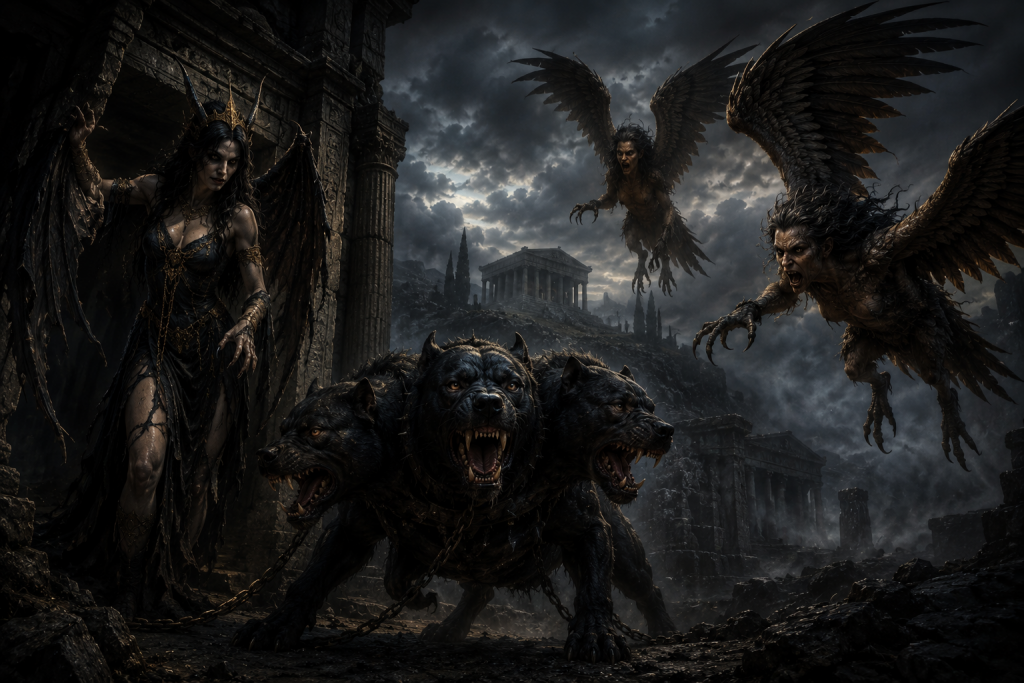
They came without warning. One moment the table was set, the food laid out, the air still. Then the beating of wings, a shriek like tearing metal, and everything was gone, snatched away or fouled beyond eating, the smell of rot hanging where a meal had been. The Harpies left nothing behind but the stench of their passing and the hollow despair of those they had visited.
In the mythology of ancient Greece, few creatures inspired quite the same quality of dread. Not the grand, confrontational terror of the Chimera or the Minotaur, but something more grinding, more personal. The Harpies did not fight you. They simply made life unbearable.
What Were the Harpies?
The Harpies were winged spirits of Greek mythology, most commonly described as women with the wings, talons, and sometimes the lower bodies of birds. Their name derives from the Greek harpazein, meaning to snatch or seize, and it is the most honest name any creature in mythology was ever given. Snatching was precisely what they did.
Early Greek sources treated them as relatively benign personifications of storm winds. Hesiod, in his Theogony, names two Harpies, Aello and Ocypete, and describes them as lovely-haired and swift as winds or birds. There is little menace in Hesiod’s description. They are swift, they fly, they carry things away, and that is more or less the extent of it.
This changes dramatically as the tradition develops. By the time the myth of Phineus takes hold, the Harpies have become something altogether more horrible. Beautiful is no longer among the words being used.
If you like Greek Mythology, check out more here!
The Faces of the Harpies
Ancient sources disagreed on how many Harpies there were, and what to call them. Hesiod names two. Later authors add a third. The names themselves are revealing of what the Greeks wanted these creatures to represent.
Aello means storm swift or squall. Ocypete means swift wing. Celaeno means the dark one. A fourth name that appears in some sources is Podarge, meaning fleet foot, who in the Iliad mates with the West Wind and gives birth to the immortal horses of Achilles. This softer tradition sits awkwardly beside the filth-spreading monsters of later myth, a reminder that the Harpies were not always one thing.
Celaeno in particular carries a darkness the other names lack. She appears in Virgil’s Aeneid as a prophetic and furious creature who curses Aeneas and his men after they slaughter the Harpies’ cattle on the Strophades islands. Virgil’s Harpies are genuinely frightening, their faces pale and human, their hands clawed, their bodies those of great birds, their smell poisonous. They are not minor nuisances in this telling. They are messengers of suffering.
Phineus: A King Tormented Without End
The most sustained and famous appearance of the Harpies in ancient mythology centres on Phineus, a king and prophet of Thrace whose story is one of the more quietly horrifying in the Greek canon.
Phineus had the gift of prophecy, given to him by Apollo. He used it too freely, revealing the plans of the gods to mortals who had no business knowing them. Zeus punished him in several ways depending on the source, blinding him, giving him an agonising choice between a short life with sight or a long one without, or simply condemning him to suffer. On one point the sources agree: Zeus sent the Harpies.
From that point on, every time food was set before Phineus, the Harpies descended. They snatched what they could carry. What they could not carry they fouled with their filth, contaminating it so thoroughly that even a starving man could not bring himself to eat it. They left just enough that Phineus did not die, which was precisely the point. He was not being killed. He was being kept alive inside a permanent degradation.
The Argonauts eventually arrived in Thrace during their quest for the Golden Fleece. Among their number were Calais and Zetes, the winged sons of the North Wind, and they chased the Harpies away from Phineus with such ferocity that the creatures fled to the Strophades islands, a small group in the Ionian Sea. In gratitude, Phineus told the Argonauts how to survive the Clashing Rocks that lay ahead of them.
The fate of the Harpies after their flight varies by source. In some, Iris the rainbow goddess intervenes, persuading Calais and Zetes to stop the pursuit on the condition that the Harpies never torment Phineus again. In others they simply escape, still out there somewhere, still hungry, still waiting.
Storm Winds and Something Older
The dual nature of the Harpies, benign wind spirits in one tradition, defiling monsters in another, points to something interesting about how Greek mythology evolved over time and how it absorbed older material.
Wind spirits that carry things away are ancient and cross-cultural. The idea of the dead being snatched by winds, or of storms as predatory forces with something like agency, appears in sources far older than classical Greece. Some scholars have suggested the Harpies derive from a pre-Greek tradition in which storm winds were understood as divine or semi-divine forces that could carry off not just objects but souls.
This sits behind the Odyssey‘s occasional references to the Harpies carrying off people who simply disappear without trace. When Telemachus speaks of not knowing what happened to his father, he uses the Harpies as a shorthand for vanishing into an unknown fate. They were not just thieves. They were the shape that absence took.
This older, less defined horror is in some ways more disturbing than the specific torment of Phineus. Monsters you can name and describe and eventually kill are one thing. The feeling that something unseen might simply take you, and leave no explanation behind, is another thing entirely.
If you want more like this, the Tales of Myth and Magic newsletter delivers new creatures, legends, and forgotten folklore straight to your inbox.
No fixed schedule. No noise. Just the stories, when they are ready.
Sign up here →The Harpies in Art
Depictions of the Harpies in ancient art reflect the same split in the written sources. Early representations show winged women, sometimes beautiful, in flight. They carry off human figures in some of these images, which have been interpreted as representations of death snatching souls, the Harpies serving a psychopomp-like function closer to that of the Valkyries in Norse tradition than to the filth-spreading creatures of the Argonaut myth.
The Harpy Tomb, a Lycian monument from around 480 BC now held in the British Museum, is one of the most important surviving examples. Its carved panels show winged female figures carrying small human forms, widely interpreted as souls of the dead being transported to the afterlife. These Harpies are serene, almost gentle. Whatever they are carrying, they carry with purpose.
Later Roman art moves further toward the monstrous. Virgil’s description in the Aeneid carries enough physical detail to have influenced depictions for centuries, and the combination of human face and bird body became the template that medieval and Renaissance artists inherited.
A Legacy Written Into Language
Like the Chimera, the Harpies left a permanent mark on the language we use. A harpy in English is a grasping, unpleasant woman, a use that dates back to at least the sixteenth century. It is not a flattering inheritance, collapsing a complex mythological tradition into a single, reductive insult, but it demonstrates how thoroughly these creatures embedded themselves in the Western imagination.
The word harpy eagle, given to one of the world’s largest and most powerful birds of prey, carries the name into the natural world. Found in the rainforests of Central and South America, the harpy eagle is a formidable predator, and the name was chosen deliberately. It swoops from above, it carries off prey far heavier than might seem possible, and it is almost supernaturally fast.
There is a kind of justice in that naming. Whatever the Harpies became in insult and caricature, in the rainforest canopy something genuinely powerful still carries the name forward.
The Thing With Wings
The Harpies occupy a strange and uncomfortable place in Greek mythology, never quite the centrepiece of a story in the way that the Medusa or the Cyclops is, always arriving to do damage and then retreating back into myth before they can be fully confronted. Even their defeat at the hands of Calais and Zetes is not a death. They escape. They persist.
That persistence feels true to what they represent. The snatching away of good things, the fouling of what remains, the reduction of a life to bare endurance, these are not problems that heroes can kill with a sword. They can be driven off. They can be escaped. But they circle out there still, in the storms above the Ionian Sea, waiting for the wind to change.
Further Reading
If this article sparked your interest, these are the books worth reading next.
The Iliad — Homer (Penguin Classics)
by Homer — the primary source for everything in this article, and still the most vivid account of the Trojan War ever written.
The Odyssey — Homer (Emily Wilson translation)
by Homer, translated by Emily Wilson — the best modern English translation, and the book that contains Odysseus’s own account of the horse.
The Trojan War: A Very Short Introduction
by Eric Cline — the clearest and most up to date account of what archaeology actually tells us about Troy and whether any of it happened.
Never miss a myth
Thank you for being here. The site is brand new and every subscriber genuinely means something to me. If you're here, you care about this stuff as much as I do - and that's all the reason I need to keep going. New stories, videos and dark folklore from around the world, straight to your inbox. No algorithm. Just the stories, when they're ready.