There is something uniquely unsettling about the Jiangshi. Not because it is the most powerful of the world’s undead traditions, nor because its origins are the most ancient, but because of the way it moves. It cannot walk. It cannot run. It hops, arms rigid and outstretched, eyes glazed, following the breath of the living with a horrifying single-mindedness that no locked door or darkened room can long defeat.
China’s vampire is not the seductive predator of European legend. It does not seduce, it does not speak, and it does not choose its victims with any particular intelligence. It simply comes. And if it finds you, it will drain the life from your body with the cold efficiency of something that was once human and has forgotten entirely what that meant.
What Is a Jiangshi?
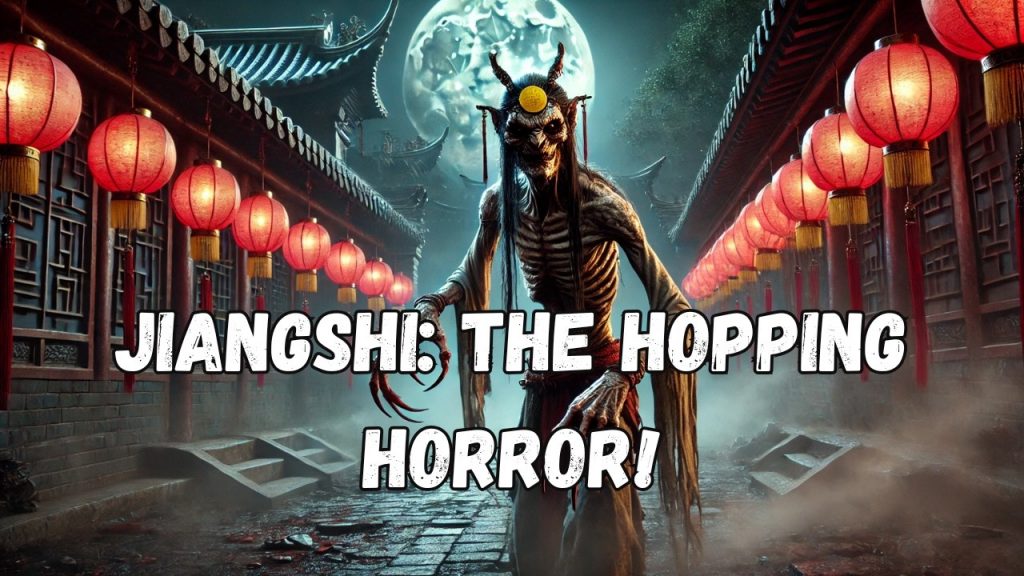
The Jiangshi is a creature from Chinese folklore, a reanimated corpse that feeds on the life energy, or qi, of the living. The name is written with the characters for “stiff” and “corpse,” which tells you most of what you need to know about its physical condition. A Jiangshi does not move with the fluid grace of a living body. Rigor mortis has locked its limbs, and so it travels in a series of rigid, forward hops, arms extended before it.
The creature typically appears wearing the official robes of the Qing dynasty, a detail that speaks to the era in which many of the most developed Jiangshi stories were recorded and codified, though the tradition itself is considerably older. Its skin is pale, sometimes greenish, and in many accounts it is covered in white fur or mould, the visible evidence of decomposition halted mid-process. Its eyes are often described as red, its fingernails long and black, its mouth frozen open.
It does not breathe in the way the living do, but it detects the living by their breath. This is one of the most consistent and unsettling elements of the folklore: if you hold your breath, the Jiangshi cannot find you. It is blind to everything except the exhalation of life itself.
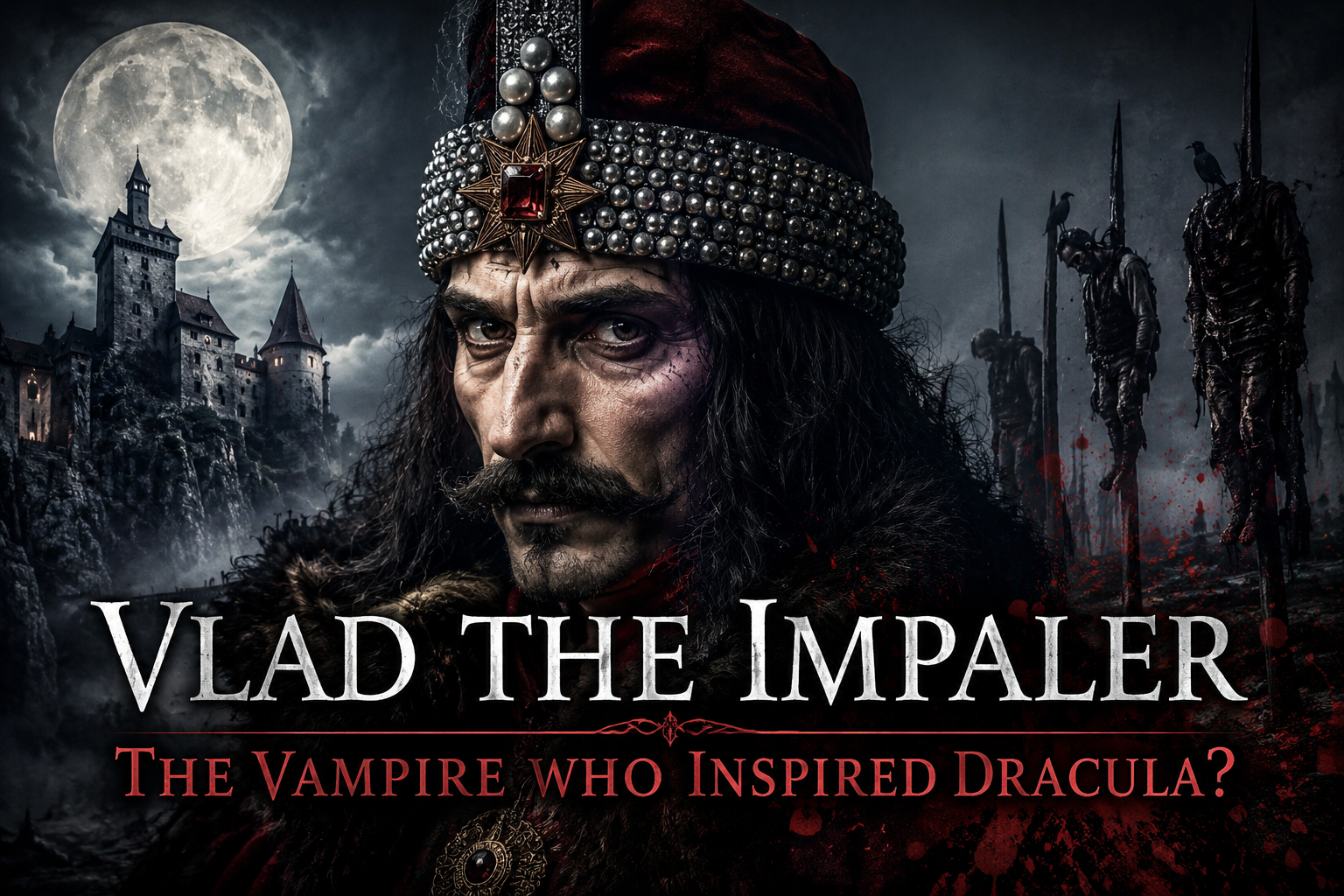
If you are interested in reading more about vampires, you can check out the main vampire page here. The video below covers Vlad the Impaler and many others, if you are interested!
How a Jiangshi Is Made
The creation of a Jiangshi reflects deep anxieties in Chinese folk belief about the treatment of the dead and the consequences of dying badly or being buried improperly.
A body might become a Jiangshi for a number of reasons. Improper burial rites were a primary cause, as were dying far from home, being struck by lightning, or taking one’s own life. A corpse that was jumped over by a cat before burial was considered particularly at risk, as was any body that had been exposed to moonlight for too long. In some regional traditions, a person who had practiced certain forms of dark magic in life might rise after death regardless of how carefully they were interred.
The common thread is disruption. The soul has not made a clean departure. Something has gone wrong in the transition between life and death, and the body, lacking the energy it needs to decay properly, instead turns predatory, seeking qi from the living as a grotesque substitute.
Some accounts describe a hierarchy of Jiangshi development. A freshly dead one might be pale and clumsy, barely able to move. One that has fed and persisted for longer might grow in strength and ability. The oldest and most powerful Jiangshi in some traditions can eventually fly, which rather removes the absurdity of the hopping and replaces it with something considerably more dangerous.
The Folklore Beneath the Monster
To understand the Jiangshi properly, it helps to understand the Chinese folk beliefs about death and the soul from which the legend grew.
Traditional Chinese belief held that a person possessed two types of soul: the hun, which was the higher spiritual soul that ascended after death, and the po, the earthly, physical soul that remained tied to the body. In ideal circumstances, proper funeral rites and ancestral veneration ensured that both souls made a clean and peaceful transition. The po would be absorbed back into the earth, the hun would move on.
When something interrupted this process, the po was believed to remain active in the corpse. Denied the natural process of dissolution, denied the proper rites that would ease its transition, it could animate the body with a corrupted, hungry energy. This was not understood as the dead person returning out of malice or choice. It was the body acting on a residual, animal impulse for energy that had gone dreadfully wrong.
This distinction matters. The Jiangshi is not, in its oldest conception, a vengeful spirit or a conscious predator. It is more like a biological process that has been grotesquely misdirected. The tragedy in many Jiangshi stories lies in the recognition that the creature wearing a loved one’s face is not, in any meaningful sense, that person anymore.
How to Survive an Encounter
Chinese folklore was reassuringly practical when it came to dealing with the Jiangshi. There were numerous methods of protection and deterrence, and the fact that so many of them were recorded in detail suggests that the fear was taken seriously enough to demand real answers.
Holding your breath, as already noted, was the most immediate defence. Since the Jiangshi tracked the living by detecting breath, stillness and silence bought time. This is the kind of detail that would have resonated deeply with people in the countryside, where the darkness was real and the dead were buried close by.
Rice was believed to be an effective deterrent. A Jiangshi supposedly could not cross a line of rice, and in some accounts would be compelled to count every grain before proceeding, a detail it shares with vampire traditions from Eastern Europe and elsewhere in Asia, where obsessive counting was used to distract the undead. A bag of glutinous rice pressed against the creature was said to absorb its malignant energy.
Mirrors were protective, as were iron filings, the sound of a rooster crowing, fire, running water, and peachwood. A Taoist priest armed with a special talisman, written on yellow paper and pressed to the Jiangshi’s forehead, could immobilise it entirely. In many stories it is the Taoist practitioner, rather than any warrior, who plays the role of monster hunter, deploying ritual knowledge where weapons would be useless.
The Taoist Priest and the Living Dead
The role of the Taoist in Jiangshi folklore is significant and consistent enough to deserve its own consideration. Unlike the vampire hunters of European tradition, who might employ a combination of religious faith, wooden stakes, and physical courage, the Chinese specialist who dealt with the Jiangshi was primarily a ritual expert.
The yellow talismans used to bind or destroy Jiangshi were a genuine feature of Taoist practice, and various forms of them were used in real funeral rites to protect the dead and the living alike. The Jiangshi stories can be read in part as a dramatisation of why these rites mattered, what happened when they were neglected or improperly performed. The monster was not simply a horror story. It was an argument for the importance of tradition.
This gave the folklore a social function beyond simple fear. Communities that took their burial obligations seriously, that observed the proper rites and showed appropriate respect to their dead, were communities that would not be troubled by Jiangshi. Neglect had consequences that visited themselves on the living in the most visceral way imaginable.
If you want more like this, the Tales of Myth and Magic newsletter delivers new creatures, legends, and forgotten folklore straight to your inbox.
No fixed schedule. No noise. Just the stories, when they are ready.
Sign up here →From Folklore to Popular Culture
The Jiangshi enjoyed an extraordinary surge of popularity in the 1980s through Hong Kong cinema, where a genre of films emerged that blended horror with martial arts and, unusually, comedy. These films drew heavily on traditional folklore while adding their own inventions, and they reached audiences across Asia and eventually worldwide.
The 1985 film Mr. Vampire is widely credited with establishing the template that many subsequent films would follow, including the hopping movement, the breath-detection mechanic, the yellow talisman, and the Taoist priest as hero. The genre was distinctive enough and popular enough that it ran for years, producing sequels, spin-offs, and imitators across multiple countries.
This cinematic tradition is responsible for the image of the Jiangshi that most people outside China would recognise today: the Qing dynasty robes, the outstretched arms, the rigid hop. Some of these details are genuinely ancient. Others are more recent invention, the product of filmmakers who understood that their audience needed a creature they could laugh at as well as fear.
The tonal complexity of the Hong Kong Jiangshi films, horror and comedy coexisting in the same scene, actually reflects something real about how folk monsters function in their communities of origin. They are frightening, yes, but they also provide a framework for confronting fear, for laughing at death, for asserting that the living have tools the dead cannot counter.
A Creature Born of Genuine Fear
Strip away the cinema and the comedy, go back to the village stories from which the Jiangshi emerged, and what you find is a creature born of genuine and understandable human anxieties.
Fear of the improperly dead. Fear that those we have lost might return in a form that no longer recognises us. Fear of the dark countryside and whatever might be moving through it. Fear that neglecting our obligations to the dead might have consequences we cannot undo. And beneath all of it, the particular horror of something that was once a person and is no longer, that wears a familiar face and comes toward you with its arms out and its eyes blank, following the simple warmth of your breath.
The Jiangshi hops because its body is rigid with death. It holds out its arms because it cannot lower them. It finds you because you cannot stop breathing forever.
That is the part that stays with you. Not the robes, not the talismans, not the counting of rice. Just the knowledge that you have to breathe, and that something out there in the dark knows it too.
Further Reading
If this article sparked your interest, these are the books worth reading next.
The Encyclopedia of Vampires, Werewolves and Other Monsters
by Rosemary Ellen Guiley — the most comprehensive reference on the vampire tradition across world cultures.
In Search of Dracula
by Raymond McNally and Radu Florescu — the book that connected Bram Stoker’s Dracula to the historical Vlad the Impaler.
Dracula (Penguin Classics)
by Bram Stoker — if you have not read the original, it is considerably better and considerably stranger than you expect.
Never miss a myth
Thank you for being here. The site is brand new and every subscriber genuinely means something to me. If you're here, you care about this stuff as much as I do - and that's all the reason I need to keep going. New stories, videos and dark folklore from around the world, straight to your inbox. No algorithm. Just the stories, when they're ready.