
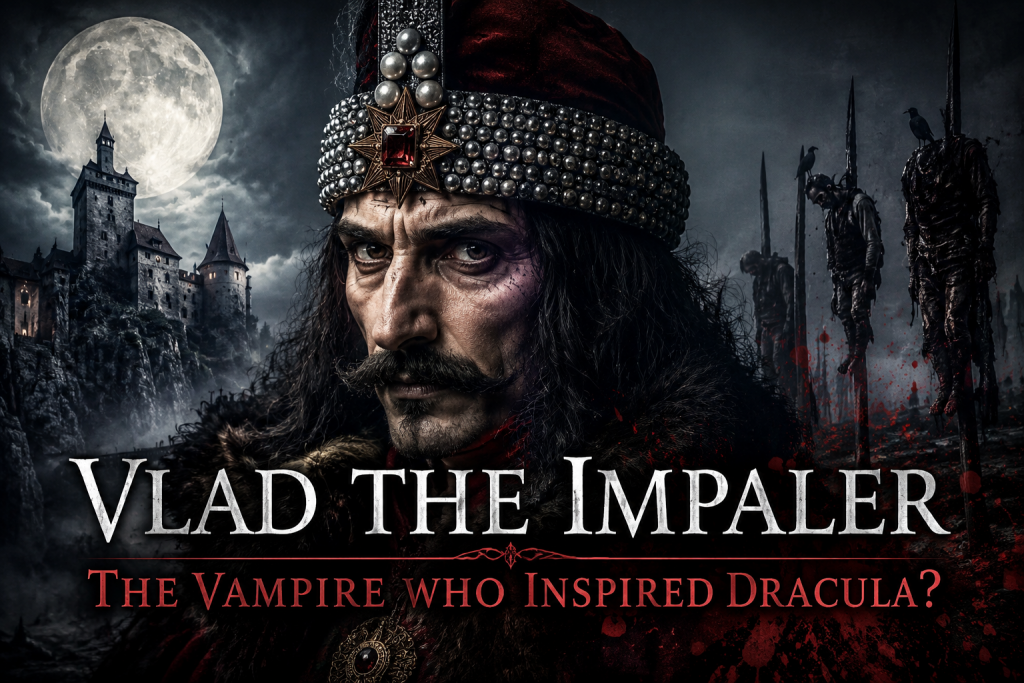
In the winter of 1461 to 1462, as Ottoman forces advanced into Wallachia, the army of Sultan Mehmed II encountered something outside the walls of Vlad’s capital that reportedly stopped them in their tracks. Twenty thousand impaled bodies, arranged in a field stretching across the approach to the city. Men, women, prisoners of war, domestic enemies, arranged on stakes at varying heights according to their rank in a grotesque protocol that Vlad appears to have considered carefully. An Ottoman chronicler who was present described it as a forest of the dead. Mehmed, who had taken Constantinople nine years earlier and was not a man easily disturbed, reportedly turned his army around.
Whether the numbers are accurate or not, something happened outside that city. The Ottoman chronicles mention it independently of the Saxon pamphlets that spread Vlad’s reputation across Europe with evident relish. The event is real. What you make of it depends entirely on who you ask and when they were alive.
That tension between monster and defender, between the figure Romanian tradition has sometimes celebrated as a protector of his people and the figure Saxon and Ottoman propaganda turned into a byword for sadistic cruelty, is at the heart of who Vlad actually was. And it is a more interesting story than the one the vampire connection tends to produce.
The World He Came From
Vlad III was born around 1431 in Sighisoara, in Transylvania, the second son of Vlad II. His father had recently been inducted into the Order of the Dragon, a chivalric order founded by the Holy Roman Emperor Sigismund to defend Christian Europe against Ottoman expansion. The order’s symbol gave Vlad’s father his name: Dracul, from the Latin draco, meaning dragon. The son became Dracula: son of Dracul, son of the Dragon.
The name also carried another meaning. In Romanian, dracul had come to mean devil as well as dragon, and the ambiguity was not lost on contemporaries. Vlad’s family operated at the intersection of those two meanings throughout their lives: defenders of Christendom against the Ottoman advance, and figures associated with darkness in the European imagination long before Bram Stoker was born.
Wallachia, the small principality Vlad would rule across three separate reigns, sat between Hungary to the north and the expanding Ottoman Empire to the south and east. It was not a comfortable position. Surviving as Prince of Wallachia in the mid-15th century required navigating between two major powers, neither of which had Wallachia’s interests as its primary concern, while managing a domestic nobility, the boyars, who were perfectly capable of switching allegiance at any moment and frequently did.
When Vlad was around eleven years old, he and his younger brother Radu were sent as hostages to the Ottoman court, a guarantee of their father’s loyalty. They stayed for several years. Radu adapted, eventually becoming close to the future sultan Mehmed II and converting to Islam. Vlad did not adapt, or at least did not appear to, and the experience appears to have left him with a deep and operational understanding of Ottoman military and court practice that he would later use against them, and a distrust of political reliability in any form that would shape how he ruled.
How He Ruled
Vlad’s second reign, from 1456 to 1462, is the one that produced the reputation. He came to power having watched his father and elder brother killed by Wallachian boyars, and he appears to have arrived at his throne with a settled view that the political structures around him were unreliable and that fear was a more dependable tool than loyalty.
His first Easter as prince, according to the Saxon pamphlets circulated after his fall, involved inviting the boyars who had murdered his father and brother to a feast and impaling them en masse. The story may be exaggerated. The underlying policy it describes was not: Vlad systematically eliminated the old nobility as a political force and centralised authority in ways that were unusual for the period and that required a level of violence to implement that contemporaries documented with a mixture of horror and, in some Romanian sources, a degree of grim approval.
He used impalement as his primary method of execution and intimidation. The method was not his invention: it had been used across the region and the period. What was distinctive was the scale and the deliberateness. Impalement on a stake was chosen over other methods partly because it was slow, partly because the displayed body served as a sustained warning, and partly, the accounts suggest, because Vlad understood the psychological value of spectacle in a way that went beyond simple cruelty.
The Saxon merchants of Transylvania, who had trade interests in Wallachia and frequently clashed with Vlad over those interests, produced the most detailed and most hostile accounts of his methods. They described him dining among the impaled, ordering people boiled alive, having the hats of visiting ambassadors nailed to their heads when they refused to remove them in his presence. These stories circulated in printed pamphlets across Central Europe, making Vlad one of the first figures in history to have his reputation shaped by mass media, a technology that was new enough in the 1460s and 1470s that nobody had yet developed the habits of critical reading that might have tempered the reception of those accounts.
Ottoman sources, which had no particular reason to be generous to Vlad, confirm the broad outline of his military campaign and the field of impaled bodies outside Targoviste. They do not confirm all of the Saxon pamphlet details, and the numbers involved in various atrocities have been disputed by modern historians. A 2023 study in the Transactions of the Royal Historical Society attempted to estimate the realistic scale of the 1462 impalement field and concluded that the figure was considerably lower than the numbers that circulated in contemporary accounts, though still substantial enough to have had the effect the sources describe.
Pope Pius II praised his resistance to the Ottomans. The Venetian Senate sent congratulations after his 1462 campaign. Within Romania, Vlad has sometimes been portrayed as a necessary if brutal ruler who defended a small and vulnerable principality against forces that would have absorbed it entirely. Outside Romania, the pamphlets won.
His Death and the Empty Grave
Vlad was killed in battle near Bucharest in late 1476, fighting Ottoman forces or pro-Ottoman rivals during his third and final attempt to hold the Wallachian throne. A Venetian report from shortly afterward describes his death. His head was reportedly sent to Constantinople as proof of his defeat, displayed on a stake outside the city in a method he himself had made infamous.
For centuries it was believed he had been buried at Snagov Monastery on an island north of Bucharest, a site he had patronised during his reign. When archaeologists excavated the supposed tomb in the 20th century, they found it empty. No remains, no burial goods, nothing. A second excavation found some human bones and a crown near the altar, but their identification with Vlad remains disputed. Where he is actually buried, if the remains survive at all, is one of the genuinely unresolved questions of his story.
The empty grave has not been lost on those who wish to make something supernatural of his legacy. It is the kind of detail that vampire stories thrive on, and it is perfectly real.
The Dracula Connection: What Actually Happened
Here is where most articles about Vlad the Impaler stop being honest, and it is worth being precise about what the evidence actually shows.
Bram Stoker published Dracula in 1897. The conventional account of the Dracula connection holds that Stoker discovered the historical Vlad while researching Eastern European history, was struck by the name and its associations, and built his vampire count around the historical figure. This version of the story is satisfying, widely repeated, and substantially wrong.
Stoker’s working notes for the novel survive and have been studied extensively. They contain no reference to Vlad the Impaler. The character who would become Count Dracula appears in early drafts under the name Count Wampyr. Professor Elizabeth Miller, one of the leading Stoker scholars, examined the working papers and concluded that Stoker apparently did not know much about Vlad the Impaler, certainly not enough for us to say that Vlad was the inspiration for Count Dracula.
What Stoker did find was the name. His primary source for historical background was William Wilkinson’s 1820 book Account of the Principalities of Wallachia and Moldavia, which mentioned a ruler called Dracula and noted that in the Wallachian language the word dracul signified devil. Stoker borrowed the name and, as Miller puts it, scraps of miscellaneous information about Wallachian history. His attention had been drawn to Romanian vampire folklore by Emily Gerard’s 1885 article about Transylvanian superstitions, and that folklore is the primary source for the supernatural mechanics of the novel. The plot, the character, the castle, the methods of destruction: these come from the Gothic literary tradition and from Slavic folklore, not from the historical Vlad.
The connection between Vlad and Dracula is therefore real but much thinner than popular culture suggests. Stoker took a name that sounded right, attached it to a vampire character he had developed from other sources, and produced a novel that then retroactively made the historical Vlad famous in ways the historical Vlad had never been outside Central and Eastern Europe. Most of what the world now associates with Vlad, the cape, the castle in Transylvania, the aristocratic predator, has nothing to do with the 15th century prince of Wallachia and everything to do with Stoker’s imagination and the films that followed it.
Vlad was not a vampire. He was a medieval ruler who used systematic violence as a political tool, who has been simultaneously celebrated and condemned by different traditions for five hundred years, and whose name happened to catch the attention of an Irish writer looking for something that sounded sufficiently sinister. The historical figure is stranger and more morally complicated than the fictional one, and he deserves to be considered on his own terms rather than as a prequel to someone else’s novel.
If you want more like this, the Tales of Myth and Magic newsletter delivers new creatures, legends, and forgotten folklore straight to your inbox.
No fixed schedule. No noise. Just the stories, when they are ready.
Sign up here →The Proteomic Evidence
In 2023, researchers at the University of Catania published a study in the journal Analytical Chemistry that used a technique called EVA technology to extract protein residues from three letters written and signed by Vlad the Impaler in the 1470s. The proteins were analysed by mass spectrometry, revealing traces of biological material from the letters’ surfaces that had survived for five and a half centuries.
The findings were unusual. Protein signatures consistent with inflammation of the respiratory tract and possibly the skin were identified, suggesting Vlad may have suffered from a haemolacria condition, a rare disorder that can cause tears containing blood. The researchers were careful to note the limitations of the analysis and the speculative nature of any conclusions about Vlad’s health from such evidence. But the detail has an obvious resonance: the possibility that the man whose name became synonymous with vampirism may have literally wept blood is the kind of thing that makes you reconsider the relationship between history and the legends it generates.
The study did not prove he was a monster. It did not prove he was a vampire. It produced a protein map of biological material on some very old letters, and what that map might mean is still being debated. But it is a reminder that the figure history called Dracula continues to generate new evidence, new questions, and new reasons to look more carefully at the gap between what he actually was and what the world decided to make of him.
For more on the vampire tradition he became entangled with, the Upyr covers the Slavic vampire tradition that preceded Stoker by a thousand years. The Abhartach covers Ireland’s own ancient vampire and the similarly contested question of his connection to Dracula. The Strigoi covers the Romanian vampire tradition that came from the same part of the world as Vlad himself.
Never miss a myth
Thank you for being here. The site is brand new and every subscriber genuinely means something to me. If you're here, you care about this stuff as much as I do - and that's all the reason I need to keep going. New stories, videos and dark folklore from around the world, straight to your inbox. No algorithm. Just the stories, when they're ready.
Pingback: The Empusa: The Shape-Shifting Vampire Demon of Ancient Greece - Tales of Myth and Magic
Pingback: The Upyr: The Forgotten Slavic Vampire That Came Centuries Before Dracula - Tales of Myth and Magic