Ben Macdui is the second highest mountain in Britain. At 1,309 metres it sits at the heart of the Cairngorm plateau, that vast and ancient high ground in the eastern Highlands that feels, on any serious winter day, categorically unlike anywhere else in the British Isles. The Cairngorms are not simply high. They are old in a way that registers in the body rather than the intellect, a landscape of such geological antiquity and such physical severity that the ordinary human sense of scale and orientation becomes unreliable up there in a way it does not at lower altitudes.
People have been going to Ben Macdui for generations. Serious mountaineers, experienced hill walkers, scientists, surveyors, men and women with good equipment and clear heads and no particular investment in the supernatural. And a significant number of them, across more than a century of documented accounts, have come back reporting the same thing.
Something was up there with them. Something large. Something that followed.
The First Account: Professor Norman Collie
The story of Am Fear Liath Mòr, the Big Grey Man of Ben Macdui, entered the written record in 1925 when Professor Norman Collie made a public statement that he had kept to himself for nearly thirty years.
Collie was not a man given to dramatic claims. He was a Fellow of the Royal Society, a distinguished chemist, and one of the most respected mountaineers of his generation, with serious ascents in the Alps, the Himalayas, and across Scotland to his name. He was, by any measure, a credible witness and a careful thinker.
In 1925, addressing the Cairngorm Club’s annual dinner, he described what had happened to him on Ben Macdui in 1891. He had been descending alone from the summit in mist when he became aware of something following him. Not a sound he could identify as wind or rock fall or any other natural cause, but footsteps, large and regular, one step for every three or four of his own, coming from somewhere behind him in the mist.
He stopped. The footsteps stopped. He went on. The footsteps went on.
Collie was, by his own account, suddenly and overwhelmingly seized by terror. Not unease, not concern, not the ordinary wariness of a man alone on a high mountain in poor visibility. Terror. He ran. He ran for several miles, he said, until he was well off the mountain and could convince himself that whatever had been behind him was no longer there.
He had told nobody for thirty years because he did not know how to account for what had happened, and a man of his standing had reasons to be careful about what he said in public. But he had gone back to the Cairngorms many times since and he had, he said, an uneasiness about Ben Macdui that he could not shake.
He was not alone.
The Pattern of Encounters
What followed Collie’s 1925 statement was a gradual accumulation of accounts from other people who had experienced something similar on Ben Macdui and the surrounding Cairngorm plateau, and who had either kept quiet for the same reasons as Collie or had spoken about it locally without the story reaching a wider audience.
The accounts share enough characteristics to constitute what researchers would now call a pattern. The experience tends to occur in conditions of poor visibility, mist or whiteout or the flat grey light of an overcast Cairngorm day that makes distance and scale difficult to judge. The experiencer is typically alone, though there are accounts involving small groups in which not everyone present felt the same thing. The initial awareness is usually sound, footsteps or a crunching in the snow that does not correspond to the experiencer’s own movement, followed by an escalating sense of presence, of being observed or followed by something large.
The emotional response is the most consistent element across accounts. It is not described as unease or apprehension, the ordinary discomfort of a person alone in a high and remote place. It is described as overwhelming, irrational, physically compelling terror, the kind of fear that bypasses conscious decision-making and produces immediate flight response regardless of the experiencer’s training, experience, or prior scepticism. Experienced mountaineers, people who have faced objective danger on serious routes in serious conditions and managed their fear effectively, describe this as qualitatively different from any fear they have previously known.
Several of them ran. Serious climbers who knew better, who knew that running on the Cairngorm plateau in poor visibility is itself dangerous, ran anyway because whatever they were feeling did not leave them the option of choosing not to.
The Witnesses and Their Credentials
The reason the Big Grey Man of Ben Macdui is taken more seriously than most supernatural mountain encounters, and the reason it has attracted sustained attention from researchers interested in genuine unexplained phenomena, is the quality of the witnesses involved.
The climber and writer Seton Gordon reported the experience. Wendy Wood, a Scottish nationalist activist and experienced hill walker, described an encounter on the plateau so frightening that she descended at speed and did not return. Dr. A.M. Kellas, a physiologist and high-altitude researcher who died on the 1921 Everest reconnaissance expedition and was therefore one of the most experienced high-altitude mountaineers of his generation, reported the experience to colleagues. The naturalist G.D. Shepherd described a long sequence of footsteps following him across the plateau.
The climber Peter Densham, who worked as a mountain rescue coordinator and therefore had more experience of the Cairngorms in all conditions than almost anyone of his generation, described his encounter in detail. He had been alone on the summit in mist when the fear came, sudden and overwhelming and without apparent cause. He found himself at the edge of the Lurcher’s Crag, a precipitous drop, with no clear memory of having moved toward it, as though something had been directing him without his awareness.
Densham was a man who spent his working life managing fear on mountains. His account of being unable to manage this specific fear, of finding himself at the edge of a cliff with his rational mind only partially engaged, is one of the more disturbing in the record.
What People Have Seen
Most accounts of Am Fear Liath Mòr involve sound and feeling rather than visual encounter. The footsteps, the sense of presence, the terror, but not necessarily a figure.
Some accounts, however, describe seeing something, and these visual reports show enough consistency to be worth examining carefully.
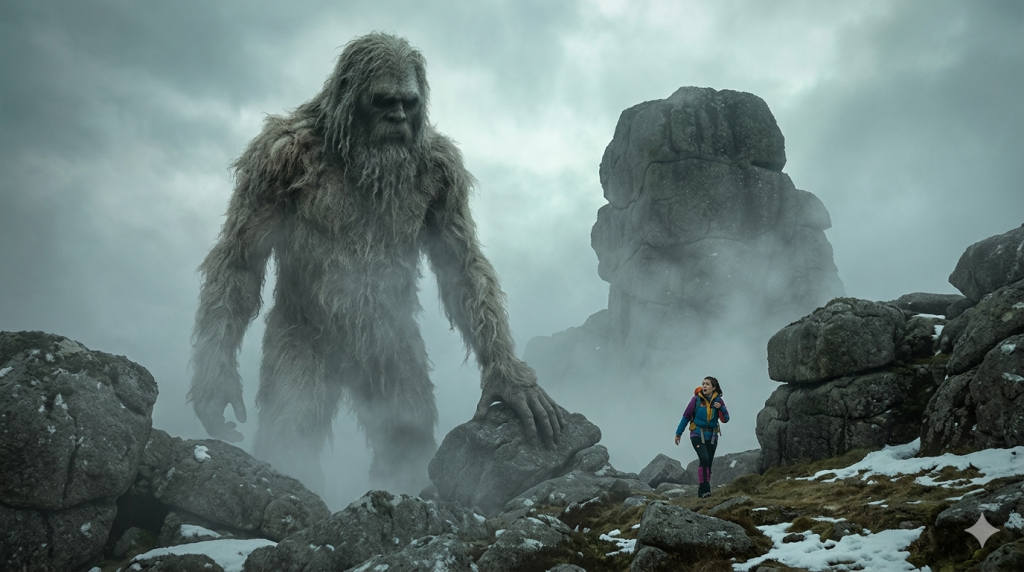
The figure, where it has been seen, is described as large, considerably taller than a human being, with a proportionally large outline visible in the mist or at the edge of visibility on the plateau. It is grey or dark in colour, which gives the tradition its name. It moves upright. It does not move like an animal. It is seen at a distance, never close, and in conditions that make precise observation difficult, which is the honest caveat that all accounts with visual elements include.
The Brocken Spectre, a well-documented atmospheric phenomenon in which a person’s own shadow is projected onto cloud or mist and appears as a vast magnified figure, has been advanced as an explanation for the visual element of Am Fear Liath Mòr accounts. The Cairngorms are a location where the conditions for Brocken Spectres occur with some regularity, and the experience of seeing your own shadow projected onto mist as a massive grey figure is genuinely startling if you are not expecting it.
The Brocken Spectre explanation accounts for the visual element of some accounts. It does not account for the footsteps when the experiencer is standing still. It does not account for the accounts in which the figure is seen moving independently of the experiencer’s own movement. It does not account for the terror, which is reported as occurring before any visual encounter and in conditions where no Brocken Spectre would be possible. And it does not account for the accounts that predate the widespread understanding of the phenomenon among the general public.
It is an explanation that covers part of the evidence. The rest remains open.
Infrasound and the High Plateau
A more recent explanation for some elements of the Ben Macdui experience involves infrasound, low-frequency sound below the threshold of human hearing that can be generated by wind moving across the specific topography of high plateaux and through certain types of rock formation.
Infrasound at certain frequencies has been shown in laboratory conditions to produce a range of physiological and psychological effects including unease, disorientation, a sense of presence, and in some cases visual disturbances. The Cairngorm plateau, with its specific geography and its exposure to the wind patterns of the eastern Highlands, is a plausible environment for infrasound generation, and some researchers have suggested that this might account for the quality of the experience, the overwhelming irrational fear, the sense of something large and present, the feeling of being followed.
Infrasound does not produce footsteps. It does not produce a figure visible in the mist. As with the Brocken Spectre explanation, it accounts for part of the evidence in some accounts and leaves the rest unexplained.
The honest position, the one that the evidence supports, is that the Ben Macdui experience is probably not a single phenomenon with a single cause. The footsteps might be one thing, the visual encounters another, the terror a third, and the specific combination of high altitude, poor visibility, solitude, and the particular quality of the Cairngorm environment creating conditions in which multiple factors combine into something that has no simple explanation.
That is the honest position. It is also, it should be said, not a fully satisfying one.
Am Fear Liath Mòr in the Tradition
The Gaelic name Am Fear Liath Mòr, the Big Grey Man, suggests a figure that was part of the folk tradition of the Cairngorm area before the climbing accounts began to accumulate in the twentieth century, though the pre-twentieth century tradition is less well documented than the modern encounter reports.
The Cairngorm plateau has a place in Scottish Highland tradition as a landscape of power and danger that goes beyond the ordinary risks of high mountain terrain. The area around Loch Avon and the high corries was understood in local tradition as a place where the ordinary rules of the human world applied less reliably, where the boundary between the human and the supernatural was thinner than elsewhere, where things happened that did not happen in the glens below.
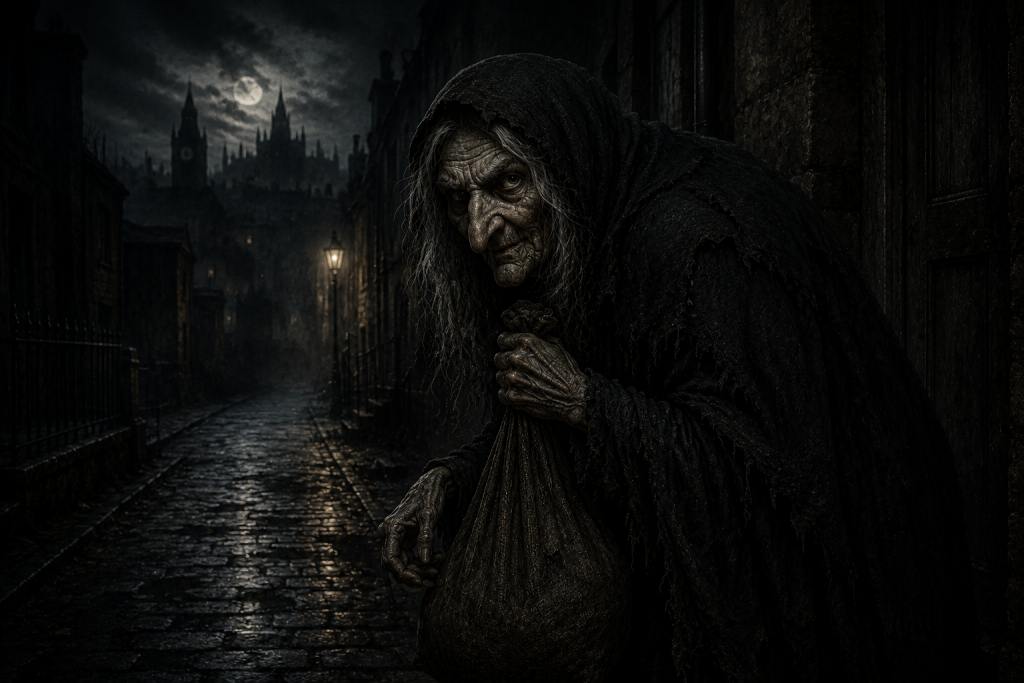
This is not unusual for high, remote, and genuinely dangerous landscapes in the Scottish tradition. The Cailleach Bheur claims the high tops as her domain. The Sluagh moves through the air above the upland country. The high ground in Scottish mythology is never simply terrain. It is territory with its own inhabitants and its own rules.
Am Fear Liath Mòr fits within this tradition as the specific presence of the Cairngorm high plateau, the figure that embodies the particular quality of that landscape, its scale, its severity, its indifference to human presence. He is what the plateau feels like when you are alone up there and the mist comes down and the wind drops and the silence becomes the kind of silence that seems to be listening.
If you want more like this, the Tales of Myth and Magic newsletter delivers new creatures, legends, and forgotten folklore straight to your inbox.
No fixed schedule. No noise. Just the stories, when they are ready.
Sign up here →What Continues
Ben Macdui is still there. People still go up it, in summer and winter, alone and in groups, and the accounts of unusual experiences on the plateau have not stopped accumulating.
The Big Grey Man has appeared in books, in academic papers on anomalous experience, in documentaries, in the work of writers and artists drawn to the Cairngorms and their specific quality of wildness. He has become, for many people interested in unexplained phenomena, the most credible of all the British supernatural encounter traditions precisely because of the quality of the witnesses and the consistency of the accounts across more than a century.
He has not been explained. Not fully. Not in a way that accounts for all of the evidence from all of the accounts without remainder.
Professor Collie kept his silence for thirty years because he did not know what to say about what had happened to him on the mountain. He was a scientist and a rationalist and he had experienced something that did not fit his framework for the world, and the experience had frightened him so completely that he had run for several miles across a high mountain in mist rather than find out what was behind him.
He went back to the Cairngorms many times after 1891. He never entirely lost the uneasiness about Ben Macdui.
The mountain does not offer explanations. It offers the plateau, and the mist, and the silence, and whatever moves through the silence when you are up there alone and the visibility closes in and you become aware that something behind you is taking one step for every three or four of yours.
You could stop and turn around.
Most people do not.
Further Reading
If this article sparked your interest, these are the books worth reading next.
Scottish Urban Legends: 50 Myths and True Stories
by Aaron Mullins — fifty Scottish urban legends including stories from Glasgow, Edinburgh, and the Highlands. The kind of tradition that Maggie Murphy belongs to, collected properly in one volume.
Scottish Urban Myths and Ancient Legends
by Grace Banks and Sheena Blackhall — vampires, werewolves, devil encounters, and the school playground legends of Scotland. A genuinely good collection of the stories Scots have been telling each other for generations.
The Lore of Scotland: A Guide to Scottish Legends
by Jennifer Westwood and Sophia Kingshill — the most comprehensive collection of Scottish legend in print, covering Glasgow to Shetland, exploring origins and historical basis. Endorsed by Terry Pratchett as the real macabre.
Never miss a myth
Thank you for being here. The site is brand new and every subscriber genuinely means something to me. If you're here, you care about this stuff as much as I do - and that's all the reason I need to keep going. New stories, videos and dark folklore from around the world, straight to your inbox. No algorithm. Just the stories, when they're ready.