
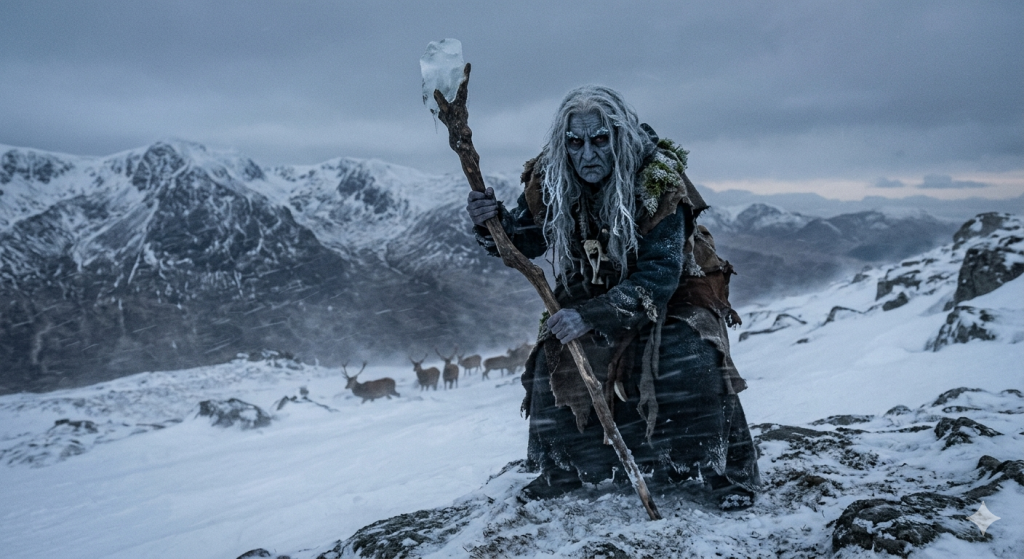
She was old before the mountains were young. That is not a poetic exaggeration. In the mythology of the Scottish Highlands and Islands, the Cailleach Bheur is a being of such immense antiquity that the landscape itself is her biography, the hills and lochs and rivers of Scotland the accumulated record of what she has done across an span of time that makes human history look like an afternoon. She did not arrive in a landscape that already existed. She made it. She carried the stones in her creel and dropped them where the mountains now stand. She struck the ground with her hammer and the glens opened. She waded through the land and her footprints became the lochs.
The Cailleach is not a monster in the way that many of the creatures in Scottish folklore are monsters. She is not something to be defeated or escaped or protected against with iron and rowan. She is something considerably more fundamental than that. She is a force of nature wearing a face, and the face she wears is the face of a very old woman, blue-grey with cold, one-eyed in some accounts, her hair white as the snow she brings with her when the year turns dark.
She is winter itself, and she has been winter for longer than anyone alive can remember.
The Name and What It Carries
The name Cailleach Bheur is most commonly translated as the Sharp Old Woman or the Cold Old Woman, the word bheur carrying connotations of sharpness, bitterness, and cold that work both literally and metaphorically. She is sharp in the way that a winter wind off the high tops is sharp, cutting through whatever you have put between yourself and it with an efficiency that does not feel impersonal even though it is.
The word cailleach itself simply means old woman in Scottish Gaelic, the same root that gives us the everyday term for an elderly woman, but in the mythological context it carries a weight that the ordinary word does not. This is the Old Woman, the original and defining one, the figure against whom all other old women are measured and found, inevitably, less ancient.
She appears under related names across the Gaelic world. In Ireland she is the Cailleach Bhéara, associated with the Beara Peninsula in County Cork, and the poems attributed to her voice, speaking across centuries of loss and endurance, are among the oldest surviving pieces of Irish literature. In Scotland her tradition is more geographically distributed, attached to specific mountains and glens and bodies of water across the length of the country, each localised tradition contributing to a figure of extraordinary complexity and range.
She is sometimes called Beira, particularly in the literary treatments of Scottish mythology produced in the early twentieth century, though this name is not traditional and is generally considered a later invention. The Cailleach Bheur, or simply the Cailleach, is how she has always been known in the communities that told stories about her.
The Landscape She Made
The tradition of the Cailleach as landscape-maker is one of the most consistent and geographically widespread elements of her mythology, and it is attached to specific, nameable features of the Scottish landscape with a precision that speaks to how seriously these stories were told.
Ben Nevis, the highest mountain in Britain, is her home in some traditions. She is said to wash her great plaid in the Corryvreckan whirlpool between Jura and Scarba, one of the most powerful tidal whirlpools in the world, and when she does the roaring of the water can be heard for miles. The whirlpool itself, in this telling, is the consequence of her laundry. The plaid, when she spreads it out to dry across the hills, becomes the snow that covers the high ground.
Loch Awe in Argyll was created when the Cailleach forgot to cover a sacred well at nightfall. The water rose and spread across the valley overnight, and in the morning the loch was there where no loch had been before. The carelessness is characteristic. The Cailleach is immensely powerful but not always careful with that power, and the landscape pays the consequences in the form of features that simply have to be accommodated because there is no undoing what she has done.
Various mountain lochs in the Highlands are said to have been formed when she dropped stones from her creel while crossing the high ground. The stones fell and the earth shaped itself around them and the water gathered. The Cairngorm plateau, that high, ancient, genuinely inhospitable stretch of ground that feels older than anything around it, carries her presence in the folk tradition of the region as strongly as any landscape in Scotland.
The Paps of Jura, the distinctive rounded hills visible from a considerable distance across the water, have a Cailleach association in local tradition. So do many of the prominent peaks of the Western Highlands, hills whose shapes are explained in local legend by the specific acts, careless or deliberate, of the great old woman moving through the landscape on business that had nothing to do with human convenience.
The Battle of the Seasons
The most dramatically compelling element of the Cailleach tradition, and the one that most directly explains the experience of living in the Scottish climate, is the seasonal battle between the Cailleach and Bride, the goddess of spring.
The Cailleach rules the dark half of the year. From Samhain at the end of October to Beltane at the beginning of May, the world is hers, and she exercises her dominion through cold and storm and the particular quality of Highland winter that strips everything back to its essentials. She rides the storm clouds. She strikes the ground with her hammer to drive the frost deeper into the earth. She is at the height of her power when the nights are longest and the mountains are white and the rivers freeze at the edges.
But she cannot hold it. Every year, as the light begins to return, the young goddess Bride gains strength, and the contest between them becomes the weather that everyone in the northern world experiences through February and March, those weeks when winter seems to be ending and then reasserts itself with sudden violence, when a mild day is followed by a blizzard, when the snowdrops come up and are immediately buried. That is the Cailleach fighting to hold what she has, striking at the returning light with everything she has, unwilling to concede the year to the warmth that she knows is coming regardless.
On the first of February, Imbolc in the old calendar, the Cailleach is said to gather her firewood for the rest of winter. If the day is bright and clear, the tradition says, she is gathering a great store of wood because she intends a long, hard winter ahead. If the day is grey and stormy, she has slept in and missed her chance, and the winter will be short. This is the direct ancestor of Groundhog Day in the American tradition, imported to North America by Scottish and Irish immigrants and attached to a groundhog rather than a divine hag, which is a significant downgrade in terms of mythological weight.
Eventually, always, Bride wins. The Cailleach throws her hammer under a holly tree and retreats to her mountain, and the world softens and greens and the long days return. But she does not die. She never dies. She simply waits, growing younger through the summer, until the year turns dark again and she rides out on the first winter storm with her hammer in her hand and the cold coming with her.
Her Age and the Creatures She Outlived
The Cailleach’s antiquity is emphasised in the tradition through a specific literary device: the enumeration of the things she has outlived. In Scottish and Irish Gaelic poetry and storytelling, the extreme age of a being is demonstrated by listing the lifespans of long-lived creatures, each one outlasted by the figure in question.
The eagle is old. The eagle outlives the oak, and the oak outlives the salmon, and the salmon outlives the deer. The Cailleach outlives all of them, has watched generations of each come and go, and is still here when they are gone. This is not metaphor. In the tradition it is biography, and the creatures she has outlived are named because they were real to the communities telling the stories, beings of genuine longevity in the natural world pressed into service as measures of time.
She is sometimes said to have renewed herself multiple times, growing young again at the end of her great lifespan and then ageing through it again, a cycle that has repeated enough times that she has accumulated the memories of an incomprehensible span of years. What she has seen and what she knows and what she has watched rise and fall in the landscape she made is beyond any human accounting.
This is part of what makes her genuinely mythological in a way that many folklore figures are not. She is not a local spirit or a regional bogle. She is a cosmological figure, a being whose existence frames the existence of everything else in the landscape, whose story is the story of the land itself.
The Cailleach’s Staff and the Deer
Two specific attributes of the Cailleach appear in enough regional traditions to be worth noting as consistent features of her mythology.
The first is her staff or hammer, the weapon she strikes the ground with to drive in the frost. It is made of holly in some accounts, which is significant because holly is one of the few plants that stays green through the Scottish winter, and its association with cold endurance made it a natural material for the winter goddess’s primary tool. The staff is also her weapon in the more straightforward sense: she uses it to drive back the spring, to strike down the green growth before it can establish itself, to keep the high ground frozen when the valleys are beginning to thaw.
The second is her relationship with deer. The Cailleach is often described as a herdswoman of deer, particularly the great red deer of the Scottish Highlands, tending the wild herds as a domestic woman might tend cattle. She milks the hinds in some accounts, and the dew that collects on the high ground in the early morning is the milk of the Cailleach’s deer, fallen from the hills onto the lower ground where humans find it.
This association with deer connects her to a very ancient tradition of a supernatural woman who presides over the wild animals of the forest and the mountain, a figure known in various forms across the northern world. The Cailleach’s deer herdsmanship places her in this tradition and gives her a nurturing, pastoral dimension that sits interestingly alongside her more destructive seasonal role. She is not simply the force that kills the summer. She is also the keeper of the living things that survive the winter she brings, the guardian of the creatures that endure through the cold she creates.
One Eye and the Sight That Comes With It
The Cailleach is described in many accounts as one-eyed, her single eye positioned in the centre of her blue-grey forehead and possessed of a supernatural acuity that compensates for what she lacks in binocular vision. The one eye sees further and more clearly than two ordinary eyes, which is a consistent feature of the mythological one-eyed figure across multiple traditions.
The association of single-eyedness with supernatural vision and wisdom is ancient and widespread. Odin sacrificed one eye for wisdom at the well of Mimir. The cyclops, for all its savagery, possessed a kind of primal focus that its single eye embodied. The Cailleach’s one eye is the eye that sees through storms, that watches the landscape she made across the full extent of the dark half of the year, that misses nothing in the white world she creates each winter.
It is also, less grandly, the eye of old age. The loss of an eye, or of sight in one eye, was a common consequence of long life in a world before corrective medicine, and the Cailleach’s one eye is in part simply what you might expect of a being who has been alive long enough to have lost something along the way. Her blue-grey skin is the skin of extreme cold and extreme age together. Her white hair is the hair of someone who has lived through more winters than can be counted. She wears her years in her body, and her body is formidable.
If you want more like this, the Tales of Myth and Magic newsletter delivers new creatures, legends, and forgotten folklore straight to your inbox.
No fixed schedule. No noise. Just the stories, when they are ready.
Sign up here →The Cailleach in the Living Tradition
Unlike many of the figures in Scottish supernatural folklore, the Cailleach has never quite retreated into pure antiquarianism. She remains a living figure in Scottish cultural consciousness, referenced in poetry and song and in the naming of landscape features, and her seasonal role is still understood in the communities of the Highlands and Islands as something more than a pretty myth.
The weather lore attached to her is genuinely functional. The tradition about the first of February and the Cailleach’s firewood is a piece of seasonal observation with real predictive content, rooted in centuries of watching the weather patterns of the Highland climate. The understanding of February and March as the Cailleach’s last stand, the explanation for the unpredictability of those months, is meteorologically accurate in a way that suggests the tradition was built on careful observation rather than pure imagination.
She appears in the names of mountains, glens, and watercourses across Scotland. Ben Chonzie in Perthshire carries her name in one interpretation. Various sìthean, fairy hills, are associated with her in regional tradition. The Corryvreckan whirlpool, which really does roar loudly enough to be heard miles away under certain conditions, really is one of the most powerful tidal features in European waters, and the tradition of the Cailleach washing her plaid there is a myth adequate to its subject.
Modern Scottish writers, artists, and musicians return to her repeatedly, finding in the Cailleach a figure of sufficient depth and complexity to sustain serious creative engagement. She is not a simple villain, not a simple victim, not a simple allegory. She is winter, and winter is not simple. It is beautiful and brutal and necessary and enduring, and so is she.
The Mountain She Comes From
There is a particular quality to the high Scottish mountains in winter that anyone who has been on them in those conditions will recognise and that is difficult to fully convey to those who have not. The scale is different from anything at lower altitude, not just in the visual sense but in the bodily sense, in the way the wind comes at you from directions that do not correspond to what is happening at ground level, in the way the temperature drops with a speed that requires constant adjustment, in the way the landscape loses its detail under snow and becomes something abstract and immense and indifferent to your presence.
The Cailleach is what that feels like given a face and a name and a mythology adequate to its power. She is the reason the high ground is what it is in winter, and the tradition that produced her was made by people who knew those mountains intimately and needed a way of talking about them that matched their actual character.
She is still up there. She has never left. Every winter she comes down from her mountain with her hammer in her hand and the cold comes with her, and every spring she retreats again, and the world breathes out, and the green things come back, and the deer move down from the high ground into the glens.
Until October. Until the year turns dark again and the first winter storm comes rolling in from the northwest, carrying something in it that is older than the mountains it is crossing.
The Cailleach is on her way.
Further Reading
If this article sparked your interest, these are the books worth reading next.
Scottish Urban Legends: 50 Myths and True Stories
by Aaron Mullins — fifty Scottish urban legends including stories from Glasgow, Edinburgh, and the Highlands. The kind of tradition that Maggie Murphy belongs to, collected properly in one volume.
Scottish Urban Myths and Ancient Legends
by Grace Banks and Sheena Blackhall — vampires, werewolves, devil encounters, and the school playground legends of Scotland. A genuinely good collection of the stories Scots have been telling each other for generations.
The Lore of Scotland: A Guide to Scottish Legends
by Jennifer Westwood and Sophia Kingshill — the most comprehensive collection of Scottish legend in print, covering Glasgow to Shetland, exploring origins and historical basis. Endorsed by Terry Pratchett as the real macabre.
Never miss a myth
Thank you for being here. The site is brand new and every subscriber genuinely means something to me. If you're here, you care about this stuff as much as I do - and that's all the reason I need to keep going. New stories, videos and dark folklore from around the world, straight to your inbox. No algorithm. Just the stories, when they're ready.
Pingback: Am Fear Liath Mòr: The Big Grey Man of Ben Macdui - Tales of Myth and Magic