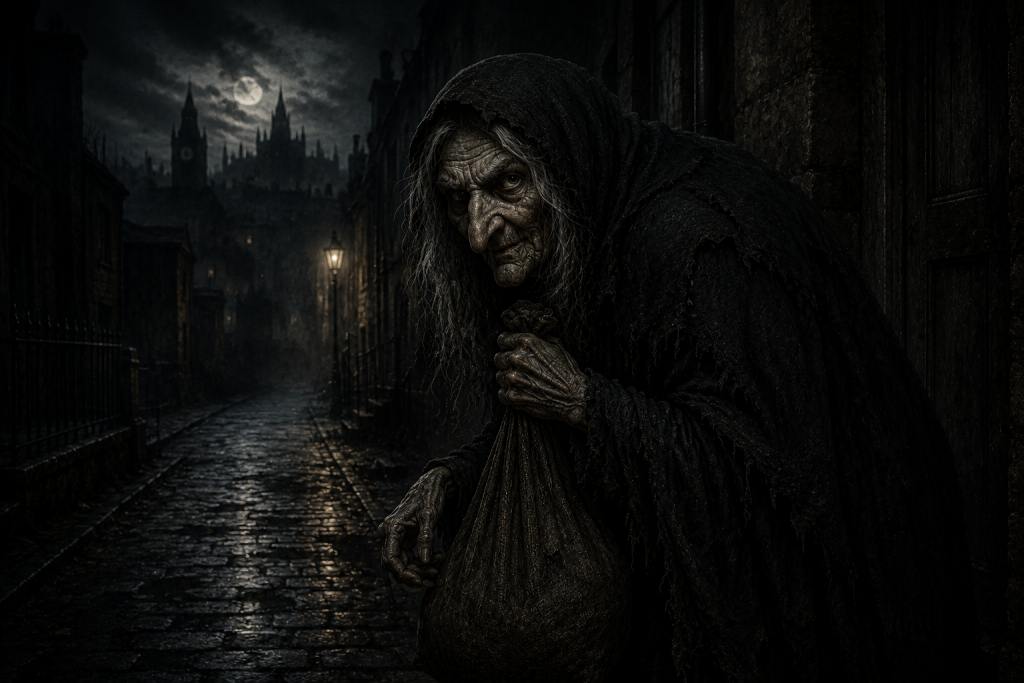
Before you see him, you hear him. A rattling, clattering sound from somewhere along the riverbank, or out in the shallows where the water moves fast over the stones, a noise like someone wearing a coat made entirely of shells and bones and whatever the river has thrown up and kept. It is not a subtle sound. The Shellycoat makes no attempt at silence. He announces himself with every movement, clattering through the dark with the cheerful noisiness of a creature that has long since concluded that stealth is less interesting than spectacle.
This is what immediately sets the Shellycoat apart from most of the supernatural beings in Scottish river and water tradition. The Kelpie is silent until it is too late. The Each-Uisge disguises itself with careful, predatory patience. The water spirits of the Scottish tradition, by and large, hunt through concealment. The Shellycoat does the opposite. He clatters toward you across the stones and dares you to do something about it, and what happens next depends almost entirely on whether you have the wit and the nerve to respond correctly.
He is a bogle, which is the Scots word for a goblin or supernatural troublemaker, and he belongs to the rivers and the coastlines of Scotland with a specificity that suggests a genuine and localised tradition rather than a generalised import from elsewhere. He has been seen, or heard, or both, on the River Ettrick in the Scottish Borders, on the shores of the Firth of Forth, and in various other locations where water and darkness and a certain quality of solitude combine into the conditions he seems to prefer.
The Coat That Names Him
The Shellycoat takes his name from his most distinctive characteristic, a coat or covering of shells that he wears over whatever body lies beneath them. The shells rattle and clatter as he moves, which is how you know he is coming before you can see him, and in the dark beside a river the sound carries further than you might expect.
The shells in question are most commonly described as freshwater mussels or the shells of river creatures, accumulated over time in the way that a creature with a long relationship with the water might accumulate them. Some accounts add bones to the collection, and small stones, and whatever else the river or the shore has produced that can be threaded or attached to the coat. The overall effect, in the descriptions that survive, is of a figure that looks as though the river itself has decided to take a vaguely humanoid form, wearing its own debris as clothing.
This is a kind of camouflage in reverse. Most creatures that want to survive in a world that contains predators try to look like their background. The Shellycoat looks like nothing else in the landscape, a walking assemblage of river detritus, immediately recognisable as something that should not exist once you have seen it, and audible from a considerable distance before you have the chance to see it at all.
Whether this is a disadvantage or simply a characteristic that the Shellycoat does not consider worth addressing is one of the more interesting questions the tradition raises. He is not, on the whole, understood as a subtle or strategic creature. He is understood as a creature that finds its own existence immensely entertaining and expects others to share that assessment, whether they want to or not.
What He Does
The Shellycoat’s activities in the tradition tend toward mischief rather than genuine malevolence, which places him in a specific category of Scottish supernatural being that is troublesome and occasionally dangerous but not fundamentally predatory.
His most commonly recorded behaviour is the false distress call. He will position himself some distance along a river or on a stretch of shoreline and begin making sounds that suggest a person in serious difficulty, calling out, splashing, producing the noises of someone drowning or lost. A traveller who follows the sounds to try to help will find the source constantly retreating, always just a little further along the bank, always just around the next bend, leading the would-be rescuer deeper into the dark and further from wherever they were trying to go.
When the pursuit has gone on long enough to satisfy him, the Shellycoat lets out a burst of what the tradition describes as terrible laughter, the clattering of his coat providing a percussion to the mockery, and then he is gone. The traveller is left in the dark some distance from where they started, having helped no one and accomplished nothing except providing the Shellycoat with his evening’s entertainment.
There are darker accounts in which the pursuit leads to more dangerous ground, boggy stretches or deep water that a traveller stumbling through the night might not realise they were approaching until it was too late. Whether the Shellycoat in these versions intends genuine harm or is simply indifferent to the consequences of his mischief is not always clear, and the tradition itself does not seem particularly interested in establishing his intent. What matters is the outcome, and the outcome of following a Shellycoat into the dark is rarely good.
He has also been credited with more straightforward haunting behaviour, lurking near fords and crossings and startling those attempting to cross, appearing suddenly from beneath the water in a way that caused horses to bolt and travellers to drop whatever they were carrying. The clattering of his coat in the dark beneath a ford was apparently enough, in some accounts, to make the crossing seem not worth attempting that night.
A Creature of the Borders
The Shellycoat’s strongest associations in the surviving tradition are with the Scottish Borders, the region of the Southern Uplands that runs along the boundary between Scotland and England, a landscape of rivers and moorland and the kind of dark, deep valleys that the Scots call deans or dens. This is the country of the Ettrick and the Yarrow and the Tweed, rivers with long literary and folkloric associations, and the Shellycoat belongs to the watery margins of this landscape with an apparent ease of tenure.
Sir Walter Scott, who gathered Border folklore with a collector’s enthusiasm in the early nineteenth century, included the Shellycoat in his notes on Scottish supernatural tradition, which is one of the reasons the creature survives in the written record at all. Scott was not uncritical as a collector, and his inclusion of the Shellycoat in his gathering of Border lore suggests that the tradition was alive and recognised in the communities he was working with rather than being something he had to search archives to find.
The Border landscape itself contributes to the Shellycoat’s particular quality. This is a region where the rivers run fast in spate and slow in drought, where the fords that were the only crossing points on many stretches of water were genuinely dangerous after rain, where the darkness between settlements was real and long and the sounds that water makes at night carry their own unsettling vocabulary. The Shellycoat is precisely calibrated to this landscape. He belongs to the fast rivers and the dark fords and the paths that run along the waterside where you cannot always see what is ahead of you.
The Firth of Forth and the Coastal Tradition
While the Borders represent the most concentrated area of Shellycoat tradition, he is not exclusively a river creature. Accounts of his presence extend to the coastline, particularly around the shores of the Firth of Forth, where the tidal zone creates its own version of the liminal environment he seems to prefer.
The coastal Shellycoat is in some accounts slightly different in character from the river version, perhaps because the sea offers a different acoustic environment and a different range of shells and debris for the coat, or perhaps because the traditions in coastal communities developed with their own emphasis. The false distress call behaviour translates naturally to a coastal setting, where the sounds of people in difficulty at sea were a genuine and common tragedy, and where the instinct to respond to such sounds was deeply ingrained in fishing communities.
A coastal Shellycoat using the sounds of maritime distress to lead rescuers into danger carries a darker charge than the river version leading travellers astray in the dark. The fishing communities of the Firth understood what it meant to hear cries from the water, and a creature that mimicked those cries for its own amusement occupied a more troubling moral space than a simple river bogle playing tricks on travellers.
Whether this coastal version represents a genuine regional development of the tradition or a separate phenomenon that attracted the same name because of shared characteristics is difficult to determine at this distance. What is clear is that the Shellycoat’s territory is defined by water rather than by the specific form water takes, and that wherever the water is dark and the path is uncertain and the night is long enough, the conditions for a Shellycoat tradition exist.
How to Deal With Him
The good news about the Shellycoat, relative to many of the other creatures in the Scottish supernatural tradition, is that he is not trying to kill you. He is trying to make a fool of you, which is uncomfortable and potentially dangerous in its consequences but carries a different quality of threat from something that simply wants to drag you under.
The traditional response to a Shellycoat encounter, where any guidance exists in the sources, tends to involve not following the sounds in the first place. Recognising the false distress call for what it is, holding your ground rather than pursuing the retreating noise into the dark, is the first and most important defensive measure. The Shellycoat’s power over you is directly proportional to your willingness to follow where he leads, and a traveller who stops, listens carefully, and decides that the sound is moving in ways that no genuinely distressed person could produce is a traveller who has already denied the Shellycoat his entertainment.
There is also, in some accounts, the option of calling him out directly, naming what he is and refusing to be drawn. The Shellycoat’s response to being correctly identified varies by account, some suggesting he retreats immediately when named, others suggesting the laughter and the clattering departure regardless, but the implication in most versions is that the traveller who cannot be deceived is not worth the Shellycoat’s time.
This is a consistent pattern across Scottish bogle tradition. The creatures that operate through deception lose much of their power when the deception is seen through. The Shellycoat needs you to believe, even briefly, that the sounds you are following represent something real and something worth finding. The moment you stop believing that, the game is over.
If you want more like this, the Tales of Myth and Magic newsletter delivers new creatures, legends, and forgotten folklore straight to your inbox.
No fixed schedule. No noise. Just the stories, when they are ready.
Sign up here →The Rattling Dark
The Shellycoat occupies a specific and somewhat unusual position in the ecology of Scottish supernatural tradition. He is neither the most dangerous figure in the river and water mythology, nor the most benign. He sits in between, a creature of genuine nuisance and potential danger who nevertheless operates through mischief rather than malice, through the exploitation of human instincts toward helpfulness rather than through straightforward predation.
He is, in his own way, a test. The traveller who hears the clattering in the dark beside the river and the voice that sounds like distress has to make a choice: follow the sound and risk being led somewhere dangerous by something that is laughing at every step, or hold their ground and accept that if the sound is genuine they have chosen not to help someone who needed it.
It is not a comfortable choice. The Shellycoat knows this. He has been making people face it for a very long time, standing somewhere in the dark and shaking his coat and waiting to see what you will do.
The river runs on either side. The ford is somewhere ahead in the dark. The clattering comes from downstream, and the voice sounds like it is in real difficulty.
What do you do?
Further Reading
If this article sparked your interest, these are the books worth reading next.
Scottish Urban Legends: 50 Myths and True Stories
by Aaron Mullins — fifty Scottish urban legends including stories from Glasgow, Edinburgh, and the Highlands. The kind of tradition that Maggie Murphy belongs to, collected properly in one volume.
Scottish Urban Myths and Ancient Legends
by Grace Banks and Sheena Blackhall — vampires, werewolves, devil encounters, and the school playground legends of Scotland. A genuinely good collection of the stories Scots have been telling each other for generations.
The Lore of Scotland: A Guide to Scottish Legends
by Jennifer Westwood and Sophia Kingshill — the most comprehensive collection of Scottish legend in print, covering Glasgow to Shetland, exploring origins and historical basis. Endorsed by Terry Pratchett as the real macabre.
Never miss a myth
Thank you for being here. The site is brand new and every subscriber genuinely means something to me. If you're here, you care about this stuff as much as I do - and that's all the reason I need to keep going. New stories, videos and dark folklore from around the world, straight to your inbox. No algorithm. Just the stories, when they're ready.