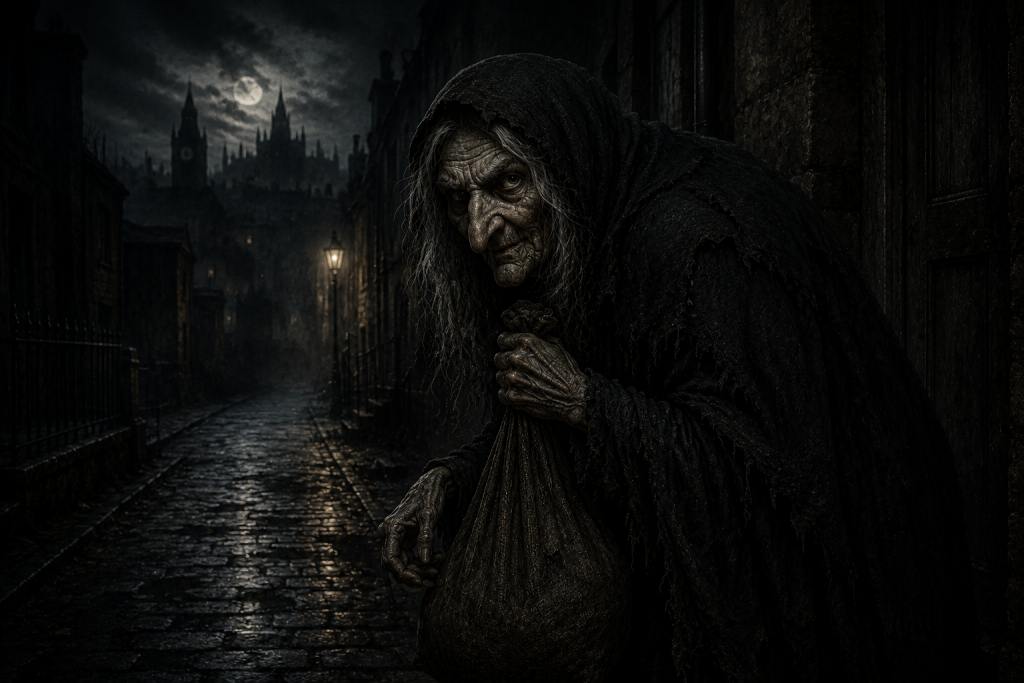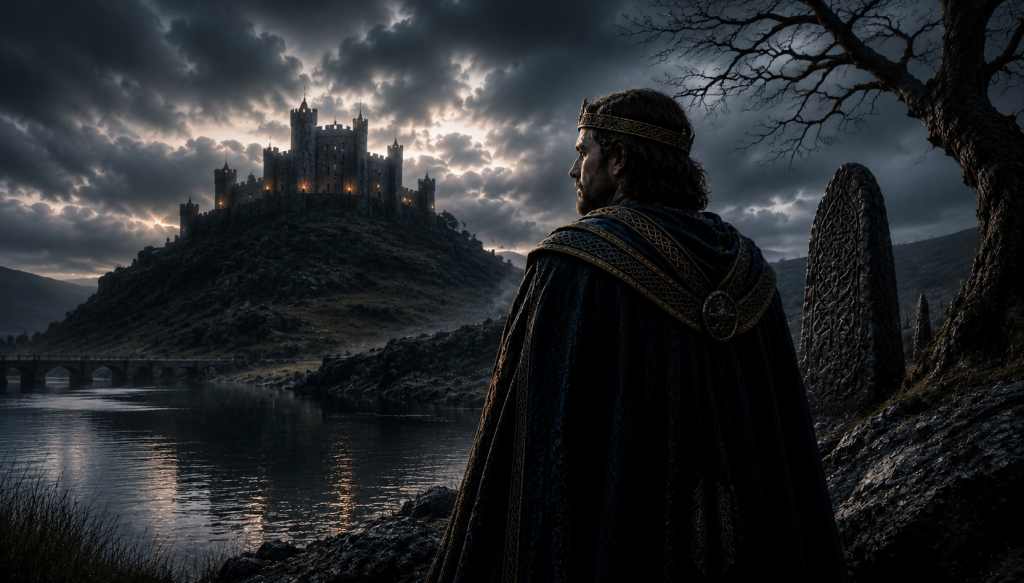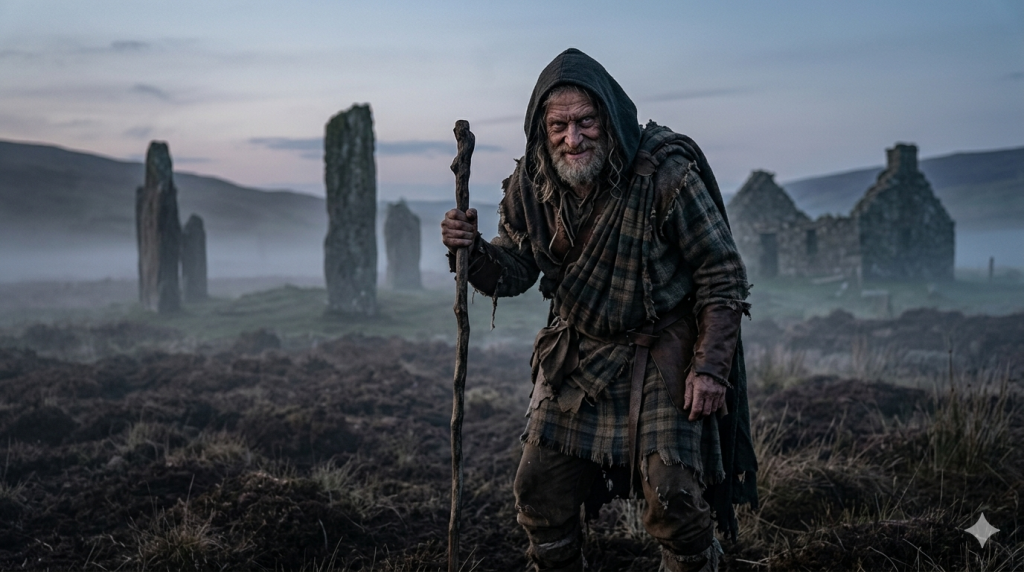
He does not knock. He does not scratch at the window or rattle the door or announce himself in any of the ways that visitors, even unwelcome ones, are expected to announce themselves. The Bodach comes down the chimney. He slides through the smoke and the soot in the dark hours while the household sleeps, and he moves through the rooms with the particular silence of something that has been doing this for a very long time and has never once been caught.
What he does when he gets inside depends on which version of the tradition you follow. In some accounts he simply watches, crouched in the shadows at the edge of the firelight, observing the sleeping family with an attention that is its own kind of threat. In others he is there to torment, pinching and prodding the sleepers into nightmares, pulling at their hair, pressing on their chests with a weight that wakes them gasping in the dark. In the darkest versions of the tradition he is there to take a specific child, chosen for reasons that the legend does not always bother to explain, slipping back up the chimney before dawn with what he came for.
The Bodach is not the most famous creature in Scottish Gaelic folklore. He does not have the dramatic profile of the Kelpie or the melancholy beauty of the Selkie. He is older and quieter and considerably more domestic in his horror, a figure that belongs not to the wild places but to the inside of the house, to the space that should be safe, to the hearth that is supposed to keep the dark things out.
He comes in through the fire. He was never kept out at all.
What the Name Tells You
The word bodach in Scottish Gaelic means, straightforwardly, old man. It is a common word, used in everyday speech to refer to an elderly man, sometimes affectionately and sometimes with a mild edge of disparagement depending on context. Its feminine counterpart is cailleach, old woman, which carries its own weight of supernatural association in the Highland tradition.
The use of such an ordinary word for a supernatural figure is itself significant. The Bodach is not given an exotic or distancing name. He is simply the Old Man, the figure of aged male authority rendered sinister by the context in which he operates. He comes in the night. He comes through the fire. He comes for the children. And he is called, with a plainness that refuses to let you keep him at a comfortable distance, simply the Old Man.
This naming strategy appears in other traditions. The most frightening figures in folklore are often the ones with the most mundane names, the ones that do not announce their supernatural status through exotic terminology but instead use the ordinary language of the community as a kind of cover. The Bodach sounds like someone’s grandfather until you learn what he does after dark.
The Chimney as Entry Point
The specific detail of the chimney as the Bodach’s point of entry is one of the most consistent and most interesting features of the tradition, and it is worth thinking about why this particular means of entry was chosen.
The hearth and its chimney occupied a specific and important position in the cosmology of the Highland home. The fire was the centre of domestic life, the source of heat and light and cooked food, the gathering point of the family. It was also, in the older Highland tradition, a ritual boundary. Certain protective practices were associated with the hearth, the banking of the fire at night in specific ways, the speaking of certain prayers or protective words over it before sleep, the placing of iron near the fireside to deter supernatural intrusion.
The chimney was the one point in this defensive domestic architecture that could not be fully closed. The smoke had to go somewhere. And the Bodach, in the tradition, understood this perfectly. The one opening you could not seal was the one he used.
There is a practical resonance to this as well. Chimneys make sounds at night. Wind in a chimney produces noises that are easy, in the dark and half-asleep, to interpret as something moving, something descending. Soot falls. Embers shift. The sounds of a house settling in the cold of a Highland night, transmitted through the chimney, could easily become, in the folk imagination, the sounds of something coming down.
The Bodach is what a Highland family heard when the chimney made noises in the night and sleep had loosened the rational mind’s grip on interpretation.
Children and the Bodach’s Purpose
The targeting of children is one of the most consistent features of the Bodach tradition, and it places him in a broad category of supernatural child-threateners that appears in folklore across the world.
The function of such figures in traditional communities is partly protective in a paradoxical way. The threat of the Bodach kept children away from the fire, away from the chimney, in bed when they were supposed to be in bed, quiet when quiet was required. A child who got up and went to the fireplace in the night, who made noise when the household was trying to sleep, who stayed up past the hour when children were expected to be asleep, was a child who was making themselves available to the Bodach. The supernatural threat enforced domestic order in a way that parental instruction alone could not always manage.
This function does not fully explain the tradition, any more than the nursery bogie function fully explains Black Annis or Jenny Greenteeth. Folk figures that are used to frighten children into compliance still have to come from somewhere, and the Bodach’s specific characteristics, the chimney entry, the nighttime activity, the watching and the pinching and the taking, suggest a tradition that predates any simple childcare application.
The children most vulnerable to the Bodach in some versions of the tradition are those who have been singled out for some reason, the particularly beautiful, the particularly troublesome, or simply those whose luck has run differently from their siblings. The Bodach’s selection criteria are not always morally legible, which is one of the things that makes him genuinely frightening rather than merely a disciplinary tool. He does not only come for the children who misbehave. He comes for the children he chooses, and the criteria for being chosen are not always clear.
The Bodach and the Cailleach
The Bodach does not exist in isolation in Scottish Gaelic supernatural tradition. He has a counterpart, the Cailleach, the Old Woman, who appears in Gaelic mythology in forms ranging from the divine hag who shaped the landscape of Scotland with her hammer to the more localised figure of a supernatural woman associated with winter, storms, and the wild places.
The pairing of the Bodach and the Cailleach appears in some regional traditions, the two old figures understood as a couple of sorts, moving through the world together in ways that the folklore does not always specify in detail but implies with consistency. They are the old pair, the ancient couple, belonging to a time before the present order of things, carrying in their persons the memory of the world as it was before human settlement made it familiar and manageable.
Where the Bodach is specifically domestic in his horror, associated with the house and the hearth and the night hours inside, the Cailleach tends toward the outdoor and the seasonal, a figure of winter and storm and the wild landscape. Together they cover the full range of the places where a Highland community might encounter the supernatural, inside and out, domestic and wild, the settled world and the world beyond its boundaries.
This pairing, the old man and the old woman as the supernatural bookends of human experience, is a structure that appears in many mythological traditions. It belongs to a very old way of thinking about the world that places the human community between two ancient forces, neither fully benign nor fully hostile, both older than anything the community itself can remember.
Regional Variations
The Bodach in his various regional forms demonstrates the richness and the variation that characterises genuinely living folk traditions, stories that are told and retold and adapted by communities with their own specific landscapes and concerns rather than transmitted as fixed texts.
In some parts of the Highlands the Bodach is specifically associated with storms, appearing or becoming more active during bad weather, his chimney entry made easier by the wind that drives everything down. In these versions he is almost a weather spirit as much as a domestic intruder, his activity a sign that the storm is serious and that the household should take precautions.
In other regional traditions he is more specifically an omen figure, his presence in the house not necessarily physically dangerous but predictive. A household that heard the Bodach in the night, or felt his presence in the particular quality of the darkness, was a household that could expect bad news or misfortune in the days following. He was the warning before the thing, rather than the thing itself.
In parts of the Western Isles the Bodach is associated with specific families or locations, a figure attached to a particular glen or a particular lineage rather than a general supernatural threat. These localised versions carry the weight of specific community history, stories about encounters or losses that have been attributed to the Bodach over generations until the attribution has become as fixed as geography.
If you want more like this, the Tales of Myth and Magic newsletter delivers new creatures, legends, and forgotten folklore straight to your inbox.
No fixed schedule. No noise. Just the stories, when they are ready.
Sign up here →Protection and the Limits of It
The protective measures against the Bodach in Highland tradition reflect the same practical intelligence that produced the protections against the Finfolk and the Sluagh. Iron near the hearth. The correct banking of the fire before sleep, performed in a specific way that acknowledged the fire’s role as both warmth and boundary. Certain prayers spoken over the sleeping children.
Some accounts mention rowan as a protective material, branches placed near the chimney or above the children’s beds, the rowan being one of the most widely credited protective plants in Scottish folk tradition. Others mention the importance of not leaving the fire completely dead overnight, the living ember being a continuation of the domestic protection that the full fire provided.
What is notable about all of these protective measures is that they require attention and intention. They are not passive. The household that was protected against the Bodach was a household that had performed specific acts before sleep, that had taken the threat seriously enough to observe the rituals and maintain the practices. The unprotected household, the one that fell asleep without banking the fire correctly or speaking the words or placing the iron, was the household that might hear something coming down the chimney in the night.
This is, again, a tradition that serves a practical function beyond the purely supernatural. A household that banks its fire properly before sleep is a household that is less likely to burn down overnight. A household that checks on its children before sleeping is a household whose children are safer for a dozen ordinary reasons. The Bodach enforces a set of domestic practices that are sensible entirely independently of whether he exists.
The Old Man in the Dark
What the Bodach represents, at his most essential, is the vulnerability of the domestic space. The home is the place we build against the outside world, the structure we put between ourselves and the dark, and the Bodach exists to remind us that no structure is fully sealed. There is always the chimney. There is always the one opening that cannot be closed.
He is old, which means he has been doing this since before your house was built, since before anyone who lives there was born. He is the Old Man, which means he carries the authority of age and the implication of accumulated knowledge, things learned across a span of time that dwarfs any individual human life. He comes in the night, which is the time when the ordinary defences of the rational mind are at their lowest and the imagination is at its most susceptible.
He slides down through the soot and the smoke and he moves through the rooms where your children are sleeping, and the only question that matters is whether you observed the protections before you went to sleep.
Bank the fire correctly. Place the iron. Speak the words.
The chimney will still make its sounds in the night. The Bodach will still be what he is. But the household that takes him seriously, that acknowledges his existence and takes the measures the tradition provides, is the household that wakes in the morning with everyone still there.
The one that does not is the one the stories are about.
Further Reading
If this article sparked your interest, these are the books worth reading next.
Scottish Urban Legends: 50 Myths and True Stories
by Aaron Mullins — fifty Scottish urban legends including stories from Glasgow, Edinburgh, and the Highlands. The kind of tradition that Maggie Murphy belongs to, collected properly in one volume.
Scottish Urban Myths and Ancient Legends
by Grace Banks and Sheena Blackhall — vampires, werewolves, devil encounters, and the school playground legends of Scotland. A genuinely good collection of the stories Scots have been telling each other for generations.
The Lore of Scotland: A Guide to Scottish Legends
by Jennifer Westwood and Sophia Kingshill — the most comprehensive collection of Scottish legend in print, covering Glasgow to Shetland, exploring origins and historical basis. Endorsed by Terry Pratchett as the real macabre.
Never miss a myth
Thank you for being here. The site is brand new and every subscriber genuinely means something to me. If you're here, you care about this stuff as much as I do - and that's all the reason I need to keep going. New stories, videos and dark folklore from around the world, straight to your inbox. No algorithm. Just the stories, when they're ready.