The stretch of water between the Outer Hebrides and the Scottish mainland is not a sea that forgives mistakes. The Minch, as it is known, runs roughly seventy miles from north to south and varies between twenty and forty-five miles in width, and within that space it generates conditions that have humbled experienced sailors for as long as people have been crossing it. The currents are strong and unpredictable. The weather changes with a speed that leaves no time to prepare. The water is cold enough, in any season, to kill a man in minutes if he goes in without a survival suit.
The people who have crossed the Minch across the centuries knew all of this. They also knew about the Blue Men.
In Scottish Gaelic tradition, specifically in the folklore of the Shiant Islands and the surrounding stretch of the Minch known as the Stream of the Blue Men, there are beings that live in the underwater caves of the strait and rise to the surface to make their presence felt in ways that range from disconcerting to fatal. They are blue-skinned, human in form from the waist up, and they have a peculiar characteristic that sets them apart from almost every other supernatural threat in the Scottish tradition.
They want to talk.
What the Blue Men Are
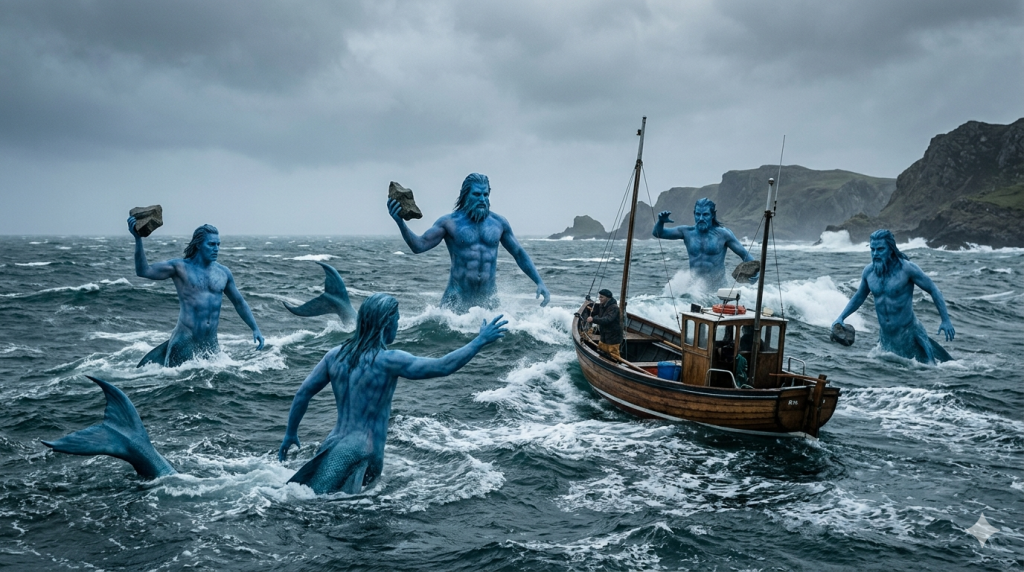
The Blue Men of the Minch, known in Scottish Gaelic as Na Fir Ghorma, are supernatural beings described as having blue-grey skin, human upper bodies, and the lower forms of sea creatures. They sleep in underwater caves in the Minch during calm weather and rise to the surface when storms approach, or when a ship passes overhead that catches their attention.
They are sometimes described floating on the surface in groups, arms folded, watching approaching vessels with an evaluating attention that sailors found deeply unsettling even before anything hostile had occurred. A crew that spotted Blue Men ahead had very little time to decide what to do, because once the Blue Men had decided to take an interest in a particular vessel, events moved quickly.
The chief of the Blue Men, who led the others and initiated the ritual challenge, would call out to the captain of the approaching ship and begin a verse. The captain was required to complete it. If he could match the Blue Man’s verse, completing the rhyme correctly and with sufficient fluency, the Blue Men would let the ship pass. If he could not, or if he hesitated too long, the Blue Men would capsize the vessel and take the crew down to their underwater caves.
This is one of the most distinctive and unusual features of any supernatural tradition in Scottish folklore. A monster that challenges you to a poetry contest before deciding whether to drown you is not something that appears anywhere else in quite the same form, and the specificity of it, the requirement for quick thinking and verbal dexterity under extreme pressure, says something interesting about the values of the communities that told these stories.
The Shiant Islands and the Stream of the Blue Men
The Blue Men are most closely associated with the Shiant Islands, a small group of uninhabited islands sitting roughly in the middle of the Minch between the Isle of Lewis and the Scottish mainland. The Shiants are extraordinary in appearance, their basalt columns rising sheer from the water in formations that look almost architectural, as though something with geometric intentions had been at work on them. They are home to enormous seabird colonies and very little else, and the waters around them are among the most turbulent in the Minch.
The stretch of water immediately south of the Shiants is known in Gaelic as Sruth nam Fear Gorm, the Stream of the Blue Men, a name that appears on older maps and charts and that represents an unusual degree of supernatural specificity. Most folkloric creatures are associated with regions or landscape types. The Blue Men have a named stretch of sea, a specific geographical designation that treats their presence as a navigational fact rather than a legend.
Sailors crossing the Minch knew to be especially careful in the Stream of the Blue Men. This was not simply received folklore. It was practical guidance, because the conditions in that particular stretch of water, affected by the currents generated by the Shiant Islands and by the shape of the seabed, were genuinely more dangerous than the surrounding sea. The Blue Men were the explanation for why this specific stretch behaved as it did.
The Challenge: Poetry as Survival
The ritual of the verse challenge deserves more attention than it sometimes receives, because it is not the feature you would expect from a tradition built around a dangerous stretch of sea.
In the recorded accounts, the chief of the Blue Men would call out to the ship’s captain and deliver a line or a couplet, then wait for a response. The captain had to complete the rhyme, extending the verse in a way that demonstrated both poetic competence and quick thinking. A successful response bought the ship safe passage. A failed one, or no response at all, was the signal for the Blue Men to capsize the vessel.
Several specific exchanges have been recorded in Hebridean folklore. In one of the most cited, the Blue Man calls out something along the lines of:
Man of the black cap, what do you say as the winds blow and the waves rise?
And the captain must respond with a completing verse that matches the rhythm and the rhyme and, crucially, does not show fear.
The requirement for composure is as important as the requirement for verbal skill. The Blue Men were watching not just for a correct answer but for a captain who could deliver it without flinching, who could match wits with a supernatural entity in the middle of a body of water that was becoming increasingly dangerous, and do so calmly. A man who panicked would fail even if he knew the words.
This tells you something about what the communities of the Hebrides valued in their sailors. Quick thinking, verbal dexterity, composure under pressure, and a certain quality of confident engagement with the world rather than retreat from it. The Blue Men did not reward cowardice. They did not reward silence. They rewarded the kind of man who could look a supernatural threat in the eye and answer it in verse.
Origins: Where the Blue Men Came From
The origins of the Blue Men tradition have been debated by folklorists for generations, and no single explanation has achieved consensus, which is itself suggestive. The most interesting traditions usually resist simple origins.
One theory, advanced by several nineteenth century scholars and still occasionally cited, connects the Blue Men to the historical presence of North African captives or Moorish slaves brought to the Hebrides by Norse raiders in the early medieval period. The blue-grey skin, in this reading, represents a distorted folk memory of dark-skinned men seen in the islands, preserved and transformed over centuries into something supernatural. This theory has a certain historical plausibility in that Norse raiders did bring captives from southern Europe and North Africa to the islands, but it does not fully account for the specifically aquatic nature of the Blue Men or the verse challenge tradition.
A more purely folkloric reading connects the Blue Men to the fallen angel tradition that appears in several Scottish and Irish supernatural beliefs. In this tradition, when Lucifer and his followers were cast out of heaven, not all of them fell to hell. Some fell into the sea, some onto the land, some remained in the air, and the different categories of supernatural being that trouble the human world are the descendants or manifestations of these fallen angels in different domains. The Blue Men, in this reading, are the fallen ones who went into the sea, and their intelligence and their capacity for complex interaction with humans, the verse challenge, the organised hierarchy under a chief, reflects their origin as beings who were once something considerably more than mere monsters.
A third possibility, which is not incompatible with the second, is that the Blue Men tradition preserves elements of a much older pre-Christian belief about the spirits of the sea in the Hebrides, beings understood as having agency and intelligence and a specific relationship with the human world that required careful management. The verse challenge may be a remnant of older propitiation rituals, formalised interactions between human communities and sea spirits that acknowledged the spirits’ power and negotiated safe passage through their domain.
None of these explanations is entirely satisfying on its own. The Blue Men, like most genuinely ancient folklore, probably contain layers of all of them.
If you want more like this, the Tales of Myth and Magic newsletter delivers new creatures, legends, and forgotten folklore straight to your inbox.
No fixed schedule. No noise. Just the stories, when they are ready.
Sign up here →The Hierarchy of the Deep
One of the details that distinguishes the Blue Men tradition from many other Scottish supernatural traditions is the presence of a clear social hierarchy among the beings themselves. They are not a formless threat or an undifferentiated mass. They have a chief, a leader who initiates the challenge and whose authority over the others is clear. When the chief gives the signal, the others act. When the chief is satisfied, the others stand down.
This social organisation is itself unusual and worth noting. The Blue Men are not chaotic in the way that many supernatural threats in folklore are chaotic. They operate according to rules, according to a hierarchy, according to a specific ritual that has expected forms and expected responses. They can be dealt with, if you know how. They have, in this sense, more in common with the fae of Irish and Scottish tradition, beings with their own courts and customs and codes that the human world can navigate if it is careful and knowledgeable, than with simple sea monsters.
The chief is sometimes described as larger than the others, darker in complexion, and with a voice that carries across the water even in strong wind. He is the one you have to answer. Getting past him is everything.
The Minch Today
The Minch is still one of the more demanding stretches of water in the British Isles, and the Shiant Islands are still uninhabited, rising from the sea in their extraordinary basalt columns with the same dramatic indifference to human presence that they have always had.
The ferry crossings that now connect the Outer Hebrides to the mainland cross the Minch on a regular schedule, and the passage, in rough weather, can be rough enough to remind you that the water is doing whatever it was going to do regardless of the schedule. The Stream of the Blue Men is still there, between the Shiants and the mainland, still generating the currents and the conditions that gave it its name.
No captain of a modern ferry is expected to answer in verse if something surfaces ahead of the bow. But the tradition that produced that expectation came from a genuine and specific danger, and from a community that met that danger with a response that seems, the more you think about it, entirely characteristic of the Gaelic-speaking world that produced it.
They did not just flee from the thing in the water. They answered it back.
The Verse That Saves You
There is something genuinely inspiring about a supernatural tradition in which the way to survive is to think clearly, speak well, and hold your nerve. Most monster traditions offer you very little agency. You are faster or slower than the thing pursuing you, better armed or less well armed, luckier or unluckier. The outcome is largely physical.
The Blue Men offer you a different kind of contest. They are stronger than you. They are in their own element. The water is theirs and if they capsize your vessel you are gone. But they will not capsize it without giving you the chance to meet them on their own terms, and their terms are intellectual rather than physical. Can you think? Can you speak? Can you hold your composure when everything around you is threatening to come apart?
If you can, you may pass.
The Minch is still cold and the currents are still unpredictable and the basalt columns of the Shiants still rise from the water like the columns of a drowned cathedral. And somewhere beneath the Stream of the Blue Men, in the tradition of the people who have known these islands longest, something is still waiting to see whether the next person who passes overhead is worth talking to.
Have your verse ready.
Further Reading
If this article sparked your interest, these are the books worth reading next.
Scottish Urban Legends: 50 Myths and True Stories
by Aaron Mullins — fifty Scottish urban legends including stories from Glasgow, Edinburgh, and the Highlands. The kind of tradition that Maggie Murphy belongs to, collected properly in one volume.
Scottish Urban Myths and Ancient Legends
by Grace Banks and Sheena Blackhall — vampires, werewolves, devil encounters, and the school playground legends of Scotland. A genuinely good collection of the stories Scots have been telling each other for generations.
The Lore of Scotland: A Guide to Scottish Legends
by Jennifer Westwood and Sophia Kingshill — the most comprehensive collection of Scottish legend in print, covering Glasgow to Shetland, exploring origins and historical basis. Endorsed by Terry Pratchett as the real macabre.
Never miss a myth
Thank you for being here. The site is brand new and every subscriber genuinely means something to me. If you're here, you care about this stuff as much as I do - and that's all the reason I need to keep going. New stories, videos and dark folklore from around the world, straight to your inbox. No algorithm. Just the stories, when they're ready.