
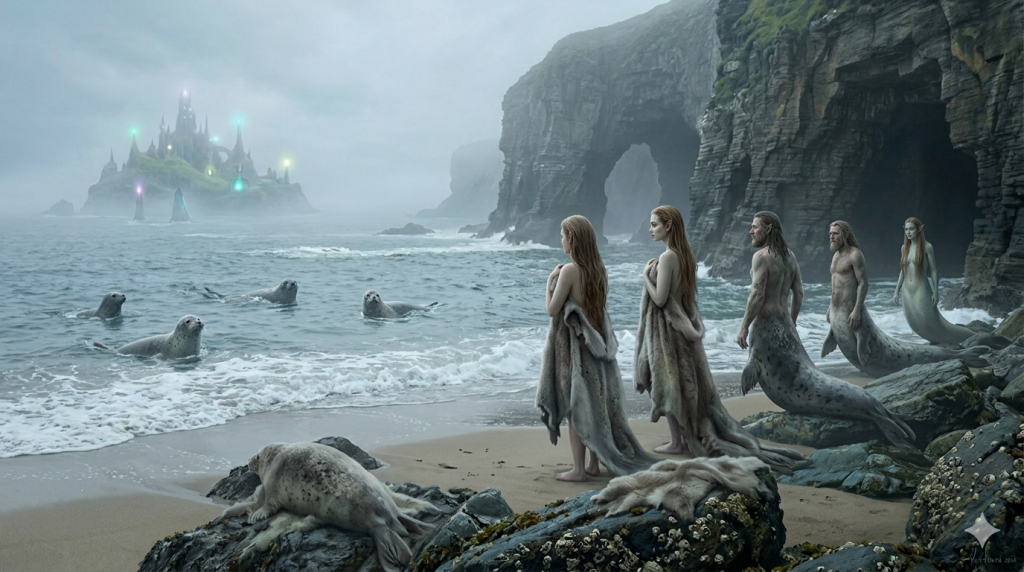
There is a particular kind of grief that runs through Selkie stories. Not the sharp, sudden grief of violence or loss, but something slower and more complicated. The grief of a life half-lived. The grief of belonging to two worlds and being fully at home in neither. The grief of the person left on the shore watching the water, and the grief of the one who swam away and could not come back, and the grief of the children caught between the two.
Of all the supernatural traditions of the northern islands, the Selkie is the one that has endured most completely into the modern imagination, and it has endured because the sorrow at its heart is not supernatural at all. It is entirely, recognisably human.
What a Selkie Is
A Selkie is a being of Orcadian and Shetlandic folklore that lives as a seal in the sea and as a human on land, the transition between forms made possible by a seal skin that can be shed and resumed. In seal form, Selkies are indistinguishable from ordinary seals, grey and sleek and at home in the cold northern waters. On land, having shed the skin, they appear as men and women of exceptional beauty, dark-eyed and pale, with a quality about them that is not quite of the ordinary world.
The name itself is a Scots diminutive of seal, selch or selk in older Scots, and the -ie suffix carries the same affectionate diminution as words like lassie or laddie. There is something telling in that naming. These are not monsters. They are not predators in the way the Finfolk are predators. They are beings that the communities of the northern islands named with a kind of tenderness, even while telling stories about them that were anything but tender.
The skin is everything. Without it, a Selkie cannot return to the sea. With it, nothing on land can hold them.
The Shape of the Stories
Selkie stories follow recognisable patterns, and those patterns matter because they carry the tradition’s moral weight.
The most common is the story of the stolen skin. A man finds a Selkie woman on the shore, having shed her skin to dance or rest in human form. He takes the skin and hides it, and without it she cannot return to the sea. She stays, because she has no choice, and she becomes his wife, and they have children together, and she is not unhappy exactly, but she is never entirely present either. Part of her is always somewhere else, listening for the sound of the water.
Then one day, years later, a child finds the hidden skin, or she finds it herself while searching for something else, and she puts it on and she goes back to the sea. In most versions of the story she goes without hesitation, though some accounts give her a moment of anguish at the door, looking back at the children she is leaving. In some versions she watches over her human children from the water, appearing to them as a seal, close but unreachable. In others she simply goes and does not look back, because the sea is what she is and what she has always been, and the years on land were something that happened to her rather than something she chose.
The man is left alone. The children grow up knowing what their mother was and understanding, in the particular way that children in folk stories understand things, that she loved them and left them and that both of those things were true at the same time.
The less common but equally powerful version runs the other way: a Selkie man who comes ashore and fathers children with a human woman before returning to the sea, drawn back by the same imperative, leaving the same particular absence behind.
The Sorrow Beneath the Story
It would be easy to read the stolen skin story as a simple cautionary tale about the consequences of taking what does not belong to you, and it is that, but it is also considerably more than that.
The Selkie wife who cannot leave is a figure of specifically female constraint. She is bound not by chains or walls but by the absence of the one thing that would allow her to be fully herself, and that absence was created deliberately by the person who claimed to love her. She is present in the marriage but not fully in it. She performs the role of wife and mother with genuine feeling, but there is always the other thing, the other self, the other life that was taken from her before she could choose.
This is not an obscure subtext. It is the text. The tradition of the northern islands was made by communities in which women’s choices were substantially constrained by the expectations and legal structures of the society around them, and the Selkie story encodes that constraint in mythological form with a clarity that has made it speak to audiences across centuries and cultures.
At the same time the story does not let the Selkie wife be simply a victim. She leaves. When the means of leaving becomes available to her, she goes. She does not stay for the children, does not stay for the husband, does not weigh the years of apparent contentment against the pull of what she actually is and decide that staying is the better choice. She goes, and the tradition does not judge her for it, which is itself remarkable for stories produced by the communities and the centuries that produced them.
The Seal People and the Families They Left
In Orcadian and Shetlandic tradition the Selkie stories were not purely narrative. They were genealogy.
Several families in the northern islands traced their ancestry to Selkie unions, and this was understood not as metaphor but as literal family history. The Clan MacCodrum of the Outer Hebrides were known as Sliochd nan Ròn, the offspring of the seals, and the tradition held that they were descended from a union between a MacCodrum man and a Selkie woman. This ancestry was a point of identity rather than shame, a distinction that set the family apart and explained certain characteristics, the particular affinity for the sea, the dark eyes, the way some of them moved.
The practical consequence of this genealogical tradition was a specific prohibition: MacCodrum men did not kill seals. To kill a seal might be to kill a relative. This is the kind of specific, behaviour-shaping function that origin legends serve in the communities that hold them, and it speaks to the practical roots of what might otherwise seem like pure romanticism.
Other families had similar traditions. Fishermen who never harmed seals. Communities where seals were spoken of with a respect that went beyond the ordinary. Where the water’s edge was treated as a boundary requiring a certain care, because you could not always be certain what was seal and what was something else.
The Sound They Made
One detail that appears in Selkie accounts with enough consistency to be worth noting is the sound. Selkies heard singing on certain nights, a sound that came from the water and was not quite like any other sound, too structured to be the wind, too inhuman to be voices from a passing boat.
The grey seal in particular has a vocal range that people who have not heard it up close would find startling. It produces sounds that are genuinely, uncannily close to human vocalisations, moaning and crying in registers that can carry considerable emotional weight if you hear them across dark water on a quiet night without knowing what is making them. The scientific explanation and the folkloric one are not as far apart as they might seem.
The people of Orkney and Shetland knew exactly what grey seals sounded like. They heard them constantly. The Selkie tradition did not arise from mistaking seals for something else. It arose from a community that knew seals intimately and chose, over generations, to tell a particular kind of story about them. The choice of that story, and the specific form it took, says something about the communities that told it and the experiences they were trying to make sense of.
Selkies and the Finfolk
If you have read the article on this site about the Finfolk, you will know that the two traditions exist in close proximity in Orcadian folklore and are sometimes confused or conflated. The distinction is worth maintaining because the two figures serve very different narrative purposes and carry very different emotional weights.
The Finfolk are sorcerers and predators. They come ashore to take what they want, they operate through deception and force, and the human beings they encounter are resources to be acquired rather than people to be known. There is no grief in Finfolk stories. There is only threat and the management of threat.
The Selkies are something else entirely. They are not predators. They do not seek out human contact for any malicious purpose. When they come ashore it is to rest, to dance, to simply be in a different form for a while, and the encounters that result are accidental on their part even when they are deliberate on the human side. The tragedy in Selkie stories is not what the Selkie does to the human. It is what the human does to the Selkie, and what that costs everyone involved.
One tradition leaves you watching the shore for what might come toward you. The other leaves you watching the sea for what has gone.
If you want more like this, the Tales of Myth and Magic newsletter delivers new creatures, legends, and forgotten folklore straight to your inbox.
No fixed schedule. No noise. Just the stories, when they are ready.
Sign up here →The Shore at the Edge of Everything
Orkney is a place where the sea is never far away. You are never, on any of the main islands, more than a few miles from water, and the quality of the light on the sea there, on certain days, is unlike anything in the more sheltered south. The grey seals haul themselves onto rocks and sandbars and watch the passing boats with a dark-eyed attention that is easy to anthropomorphise, easy to read as something more than animal curiosity.
The Selkie tradition was born from exactly this proximity. From people who lived alongside seals for generations, who watched them and listened to them and knew their rhythms, and who chose to tell a story about them that was really a story about longing and constraint and the impossibility of fully belonging to more than one world.
There is a woman in the story who finds the skin behind the loose stone in the wall and holds it for a moment, feeling the cold of it, the sea still in it, and she knows before she puts it on that she is not coming back. She looks at the door of the house where her children are sleeping. She looks at the water.
She puts the skin on.
The shore she leaves from is still there, somewhere on the edge of the islands. The seals still haul out on the rocks. On certain nights, if the conditions are right, you can hear them from a long way off, calling out across the water in voices that sound almost like something you should be able to understand.
Almost.
Further Reading
If this article sparked your interest, these are the books worth reading next.
Scottish Urban Legends: 50 Myths and True Stories
by Aaron Mullins — fifty Scottish urban legends including stories from Glasgow, Edinburgh, and the Highlands. The kind of tradition that Maggie Murphy belongs to, collected properly in one volume.
Scottish Urban Myths and Ancient Legends
by Grace Banks and Sheena Blackhall — vampires, werewolves, devil encounters, and the school playground legends of Scotland. A genuinely good collection of the stories Scots have been telling each other for generations.
The Lore of Scotland: A Guide to Scottish Legends
by Jennifer Westwood and Sophia Kingshill — the most comprehensive collection of Scottish legend in print, covering Glasgow to Shetland, exploring origins and historical basis. Endorsed by Terry Pratchett as the real macabre.
Never miss a myth
Thank you for being here. The site is brand new and every subscriber genuinely means something to me. If you're here, you care about this stuff as much as I do - and that's all the reason I need to keep going. New stories, videos and dark folklore from around the world, straight to your inbox. No algorithm. Just the stories, when they're ready.
Pingback: Finfolk: Orkney's Dark Shapeshifters of the Sea - Tales of Myth and Magic