Maggie Murphy is a name that has been used to frighten children in Glasgow for at least a century and possibly considerably longer, and it is one of the very few urban legends that is specific enough in its geography, its character, and its method of operation to suggest genuine local roots rather than simple importation of a generic child-threatening figure from elsewhere. Every city has its bogeyman. Glasgow’s is specifically Glaswegian in a way that requires explanation, and the explanation, when you follow it back through the layers of Irish immigration, Victorian institutional history, and the specific social conditions of a city that was simultaneously one of the most prosperous and one of the most brutally unequal in the British Empire, is considerably more interesting than the legend itself suggests on the surface.
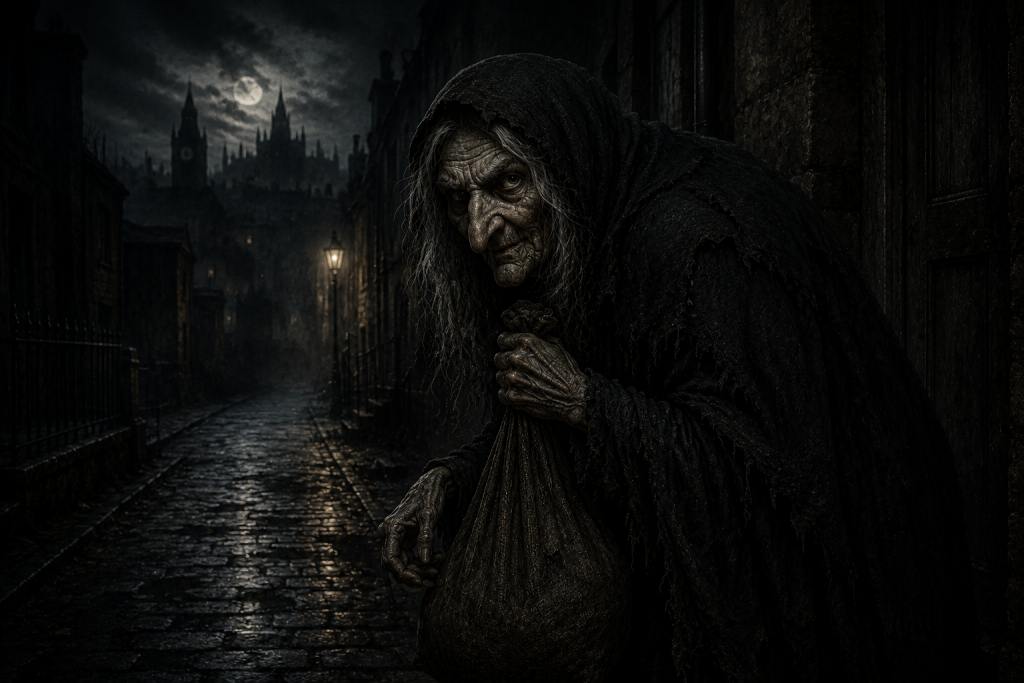
The basic outline of the Maggie Murphy legend is consistent across the accounts collected from people who grew up in Glasgow across the twentieth century. Maggie Murphy is an old woman, hag-like in appearance, who runs a home for naughty children somewhere in the city. She comes out at night looking for children who have misbehaved, who are out past dark, or who have otherwise failed to meet the standards that adults expect of them. She takes them back to her home. What happens to them there varies by account: some versions say she beats them, some say she starves them, some say she eats them. The consistent element is that the children she takes do not come back. Their families do not see them again. Whatever Maggie Murphy’s home is, it is a place of no return.
This legend was used actively in Glasgow households as a child management tool across the twentieth century, invoked by parents, grandparents, and older relatives to enforce bedtimes, discourage bad behaviour, and keep children indoors after dark. The Hidden Glasgow online forum, which has preserved accounts from Glaswegians of multiple generations, contains testimony from people who remember being threatened with Maggie Murphy in the 1940s, 1950s, and 1960s, and the consistency of the accounts across different families, different parts of the city, and different decades confirms that the legend had genuine cultural currency rather than being a localised family tradition.
The Child-Threatening Tradition and Where Maggie Murphy Fits
Before examining the specific origins of the Maggie Murphy legend, it is worth placing her in the broader context of child-threatening supernatural figures that appear across European and world folklore, because this context illuminates both what she is and why she works as a legend.
The child-threatening hag is one of the most universal figures in world folklore. Grýla in Iceland descends from her mountain cave every December to collect naughty children in her bag and boil them. Baba Yaga in the Slavic world lives in a hut on chicken legs in the deep forest and eats those who come to her without knowing the correct rituals. La Llorona in Latin American tradition weeps for the children she drowned and now steals living children to replace them. The Homem do Saco in Portugal carries a sack for the children who misbehave. Perchta in the Alps disembowels those who have not met her standards during the year.
Each of these figures operates in the same basic way: they establish a supernatural sanction for specific categories of child misbehaviour, they are associated with a specific method of capture or punishment that the imagination can elaborate on, and they are deliberately vague about the details of what happens after capture, because the imagination of a child confronted with the possibility of being taken by an old woman in the night is always more frightening than any specific description could be. Maggie Murphy belongs to this tradition. She is Glasgow’s version of a figure that appears, in different forms, across virtually every culture that has ever told stories to children.
What makes Maggie Murphy specifically interesting, and what distinguishes her from generic child-threatening figures, is the combination of institutional specificity and immigrant mythology that appears to have produced her. She is not simply a generic hag. She runs a home. The home is a real institutional category that existed in Glasgow’s specific historical context. And the name Murphy connects her to a specific immigrant community whose presence in Glasgow shaped the city’s social character in ways that the legend reflects.
Rosie’s Home: The Institutional Foundation
The first thread of the Maggie Murphy legend is institutional, and it connects the legend to a specific place in Glasgow’s geography and a specific period in Glasgow’s history. In the late nineteenth century, Glasgow had a network of institutions designed to manage the city’s vast population of poor, vagrant, and disorderly adults and children, and these institutions occupied a specific place in the folk imagination of Glasgow’s working class communities as places of feared removal rather than simply as welfare provision.
Among these institutions was a male lodging house on Garscube Road, converted from an old cotton mill and known in the neighbourhood as Rosie’s Home. The specific origin of the name Rosie is not entirely clear from the historical record, but what is clear is that the institution was understood by local children as a place of severe discipline and deprivation to which naughty or unwanted children might be sent. The threat to send a child to Rosie’s Home was a genuine threat in the social context of late Victorian Glasgow, because the distinction between a children’s home as welfare provision and a children’s home as punishment was not always clear in the folk understanding of these institutions, and the fear of institutional removal was real and well-founded in communities where poverty made the removal of children a genuine possibility rather than simply a theoretical threat.
The transformation of Rosie’s Home into Maggie Murphy’s Home for Bad Children is the first stage in the legend’s development, and it reflects a specific process by which institutional fear becomes supernatural legend. The real institution provides the basic structure: there is a place where naughty children are sent, it is run by a woman, it is a place of punishment from which return is not guaranteed. The supernatural elaboration then adds the nocturnal hunting, the hag appearance, the active seeking out of naughty children rather than simply the passive reception of those who are sent, and the final transformation of the institutional superintendent into a figure who actively desires the children she collects rather than simply managing them.
This transformation from institutional threat to supernatural figure is not unique to Glasgow. The Homem do Saco in Portugal and the El Coco of the Spanish tradition both appear to have similar origins in institutional figures, real places, and real practices of child removal that were then elaborated by folk tradition into supernatural threats. The institutional origin gives the legend a specific grounding in social reality that purely invented supernatural figures lack, and this grounding is part of what makes the threat credible to the children who hear it: behind the supernatural elaboration, they can sense a real thing that real adults are genuinely capable of doing.
The Irish Connection: Margaret Murphy of Derry
The second thread of the Maggie Murphy legend is Irish, and it connects to the most significant demographic event in Glasgow’s nineteenth century history: the mass immigration of Irish Catholics that followed the Great Famine of 1845 to 1852 and that transformed Glasgow’s social and cultural character in ways that are still visible in the city today.
Approximately 300,000 Irish people settled in Glasgow and the central belt of Scotland across the second half of the nineteenth century, creating communities that maintained strong connections to Irish folk tradition while developing specifically Scottish-Irish hybrid identities. The Gorbals, Bridgeton, Garngad, and other inner city districts became Irish Catholic communities with their own social institutions, their own religious infrastructure, and their own folk traditions that the immigrants brought from Ireland and maintained in their new home.
Among the stories that the Irish community brought with them appears to have been a tradition connected to a tragic figure named Margaret Murphy from Derry, and this figure provides the specific name that the Glasgow legend carries. The tradition involves a young woman named Margaret Murphy whose forbidden relationship with a man of different social standing led to pregnancy and ultimately to a series of violent deaths: her father, in a rage at the discovery of the relationship, killed Maggie and then himself, while the lover was subsequently charged and executed for the deaths. Maggie Murphy died before she could have the child she was carrying.
The ghost that emerged from this tragedy was understood, in the Irish tradition that preserved the story, as specifically oriented toward children: a spirit whose grief at the loss of her own unborn child expressed itself as a compulsive hunger for the children of others. She haunts the area around her death, seeking children, not out of malice precisely but out of an overwhelming need to possess what was taken from her. This ghost tradition is structurally consistent with a widespread pattern in Irish and broader European supernatural belief about the female dead who died with unfulfilled reproductive desires: the woman who died in pregnancy, in childbirth, or before she had children often becomes a specifically child-threatening supernatural figure in these traditions, because the desire she could not fulfil in life does not simply disappear at death but continues to drive her in a form that is dangerous to the living.
The Irish immigrant community in Glasgow brought this tradition with them, and in their new urban environment it encountered the institutional tradition of Rosie’s Home and the broader Glasgow tradition of child-threatening figures. The merger of these traditions produced the specific Glasgow legend: a figure with an Irish name, an Irish backstory of tragic death and frustrated maternity, and a Glasgow institutional setting in which she operates as a hag who runs a home for the children she collects.
Glasgow’s Geography of Fear
The Maggie Murphy legend is specifically Glaswegian not simply in its name and its institutional setting but in its geography, and the areas of the city most closely associated with the legend reflect the specific social geography of Glasgow’s working class and immigrant communities across the late nineteenth and twentieth centuries.
The Gorbals, which was one of the densest and most deprived urban districts in Britain at the turn of the twentieth century and which was the heart of Glasgow’s Irish Catholic immigrant community, appears consistently in accounts of the legend as one of the primary areas where it circulated. The Gorbals in its Victorian and Edwardian form was a landscape that the legend fitted: overcrowded tenements, dark closes and alleys, a population that included a significant proportion of recent immigrants maintaining folk traditions from home, and a general atmosphere of poverty and social precariousness that made the threat of institutional removal genuinely credible.
Garscube Road, where Rosie’s Home was located, and the surrounding areas of Maryhill and Cowcaddens also appear in accounts of the legend, reflecting the institutional origin thread. The specific geography of Glasgow’s Victorian institutional landscape, the locations of workhouses, reformatories, lodging houses, and children’s homes, corresponds closely to the geography of the Maggie Murphy legend, which suggests that the institutional dimension of the legend was not simply a narrative backdrop but a specific local knowledge about real places that gave the threat its credibility.
The loft tradition documented in the Hidden Glasgow forum accounts, in which Maggie Murphy was said to live specifically in the loft of the family home rather than in a distant institution, represents a later and more intimate development of the legend in which the figure has moved from the public institutional setting to the private domestic space. This domestication of the threat, in which the dangerous figure is present in the home itself rather than requiring the child to be taken somewhere else, is characteristic of how child-threatening figures develop over time: they move progressively closer to the child’s immediate environment, because the threat in the home is more immediately terrifying than the threat in a distant institution.
The Variants: What Different Families Believed
One of the most interesting aspects of the Maggie Murphy legend is the range of variants that appear in the accounts collected from different Glasgow families, and what this variation reveals about how the legend functioned in different social contexts.
In some accounts Maggie Murphy is primarily an institutional figure, a woman who runs a home to which naughty children are sent by parents who have had enough of them. In these versions the threat is social rather than supernatural: Maggie Murphy is frightening not because she is a ghost or a monster but because the home she runs is a real place where a child could genuinely be sent, and the conditions in that home are understood to be harsh enough to make the threat genuinely deterrent. This version of the legend is closest to the institutional origin in Rosie’s Home.
In other accounts Maggie Murphy is a nocturnal hunter, coming out at night to find children who are out after dark or who have misbehaved during the day. In these versions she is more clearly supernatural, with the hag appearance, the specific hunger for naughty children, and the active hunting behaviour that connects her to the Irish ghost tradition and to the broader European hag tradition. The home she takes children to in these accounts is not an institution in any realistic sense but a supernatural space from which no return is possible.
In the most frightening versions, documented primarily in the Hidden Glasgow forum accounts, Maggie Murphy is a presence in the home itself, living in the loft, her rocking chair audible in the noises of the house at night. This version is the most psychologically sophisticated, because it places the threatening figure inside the safe space of the home and makes every unexplained domestic noise a potential manifestation of her presence. The child who cannot sleep because they can hear Maggie Murphy’s rocking chair above them is in a qualitatively different state of fear from the child who is told not to go out after dark because Maggie Murphy might find them.
The variation across these accounts reflects the flexibility that effective folk legends require: the basic structure, the name, the character, and the threat are consistent enough to be recognisable across accounts, while the specific details adapt to the specific context in which the legend is being deployed. A parent who wants to keep a child indoors uses the nocturnal hunter version. A parent who wants to enforce good behaviour uses the institutional version. A parent or older sibling who wants to maximise terror for reasons of their own uses the loft version.
Jenny wi’ the Iron Teeth: The Older Glasgow Tradition
The Maggie Murphy legend does not exist in isolation in Glasgow’s folk tradition. It sits alongside a group of related child-threatening figures that suggest Glasgow has a specific and developed tradition of this kind of urban supernatural figure that predates the specific Maggie Murphy legend and that continues to generate new figures alongside the older ones.
The most significant of these related figures is Jenny wi’ the Iron Teeth, a supernatural hag figure whose specific characteristic, the iron teeth, connects her to a much older stratum of Scottish and broader Celtic supernatural tradition. Iron teeth appear in descriptions of supernatural hag figures across the Celtic world, and their specific character as iron, the material that is both associated with supernatural power in the folk tradition and used as a protection against supernatural beings in the same tradition, gives the figure a specifically archaic quality that Maggie Murphy lacks.
Jenny wi’ the Iron Teeth is older than Maggie Murphy in the Glasgow tradition, and the relationship between the two figures illuminates how the tradition works: the older figure provides the template of the threatening hag with supernatural attributes, and the newer figure adapts that template to the specific social conditions of a particular historical moment. Jenny wi’ the Iron Teeth is a pre-industrial hag of uncertain origin. Maggie Murphy is a Victorian and Edwardian hag with a specific institutional setting and a specific immigrant backstory. The tradition is not static but generative, producing new figures that address new social conditions while drawing on the structural template established by older ones.
Why the Legend Persists
The Maggie Murphy legend has persisted in Glasgow’s folk tradition for well over a century, surviving the demolition of the specific Victorian institutional landscape that gave it its original setting, the dispersal of the Irish immigrant communities whose folk traditions contributed the ghost element, and the transformation of Glasgow from the densely overcrowded industrial city of the legend’s origin into the post-industrial city of the present. The legend persists because it addresses something that does not change with social conditions: the need to manage children’s behaviour through the invocation of consequences that children find genuinely frightening, and the specifically urban anxiety about what the city contains beyond the safe domestic space.
Glasgow is a city that has always had a specific relationship with its own darkness. The industrial period produced a level of poverty, overcrowding, and social precariousness that generated a specific urban imagination of threat, and that imagination found expression in the city’s folk tradition as well as in its political and literary culture. Maggie Murphy is part of that imagination: a figure that crystallises the specific anxieties of Glasgow’s working class communities about institutional removal, about what happens to children who fail to meet standards, and about the presence of threatening figures in the spaces between the domestic and the public.
The legend also persists because it works. The accounts collected from people who remember being threatened with Maggie Murphy consistently emphasise the effectiveness of the threat: children who were told about Maggie Murphy modified their behaviour in exactly the ways their parents intended. The rocking chair in the loft kept children in bed at night. The threat of the home kept them from misbehaving during the day. The nocturnal hunter kept them indoors after dark. Whatever its historical origins, the legend functioned as precisely the tool that the communities which maintained it needed it to be.

If you enjoyed this article, the creatures and legends of Scotland are collected in my book Tales of Myth and Magic, Volume I: Scotland — 25 tales told in full, each traced to its earliest sources, with a map, glossary, and full bibliography. Available in paperback for £11.99.
Find Out More →Further Reading
If this article sparked your interest, these are the books worth reading next.
Scottish Urban Legends: 50 Myths and True Stories
by Aaron Mullins — fifty Scottish urban legends including stories from Glasgow, Edinburgh, and the Highlands. The kind of tradition that Maggie Murphy belongs to, collected properly in one volume.
Scottish Urban Myths and Ancient Legends
by Grace Banks and Sheena Blackhall — vampires, werewolves, devil encounters, and the school playground legends of Scotland. A genuinely good collection of the stories Scots have been telling each other for generations.
The Lore of Scotland: A Guide to Scottish Legends
by Jennifer Westwood and Sophia Kingshill — the most comprehensive collection of Scottish legend in print, covering Glasgow to Shetland, exploring origins and historical basis. Endorsed by Terry Pratchett as the real macabre.
For more on Glasgow’s folk tradition, the Jenny wi’ the Iron Teeth article covers the older Glasgow child-threatening figure whose tradition sits alongside Maggie Murphy’s. The Glasgow Folklore hub page has every article in the Glasgow series. The Gorbals Vampire article covers the 1954 moral panic that represents Glasgow’s most famous modern folk event. The Scottish folklore category has the full range of Scottish supernatural tradition.
Never miss a myth
Thank you for being here. The site is brand new and every subscriber genuinely means something to me. If you're here, you care about this stuff as much as I do - and that's all the reason I need to keep going. New stories, videos and dark folklore from around the world, straight to your inbox. No algorithm. Just the stories, when they're ready.

