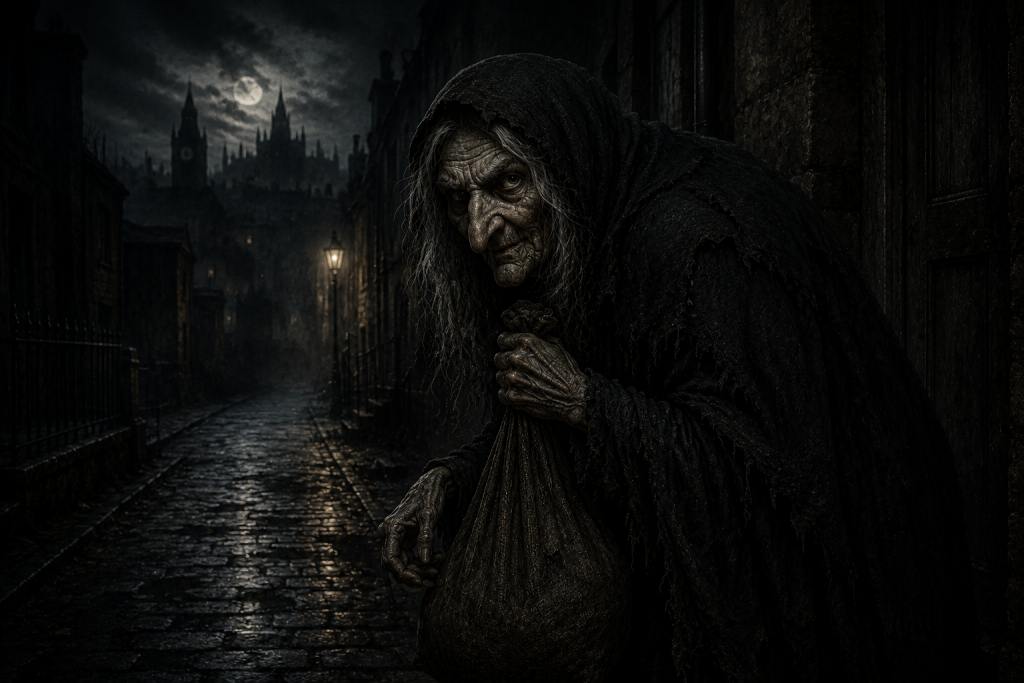

Glasgow has a particular talent for producing bogeymen. Not the vague, shapeless kind that could belong to anywhere, but specific, located figures with names and addresses and a consistent set of behaviours that parents passed down to children for generations. Jenny wi’ the Iron Teeth is the oldest of them. She is also, when you look closely at the evidence, the most important, because she did not disappear. She just kept coming back in different forms.
Understanding Jenny means understanding something about how Glasgow’s folk tradition actually works, and why a city that was being industrialised and modernised at speed still found room for monsters that would not go away no matter how many gas lamps or electric lights were installed.
Who Was Jenny wi’ the Iron Teeth?
The earliest version of Jenny is rooted in a very specific place. Glasgow Green, the oldest public park in the city, sits on the north bank of the Clyde and has been common land since at least the 15th century. By the early 19th century it was surrounded by the growing city on all sides, and it was here that Jenny was said to haunt: a monstrous hag with iron teeth who prowled the edges of the green looking for children who had stayed out too late or wandered too far from home.
The iron teeth are the detail that makes her distinctive and the detail that stuck across every subsequent retelling. In a city being built on iron and steel, where the sound of foundries was part of the daily texture of life, giving your bogeyman iron teeth was not an arbitrary choice. It was the most frightening material available, the stuff that built the city and that could just as easily destroy the people in it.
Local historian Hugh Macintosh, writing in his 1902 book on the origins and history of Glasgow streets, provides one of the most grounded accounts of where Jenny might have actually come from. Near Glasgow Green, he records, there was a shed owned by two elderly women, one of whom had received particularly poor dental work that left iron fillings clearly visible in her teeth. Children, with the instinct children have always had for identifying and magnifying the unusual in the people around them, seized on this detail. The woman, possibly named Allan, became the template. The iron teeth were real before they were legendary.
That is how a great deal of folk tradition actually starts. Not with a deliberate story but with a real person, a real detail, and a community that needed a way to talk about something. The woman near Glasgow Green becomes Jenny wi’ the Iron Teeth in the same way that a real woman in Derry became part of the Maggie Murphy legend that would later terrify children across Glasgow and the central belt. The raw material is always something real. What folklore does is give it shape and purpose.
The Poem That Kept Her Alive
Jenny might have remained a purely local figure, known only to the children of Glasgow Green and the streets around it, if it were not for Alexander Anderson. Anderson was a Scottish poet born in Kirkconnell in 1845 who worked as a surfaceman on the railways and wrote verse under the pen name Surfaceman. In 1879 he published a poem called Jenny wi’ the Airn Teeth, written in Scots dialect, in which a parent threatens a child with Jenny as a way of getting them to sleep.
The poem is a bedtime threat in verse form. Jenny is summoned by parents who have run out of patience, a creature who will come for children who will not settle, who will carry them off to her den and use those iron teeth on them. The bowgie, an old Scots term for a bogeyman figure, is invoked alongside her, placing Jenny firmly within a specific Scottish tradition of child-frightening folk figures rather than presenting her as something unique or isolated.
What the poem did was fix Jenny in the cultural memory of central Scotland in a way that a purely oral tradition might not have managed. It gave her a form that could be printed and shared and read aloud and remembered. By the time the 20th century arrived, Jenny wi’ the Iron Teeth was not just a Glasgow Green legend. She was a figure known across the west of Scotland, carried in the memory of anyone who had been threatened with her as a child and who passed that threat on in turn.
There is also a connection worth noting to an older and wider tradition. Jenny shares her name and something of her character with Jenny Greenteeth, an English water spirit known for dragging children to a watery grave. Glasgow’s Jenny was differentiated by her iron teeth rather than green ones, and by her connection to the city rather than to water, but the underlying figure, a monstrous female entity who takes children, belongs to a tradition that runs through British folk belief at a level that predates any individual legend.
The Same Story, Three Times
Here is where it gets interesting. If you look at the child-stealing bogeymen of Glasgow across the 19th and 20th centuries, you see the same figure appearing again and again in different clothes.
Jenny wi’ the Iron Teeth haunts Glasgow Green in the early 1800s: a hag with metal teeth who takes children who misbehave or stay out too late. By the late 1800s, Maggie Murphy has arrived in Glasgow with the Irish immigrant community, a woman who runs a home for naughty children and comes out at night to find new ones to take. She is attached to real locations, real institutions, and a real history of Irish migration to the city. The iron teeth have gone but the mechanism is identical: a female figure, a threat directed at children, a specific location, and a set of behaviours that made sense to the community that produced them.
Then in September 1954, in the Gorbals, hundreds of children go looking for a seven-foot vampire with iron teeth who has been eating local children. The iron teeth are back. The child-eating is back. The location has shifted from Glasgow Green to the Southern Necropolis, and the figure has become male and vampiric rather than hag-like, but the core of the story has not moved at all. Something with iron teeth is taking children, and it lives somewhere specific in Glasgow, and the community needs to respond to it.
This is not coincidence. It is the same fear cycling through a city across a hundred and fifty years, finding whatever vessel the current moment makes available. In an industrial city dominated by iron and steel, iron teeth are the natural language of threat. In a city with a history of child poverty and high infant mortality, a creature that specifically targets children is the natural shape of danger. Jenny did not die. She transformed.
What Jenny Actually Represents
Child-stealing bogeymen serve a practical function in folk tradition. They are a tool for managing the behaviour of children in environments where unsupervised children faced real dangers. Glasgow Green in the early 19th century was not a safe place for small children after dark. The streets around it were busy, poorly lit, and bordered by a river that had already taken more than its share of Glasgow’s young. A monster that specifically targeted children who stayed out too late or wandered too far was a way of encoding a genuine safety concern in a form that children would actually remember and respond to.
As Glasgow grew and changed, the dangers changed with it. The threat of the industrial workhouse, the fear of institutions that separated children from families, the anxiety about what poverty and overcrowding were doing to the city’s youngest residents. All of these found expression in the folk figures that circulated in working-class communities across the 19th and early 20th centuries. Maggie Murphy, with her home for naughty children, reflects exactly those anxieties. Jenny, with her iron teeth and her association with the foundries and factories, reflects the industrial city itself turned predatory.
By 1954, those anxieties had shifted again. Post-war Gorbals was still desperately poor, still overcrowded, still a place where children faced dangers that children in other parts of the city did not. The Gorbals Vampire gave those dangers a face and a name and a location in exactly the same way Jenny had a hundred and fifty years earlier. The fact that it was called a vampire rather than a hag, and that horror comics took the blame, does not change what it actually was: the latest version of a very old Glasgow story.
All three figures belong to the same tradition. Reading them together tells you something that reading any one of them alone does not: that Glasgow has been processing fear through the same mechanism for nearly two centuries, and that the iron teeth at the heart of the tradition are not an arbitrary detail but the city’s own industrial nature turned into a monster and pointed at its children.
If you enjoyed this article, the creatures and legends of Scotland are collected in my book Tales of Myth and Magic, Volume I: Scotland — 25 tales told in full, each traced to its earliest sources, with a map, glossary, and full bibliography. Available in paperback for £11.99.
Find Out More →Further Reading
If this article sparked your interest, these are the books worth reading next.
Scottish Urban Legends: 50 Myths and True Stories
by Aaron Mullins — fifty Scottish urban legends including stories from Glasgow, Edinburgh, and the Highlands. The kind of tradition that Maggie Murphy belongs to, collected properly in one volume.
Scottish Urban Myths and Ancient Legends
by Grace Banks and Sheena Blackhall — vampires, werewolves, devil encounters, and the school playground legends of Scotland. A genuinely good collection of the stories Scots have been telling each other for generations.
The Lore of Scotland: A Guide to Scottish Legends
by Jennifer Westwood and Sophia Kingshill — the most comprehensive collection of Scottish legend in print, covering Glasgow to Shetland, exploring origins and historical basis. Endorsed by Terry Pratchett as the real macabre.
The Maggie Murphy article picks up where Jenny leaves off, tracing the tradition from the Irish immigrant community into the tenements of the central belt. The Gorbals Vampire article shows where it ends up in 1954, and why hundreds of children armed themselves and went looking for it in a cemetery. The Glasgow Folklore page has every article on the city’s dark history in one place.
Never miss a myth
Thank you for being here. The site is brand new and every subscriber genuinely means something to me. If you're here, you care about this stuff as much as I do - and that's all the reason I need to keep going. New stories, videos and dark folklore from around the world, straight to your inbox. No algorithm. Just the stories, when they're ready.