
Look at Glasgow’s coat of arms long enough and you start to notice that it is telling a story. A tree. A bird. A bell. A fish with a ring in its mouth. These four symbols appear on everything from the city’s official buildings to the side of Glasgow City Council vehicles, so familiar to anyone who has grown up in or around the city that they have long since stopped registering as anything other than decoration.
They are not decoration. They are the compressed remnants of a founding mythology, four miracle stories attached to the man who established the first Christian community on the banks of the Molendinar Burn in the sixth century and gave the city his blessing and his name. That man was Kentigern, known to Glasgow as Mungo, which means dear one, and his story begins not with a church or a prayer or an act of quiet piety, but with a woman thrown from a cliff while pregnant, set adrift in a boat on the Firth of Forth, and washed ashore to give birth to the boy who would found Scotland’s largest city.
The Mother Who Should Not Have Survived
The story of St Mungo begins with his mother, Teneu, and it begins in violence.
Teneu was a princess of the kingdom of Gododdin, daughter of King Leudonus of Lothian, a powerful ruler of the region now known as East Lothian. She was, by the accounts preserved in Jocelyn of Furness’s twelfth century biography of Mungo, devoted and pious from a young age, and she had made a private vow of chastity in the manner of early Christian women who dedicated themselves to religious life before the formal structures of the church had fully established themselves across the region.
What happened next depends on which version of the tradition you follow. In most accounts, Teneu was assaulted by a young man named Owain, son of a Welsh prince, who disguised himself as a woman to gain access to her and who is variously described as acting through desire or as carrying out a plan to force a marriage alliance with her father’s kingdom. In either case, Teneu became pregnant. And in the world of sixth century Lothian, an unmarried pregnant princess was a crisis of the first order.
Her father’s response was absolute. Teneu was sentenced to death. She was taken to the summit of Traprain Law, the great volcanic hill that still rises above the East Lothian landscape near Haddington, and thrown from the top.
She survived.
This is the first miracle attached to the story of Glasgow’s founding saint, and it happened before he was even born. The tradition does not explain precisely how Teneu survived a fall that should have killed her. It simply records that she did, and that her survival was understood by those who witnessed it as something that lay outside the ordinary operation of the world.
Her father, presented with a daughter who had been thrown from a cliff and lived, reached the conclusion that something sufficiently uncanny was protecting her that ordinary execution was not going to serve. He ordered her placed in a small boat without oars and set adrift on the Firth of Forth.
The boat carried her west, and eventually north across the Firth of Forth to the shore at Culross in Fife, where a holy man named Serf ran a monastery and took the pregnant, shipwrecked young woman in. It was there, at Culross, that Kentigern was born, sometime around 518 AD.
The Boy Serf Called Mungo
Teneu and her son were raised within the community at Culross, and it is there that the first of the four great miracle stories preserved in Glasgow’s coat of arms takes its shape.
Serf kept a pet robin, a small bird beloved to the old man and allowed to move freely through the monastery. The other boys in Serf’s care, motivated by the jealousy that the young Kentigern attracted as the teacher’s obvious favourite, killed the robin and contrived to make it appear that Kentigern had done it. When Serf discovered the dead bird, Kentigern took it in his hands and prayed over it. The robin came back to life.
This is the bird that never flew. Or more precisely, the bird that flew again after it should not have been able to fly at all.
The second miracle followed a similar pattern of jealous sabotage. Kentigern had been left in charge of the holy fire in the monastery, the flame that burned through the night as part of the community’s religious observance. The other boys put it out while he slept, hoping he would be punished for the failure. When Kentigern woke and found the fire dead, he went outside, found frozen branches on an oak tree, and held them, praying, until they ignited.
This is the tree that never grew. Or rather, the tree that bore fire in the middle of winter, producing from dead frozen wood a living flame that had no business being there.
Serf gave the boy the nickname that Glasgow has used ever since. Mungo. Dear one. The name stuck more firmly than the baptismal name Kentigern, and it is as Mungo that the man appears on every monument, every street name, and every institutional charter that bears the mark of the city he would go on to found.
The Founding of Glasgow
After Serf’s death, Mungo left Culross and travelled south and west. The account preserved by Jocelyn of Furness describes him meeting a dying holy man named Fergus, who expressed a single last wish: that his body be placed on a cart pulled by two untamed bulls, and buried wherever the bulls chose to stop. Mungo carried out this wish. The bulls moved south and west across the landscape of what is now Lanarkshire and came to rest at the edge of a small burn, the Molendinar, where it ran down to the River Clyde.
Mungo buried Fergus where the bulls had stopped and built a small church beside the burn. He called the place Glas Ghu, the dear green place in one translation, the green hollow in another, and that name, worn down and reshaped through fifteen centuries of use, became Glasgow.
The church Mungo built on the bank of the Molendinar Burn eventually became the site of Glasgow Cathedral, the magnificent medieval building that still stands in the east end of the city today, one of the very few Scottish medieval churches to have survived the Reformation unscathed. Mungo is buried in the crypt beneath the cathedral. He is still there, in the foundations of the city he built, which is fitting for a man whose entire story is about beginnings.
The Queen’s Ring and the Salmon
The third and fourth miracles attached to Mungo are connected, and together they form the most narratively satisfying of the four stories preserved in the coat of arms.
A queen, named in the tradition as Languoreth, wife of King Rhydderch of Strathclyde, was accused by her husband of giving her wedding ring to a lover. The accusation was politically devastating, the kind of charge that in the world of sixth century Strathclyde could end a marriage, a dynasty, and a life. She was innocent, but the ring was gone.
Her husband had thrown it into the River Clyde while she slept, setting up the evidence of her guilt and then accusing her of the very gift he had arranged. When Languoreth went to Mungo for help, he told her what to do. She sent a messenger to the river with instructions to catch the first fish he could, and to bring it back without opening it.
The fish the messenger caught was a salmon, and when Mungo opened it, the ring was inside.
This is the fish that never swam, preserved in the city’s coat of arms as a salmon with a ring in its mouth, and it is the miracle most Glaswegians could tell you something about even if they cannot name the others, because the image is vivid enough and the story tight enough that it lodges in the memory in a way the others perhaps do not.
The bell in the coat of arms, the bell that never rang, is understood by most traditions to refer to a bell Mungo brought back from Rome after a pilgrimage, a bell he used to mark the deaths of those in his community and to call people to prayer, and whose sound was understood to carry a supernatural quality. Some traditions describe it as a bell that rang without being struck. Others describe it as a bell whose sound could calm the most disordered mind.
The Rhyme and the City
The four miracles were compressed into a rhyme so well suited to memory that it has survived in recognisable form for centuries, still taught to Glasgow schoolchildren today:
Here is the bird that never flew.
Here is the tree that never grew.
Here is the bell that never rang.
Here is the fish that never swam.
The internal logic of this rhyme repays attention. Each line refers to a thing that did the impossible, a bird that flew after death, a tree that burned in winter, a bell that rang for those who could not ring it themselves, a fish that delivered what the river had swallowed. Each miracle is described in the negative, what the thing never did by the ordinary rules of the world, rather than what it did do, which is an oddly precise and grammatically interesting way to preserve a tradition about supernatural events.
It is also, as any teacher who has used it will confirm, impossible to forget once you have heard it, which is precisely why it was made the way it was.
A Cathedral, a Tomb, and a City Built on Legend
Glasgow Cathedral stands at the top of Cathedral Street in the east end of the city, just below the Glasgow Necropolis, and the contrast between the two sites, the medieval cathedral with its miracle-working saint’s tomb in the crypt, and the Victorian city of the dead on the hill beside it, is one of those pieces of compressed Glasgow history that rewards attention.
The crypt beneath the cathedral is where Mungo’s tomb lies, and it remains a place of genuine religious significance to the communities who maintain an active relationship with the older Christian traditions of the city. The lower church has a quality that the more visited upper floors of the building do not quite match, a weight of accumulated centuries that the stones themselves seem to carry, the knowledge that this specific place has been a site of pilgrimage and prayer for longer than almost any other still-functioning location in Scotland.
Teneu, Mungo’s mother, was eventually also recognised as a saint in her own right, Saint Enoch, whose name the city preserved in the square that bears it, St Enoch’s Square in the city centre, originally the site of a medieval church built to honour her. The church is long gone, replaced first by a Victorian railway station and then by a shopping centre, which is the kind of transformation that Glasgow’s history tends to produce without apparent irony.
The Coat of Arms on Every Corner
The four miracle symbols appear throughout Glasgow with a frequency that makes them genuinely unavoidable once you know what you are looking at. Official buildings, street furniture, council signage, institutional letterheads, sports club crests, pub signs, academic institutions. The tree, the bird, the bell, the fish.
Most of the people who see it every day do not know the story behind it, or know only fragments. The salmon with the ring is the one that tends to get explained, because the ring in the mouth is immediately puzzling in a way that prompts questions.
But behind every tree and every bird on every lamppost and building in Glasgow is a specific story rooted in the sixth century: a woman who survived being thrown from a cliff and set adrift without oars, a boy born of that miracle who went on to perform others, two frozen branches that burned at his prayer, a robin that woke from death in his hands, a ring returned from inside a salmon’s stomach, and a pair of bulls that stopped at the bank of a small burn in the valley of the Clyde and went no further.
That is where the city began. It is where the cathedral stands. It is where Mungo is buried.
Glasgow’s founding story is stranger and darker and more genuinely mythological than most people who live in the city have ever had the chance to realise.
The coat of arms has been trying to tell it for centuries.
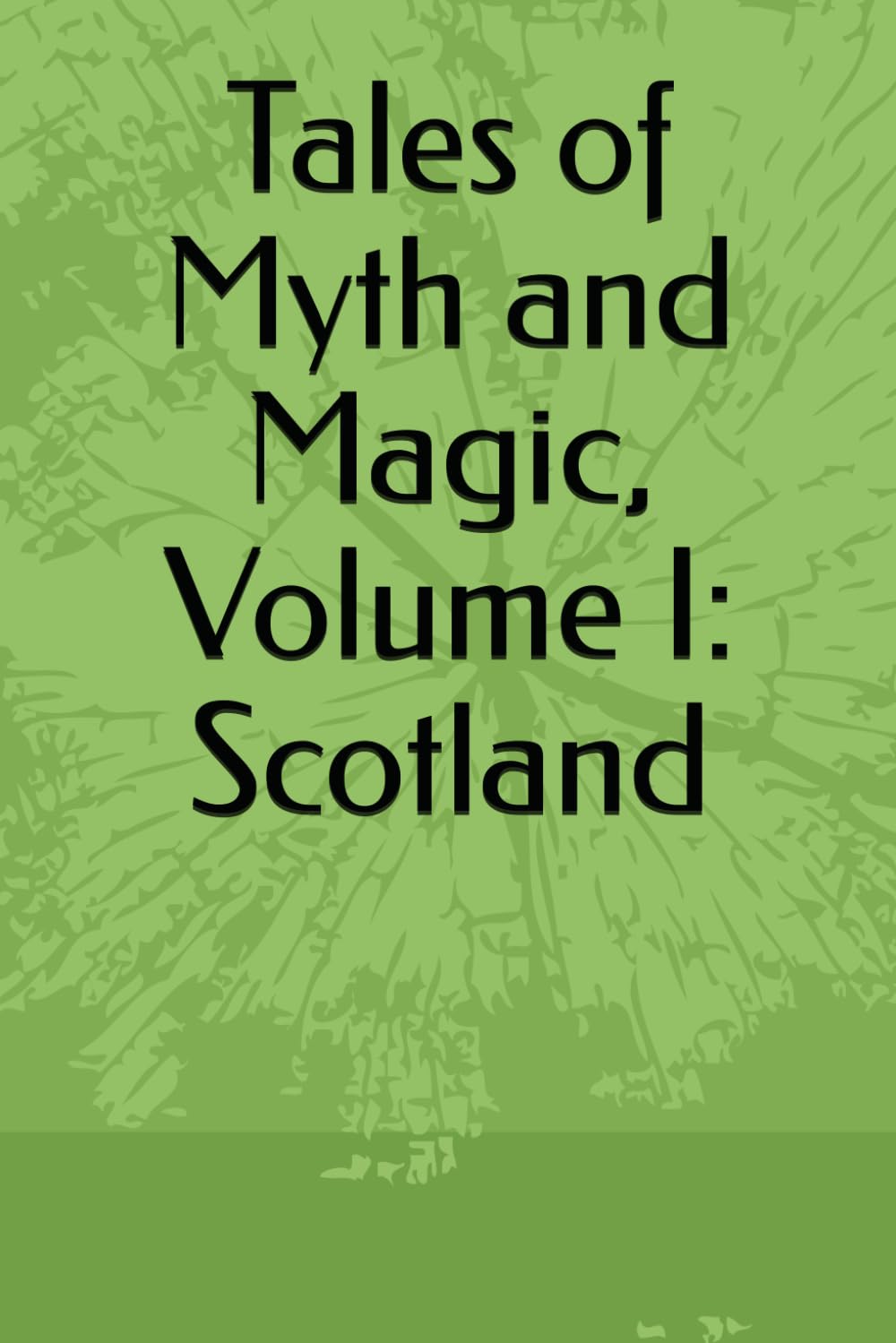
If you enjoyed this article, the creatures and legends of Scotland are collected in my book Tales of Myth and Magic, Volume I: Scotland — 25 tales told in full, each traced to its earliest sources, with a map, glossary, and full bibliography. Available in paperback for £11.99.
Find Out More →Further Reading
If this article sparked your interest, these are the books worth reading next.
Scottish Urban Legends: 50 Myths and True Stories
by Aaron Mullins — fifty Scottish urban legends including stories from Glasgow, Edinburgh, and the Highlands. The kind of tradition that Maggie Murphy belongs to, collected properly in one volume.
Scottish Urban Myths and Ancient Legends
by Grace Banks and Sheena Blackhall — vampires, werewolves, devil encounters, and the school playground legends of Scotland. A genuinely good collection of the stories Scots have been telling each other for generations.
The Lore of Scotland: A Guide to Scottish Legends
by Jennifer Westwood and Sophia Kingshill — the most comprehensive collection of Scottish legend in print, covering Glasgow to Shetland, exploring origins and historical basis. Endorsed by Terry Pratchett as the real macabre.
For more on Glasgow’s history and folklore, the Witches of Pollok House article covers what happened on the Maxwell estate in 1676. The Granny Kempock article covers the ancient stone above the Clyde that sailors feared to offend. The Glasgow Folklore page has every article on the city’s dark and founding history in one place.
Never miss a myth
Thank you for being here. The site is brand new and every subscriber genuinely means something to me. If you're here, you care about this stuff as much as I do - and that's all the reason I need to keep going. New stories, videos and dark folklore from around the world, straight to your inbox. No algorithm. Just the stories, when they're ready.