
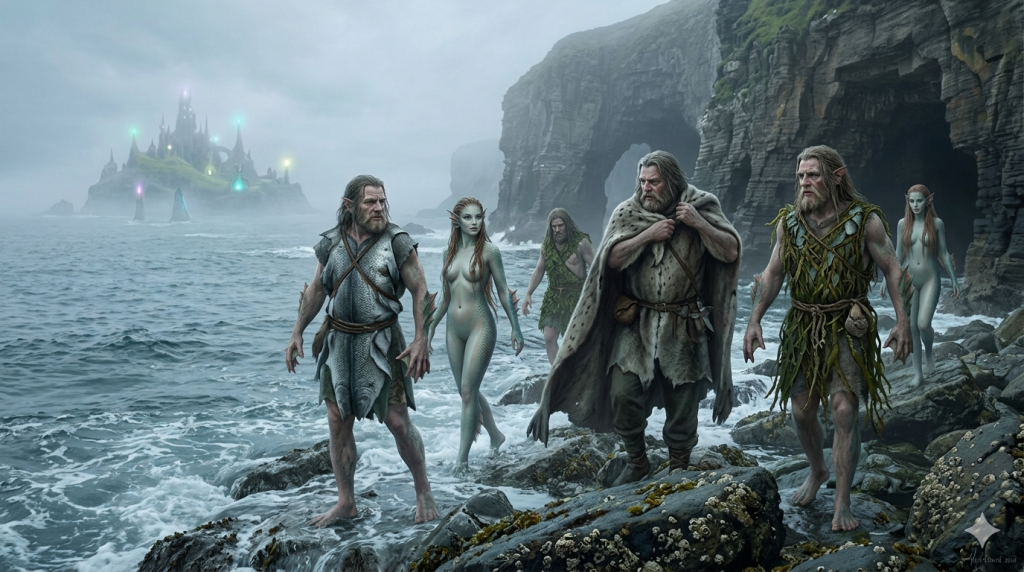
The mermaids of popular imagination are gentle things. Beautiful, curious, tragic perhaps, but essentially passive. They sit on rocks and comb their hair and long for a world they cannot quite reach. They do not, as a rule, come ashore and take you.
The Finfolk of Orkney are not those mermaids.
In the folklore of the Orkney Islands, the sea people are something considerably more dangerous, considerably more deliberate, and considerably more interested in the human world than the sanitised tradition of mer-mythology would suggest. They cross between the worlds of sea and land with a fluid ease that should be unsettling, because it means that the barrier you might reasonably expect to exist between yourself and whatever lives beneath the water is, in Orkney tradition, essentially no barrier at all. The Finfolk move through it as though it were not there. And when they come ashore, they come with purpose.
What the Finfolk Are
The Finfolk are a race of shapeshifting beings in Orcadian folklore, sorcerers of the sea who spend their winters in Finfolkaheem, their magnificent underwater realm, and their summers closer to the surface, around the islands and skerries of Orkney and the surrounding waters.
In their natural form, they appear as dark, sinuous figures, humanoid but with a quality that is not quite human, a fluidity to their movement and a coldness to their eyes that marks them as something other. In the water they take the form of various sea creatures, most commonly fish or seals, though unlike the Selkies of a related but distinct tradition, the Finfolk are shapeshifters by nature and by will rather than beings trapped between forms by the accident of a shed skin. They change because they choose to, and they choose to when it serves their purposes.
Their purposes are not always comfortable for the humans who live on the islands above their winter kingdom.
Finfolkaheem: The Kingdom Beneath the Water
The underwater realm of the Finfolk, Finfolkaheem, is described in Orcadian tradition as a place of extraordinary beauty. Its halls are built from coral and crystal, lit by a cold phosphorescent light, decorated with the treasures of a thousand shipwrecks. The Finfolk are wealthy in the way that creatures who have been collecting the leavings of the sea for centuries are wealthy, and their kingdom reflects that accumulated splendour.
In summer, when the Finfolk come closer to the surface, they gather on a phantom island called Hildaland, a place that could appear anywhere in the waters around Orkney and was visible to human eyes only occasionally and briefly before vanishing again. Hildaland was described as fertile and beautiful, a green island with rich grazing and clear water, glimpsed from boats and then gone before any course could be set toward it.
The disappearing island tradition in Orkney is old and consistent enough to have been taken seriously by people who had no particular investment in the supernatural. Sailors reported Hildaland across centuries. The island appeared, tantalised, and vanished. Whether this reflects a genuine atmospheric phenomenon, a mirage of some kind produced by the specific conditions of the northern sea, or something else entirely, the tradition was real and the Finfolk were its explanation.
What They Wanted From the Living
This is where the Finfolk tradition becomes genuinely dark, and where it diverges most sharply from the more romantic traditions of sea people elsewhere.
The Finfolk needed human spouses. This was not a metaphor or a poetic elaboration. In the Orcadian tradition, it was a specific and practical requirement rooted in the nature of Finfolk society. A female Finfolk, a Finwife, was a creature of considerable beauty in her youth, silver-tailed and luminous, the kind of being that might appear in the gentler kind of sea legend as an object of wonder. But without a human husband, a Finwife aged into a Finwoman, a grey and haggard creature stripped of her beauty by the cold arithmetic of unmated Finfolk existence.
The male Finfolk, the Finmen, faced a similar imperative. They needed human wives, and they took them by abduction. A woman alone on a beach, a child playing too close to the water’s edge, a fisherman’s wife watching the sea from the shore: any of these might attract the attention of a Finman who had decided the time had come to take a spouse. He would come ashore in human form, indistinguishable from an ordinary man, and when he had what he wanted he would go back to the water and take his captive with him.
Human spouses taken to Finfolkaheem did not return. They lived out their lives in the underwater kingdom, and the Finfolk children they produced were raised in the cold halls beneath the sea while their families on the islands above grieved and wondered.
This is not a tradition designed to comfort. It is a tradition designed to explain disappearances, to account for the people who went to the shore and did not come back, to give shape and name to the thing that the sea takes when it takes someone you love.
Silver and the Power It Held
The single most effective protection against the Finfolk in Orcadian tradition was silver. Specifically, silver given freely, silver thrown into the water at the right moment, silver pressed into the hand of a Finman who had come ashore in disguise.
If a Finman approached a human woman with the intention of taking her as his wife and she managed to give him silver before he could complete the abduction, he was bound to leave her alone. The silver had to be given rather than forcibly paid, and the exchange had to happen at the right moment, but the protection was understood to be absolute. A Finman who had received silver from a woman could not take her.
This gave rise to a specific protective practice in Orcadian communities: women and girls were advised to carry silver on their person whenever they went near the shore alone. A silver coin, a silver ring, any piece of silver that could be quickly offered. It was the kind of practical measure that makes most sense in a community that took the Finfolk seriously as a genuine risk rather than a narrative device.
The silver weakness connects the Finfolk to a broader tradition of supernatural beings who are vulnerable to precious metals, a tradition that appears in various forms across European folklore. But the specific form it takes in Orkney, the voluntary gift rather than the weapon, the exchange rather than the attack, suggests a particular logic. The Finfolk were not mindless predators. They could be negotiated with, if you knew the terms.
If you want more like this, the Tales of Myth and Magic newsletter delivers new creatures, legends, and forgotten folklore straight to your inbox.
No fixed schedule. No noise. Just the stories, when they are ready.
Sign up here →The Fisherman’s Tools
Men had their own methods of protecting themselves and their families from Finfolk attention. Fishermen in Orkney developed a set of practices specifically aimed at keeping the Finfolk away from their boats and their catches.
Certain words were considered protective, spoken quietly before setting out. Iron, as in so many Scottish supernatural traditions, offered some degree of protection. The drawing of a circle around a boat with a hot iron, or the carrying of iron on the person, was understood to provide a barrier against Finfolk interference with the catch or with the fisherman himself.
The Finfolk were believed to meddle with fishing in specific ways. They could drive fish away from an area, depleting the catch of anyone who had attracted their displeasure. They could cause nets to tangle or break. They could send storms, because the Finfolk were sorcerers as much as sea creatures, and their command of weather magic was one of the most consistently noted characteristics in the tradition.
This sorcerous quality is important. The Finfolk are not simply sea monsters or supernatural predators. They are practitioners of a dark and sophisticated magic, beings who have spent long enough in the world to have accumulated knowledge and power that ordinary creatures, human or animal, cannot match. Crossing a Finman was not just physically dangerous. It was the kind of dangerous that left marks you could not always see.
The Selkie Question
Anyone familiar with Orcadian and Shetlandic folklore will notice that the Finfolk tradition overlaps in some respects with the better-known tradition of the Selkies, the seal people who shed their skins to take human form and who are among the most melancholy and beautiful figures in northern folklore.
The relationship between the two traditions is genuinely complex, and scholars of Orcadian folklore have debated it in detail. The folklorist Ernest Marwick, who did more than anyone to document and preserve Orcadian folk tradition in the twentieth century, argued that the Finfolk and the Selkies represent a distinct but related set of beliefs, possibly drawing on the same deep well of northern sea mythology but developing differently in different communities and different periods.
The Selkie tradition tends toward tragedy and longing. The seal woman who loses her skin and is trapped on land, who longs for the sea while her human husband hides the one thing that could free her, who eventually finds the skin and returns to the water, leaving her human children behind: this is a story about belonging and loss and the impossibility of fully inhabiting two worlds at once.
The Finfolk tradition is darker and more predatory. These are not trapped creatures longing for freedom. They are beings with agency and intention, who cross between worlds because it suits them and who take from the human world what they have decided they need. The Selkie is a figure of sympathy. The Finfolk are a figure of threat.
Both traditions, it should be noted, were taken seriously by the communities that lived alongside the sea in Orkney, and both served the function of giving form and name to the specific dangers and griefs of a life lived in intimate relationship with water that was beautiful and necessary and occasionally took people away forever.
Orkney’s Sea and What It Holds
The waters around Orkney are among the most dramatic in the British Isles. The tidal races through the sounds between the islands are powerful enough to have generated significant renewable energy in the modern era. The sea here is not the gentle thing of southern coastlines. It is fast and cold and deeply unpredictable, and it has taken a toll on the communities of the islands across every century of their habitation.
The Finfolk are what that sea looks like when a mythology-making intelligence tries to account for its behaviour. The beautiful kingdom beneath the surface explains why the sea is so compelling, why people are drawn to it even knowing its dangers. The abducting Finmen explain the people who went down to the shore and did not return. The silver protection explains why some people came back from encounters with the sea’s worst moods and others did not.
This is not to reduce the tradition to a simple psychological mechanism. The Orcadians who believed in the Finfolk were not using them as a metaphor. They believed in them because the sea was real and its dangers were real and the Finfolk were the shape that those dangers took when the darkness under the water moved toward the surface.
The waters around Orkney have not changed. They are still cold and fast and deeper than you can easily imagine. Whatever the Finfolk were, whatever gave rise to the tradition that kept generations of Orcadian women carrying silver to the shore and fishermen speaking quiet words before they set out, it has not entirely gone.
The sea keeps its own counsel. It always has.
Further Reading
If this article sparked your interest, these are the books worth reading next.
Scottish Urban Legends: 50 Myths and True Stories
by Aaron Mullins — fifty Scottish urban legends including stories from Glasgow, Edinburgh, and the Highlands. The kind of tradition that Maggie Murphy belongs to, collected properly in one volume.
Scottish Urban Myths and Ancient Legends
by Grace Banks and Sheena Blackhall — vampires, werewolves, devil encounters, and the school playground legends of Scotland. A genuinely good collection of the stories Scots have been telling each other for generations.
The Lore of Scotland: A Guide to Scottish Legends
by Jennifer Westwood and Sophia Kingshill — the most comprehensive collection of Scottish legend in print, covering Glasgow to Shetland, exploring origins and historical basis. Endorsed by Terry Pratchett as the real macabre.
Never miss a myth
Thank you for being here. The site is brand new and every subscriber genuinely means something to me. If you're here, you care about this stuff as much as I do - and that's all the reason I need to keep going. New stories, videos and dark folklore from around the world, straight to your inbox. No algorithm. Just the stories, when they're ready.
Pingback: Selkies: The Seal People of Orkney and the Sorrow They Left Behind - Tales of Myth and Magic