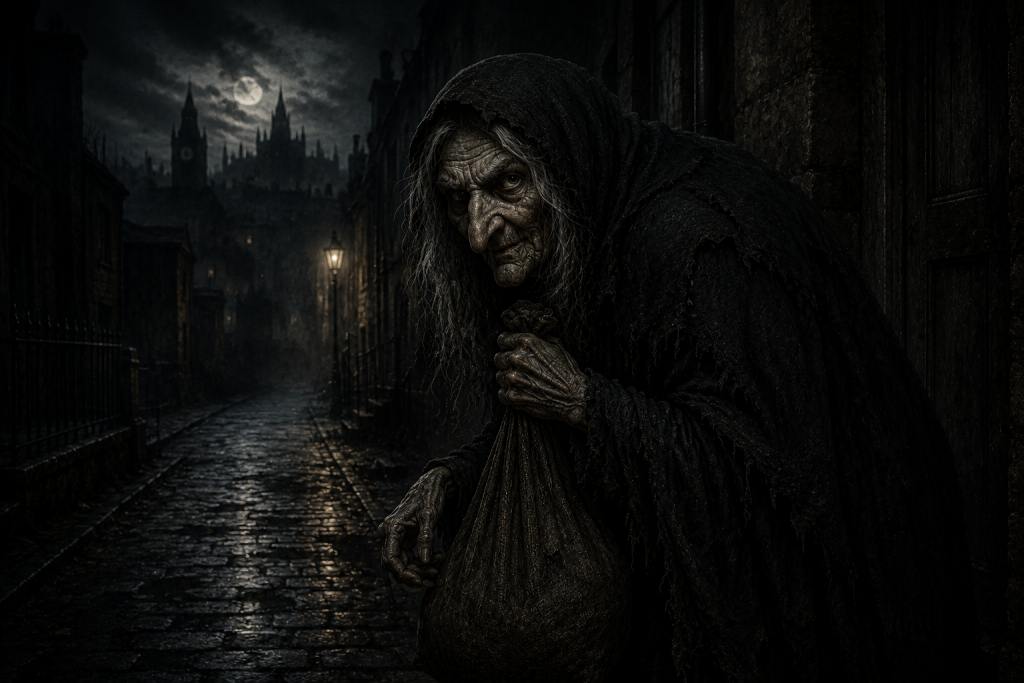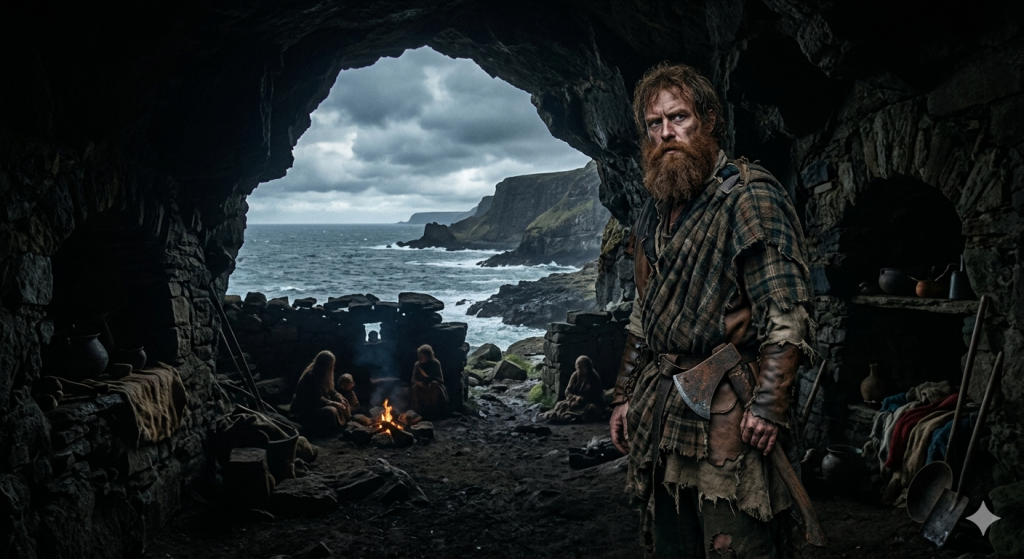
There is a cave on the Ayrshire coast, cut into the rock by centuries of tide and wind, that runs deep enough into the cliff face that daylight does not reach its furthest chambers. Local tradition has a name for it. It is called Bennane Cave, and if the most notorious legend in Scottish history is to be believed, it was home for twenty-five years to a man named Alexander Bean, his wife, and a clan of inbred children and grandchildren that eventually numbered over forty souls. They never farmed. They never traded. They never emerged into the daylight if they could help it.
They ate people instead.
The legend of Sawney Bean is one of the darkest stories attached to any landscape in the British Isles. It involves murder on a scale that, if true, would represent one of the most prolific killing sprees in recorded history. It involves cannibalism, incest, and a cave full of salted and pickled human remains. It ends with a royal manhunt, a mass execution, and a warning about what might be living in the places you cannot see.
Whether it actually happened is another matter entirely.
The Story as It Has Been Told
Alexander Bean, known as Sawney, was said to have been born in East Lothian sometime in the late fourteenth or early fifteenth century, the son of a hedger and ditcher who raised him to honest labour. Sawney had no interest in honest labour. He left home with a woman described in the sources as vicious and barbarous in her nature, and the two of them made their way to the coast of Ayrshire, where they found the cave at Bennane Head and settled in it.
They did not seek employment. They did not beg. From the beginning, the story goes, they sustained themselves by ambushing travellers on the coastal roads, killing them, robbing them, and bringing the bodies back to the cave.
Over twenty-five years, Sawney and his wife had a large number of children, and those children had children with each other, and the clan grew until it numbered, depending on which version of the story you follow, somewhere between forty and forty-eight individuals. All of them lived in the cave. All of them participated in the ambushes. The human remains that accumulated in the cave were preserved in salt or pickled, and when fresh meat was not available the clan ate what they had stored.
Limbs and body parts that could not be used were thrown into the sea, and when they began washing up on nearby coastlines, the suspicion and panic they generated fell on innocent people. Innkeepers whose guests had disappeared were accused and executed. The actual source of the remains went undiscovered for years, partly because no one who encountered the Bean clan survived to report back.
The end came when the clan attacked a man and his wife returning from a fair. The man was an experienced fighter, apparently, and managed to keep the clan off long enough for a large group of other fairgoers to come around the bend in the road and find him surrounded. The clan retreated rather than face numbers, and for the first time there were witnesses who had seen them and survived.
The report reached King James VI, who led a personal manhunt to the Ayrshire coast with four hundred men and a pack of bloodhounds. The dogs led them to Bennane Cave. What they found inside, the salted flesh, the pickled limbs, the accumulated evidence of decades of killing, reportedly caused hardened soldiers to weep.
The clan was taken to Edinburgh or Glasgow, depending on the source, and executed without trial. The men had their hands and feet cut off and bled to death. The women and children were burned alive. None of them, the story insists, showed any remorse.
The Problem With the Evidence
Here is where the story becomes considerably more complicated.
There is no contemporary record of Sawney Bean. None. Not in the court records of James VI, not in the legal documents of the period, not in the local records of Ayrshire or Edinburgh, not in any contemporary account that historians have been able to locate. For an event that supposedly involved a royal manhunt with four hundred men and a mass execution of over forty people, the absence of any documentation from the time is extraordinary.
The earliest written accounts of Sawney Bean that survive date to the eighteenth century, well over two hundred years after the events they describe were supposed to have taken place. They appear in broadsides and popular pamphlets, the tabloid press of their day, publications that were not known for rigorous fact-checking and that had a strong commercial interest in providing their readers with the most sensational material available.
The historian Louise Yeoman, among others, has examined the Sawney Bean legend in detail and concluded that there is no credible evidence it ever happened. The story has the structure of a moral panic and a folk legend rather than a historical event. It contains the elements that such stories always contain: the hidden evil in plain sight, the innocent victims of suspicion while the real culprit goes undetected, the eventual revelation and the satisfying mass punishment, the king himself riding out to restore order.
There is also the awkward matter of the timeline. Different versions of the story place Sawney Bean under different Scottish monarchs, ranging from James I in the early fifteenth century to James VI in the late sixteenth. A legend that cannot settle on which century it occurred in is a legend that is struggling with its own factual basis.
What the Legend Is Made Of
None of this means the Sawney Bean story is without interest or importance. Quite the opposite. A legend this powerful and this persistent, attached so specifically to a real landscape, demands examination precisely because of what it is made of.
Cannibalism as a folk horror motif appears across cultures as one of the most fundamental transgressions available to narrative. It is the ultimate breaking of the social contract, the reduction of other human beings to mere meat, the denial of their humanity in the most literal possible way. Stories about cannibals serve a function: they define the outer boundary of what a community considers human behaviour, and they locate that boundary violation in a specific, nameable individual or group.
The Beans, in the legend, are also marked by incest, another fundamental transgression, and by their removal from ordinary society into a cave, a liminal space that is neither fully of the earth nor of the human world. They are people who have placed themselves outside every category of civilised existence and in doing so have become something that can be exterminated without moral complication. The story requires no agonising over their execution because it has already established that they are not quite people anymore.
This is a narrative structure with deep roots. It appears in Beowulf, in which Grendel and his mother are monstrous cave-dwellers who prey on the civilised world of the mead hall. It appears in ogre and giant stories across Europe. The Sawney Bean legend may be drawing on this very old template and dressing it in the specific clothing of Scottish coastal geography and royal authority.
Bennane Cave and the Real Landscape
Whatever the truth of the legend, Bennane Cave is real, and it is worth visiting for its own sake.
Located on the Ayrshire coast between Girvan and Ballantrae, the cave is accessible at low tide and does indeed run deep into the cliff. It is genuinely large enough to have housed a significant number of people, which is one of those details that gives even the most sceptical visitor a moment of pause. The physical plausibility of the cave as a hiding place is not in question.
The stretch of Ayrshire coast around Bennane Head is wild and beautiful and, away from the main road, surprisingly isolated even today. In the fifteenth or sixteenth century, before proper roads and regular traffic, it would have been remote in a way that is difficult to fully imagine now. The coastal paths that travellers used would have been lonely, and the opportunities for ambush would have been considerable.
Whether the Beans used those opportunities or not, the landscape makes the story feel possible in a way that purely invented legends sometimes do not. Someone looked at that cave and that coastline and thought: yes, this is where something like that could happen. And that geographical imagination, that rooting of the darkest possible story in a real and specific place, is part of what has kept the legend alive for centuries.
If you want more like this, the Tales of Myth and Magic newsletter delivers new creatures, legends, and forgotten folklore straight to your inbox.
No fixed schedule. No noise. Just the stories, when they are ready.
Sign up here →The English Connection and the Anti-Scottish Reading
It is worth noting, because intellectual honesty requires it, that the Sawney Bean legend gained much of its early traction in English publications during a period of considerable political tension between England and Scotland. The eighteenth century pamphlets that first gave the story wide circulation were produced in London, and some historians have read the legend as carrying an anti-Scottish subtext, the barbarous Scots lurking in caves and eating their neighbours while civilised England looked on in horror.
This does not mean the legend was invented wholesale as propaganda. Folk legends rarely work that simply. But it does mean that the form the story took, the specific emphases, the gleeful accumulation of transgressive detail, may have been shaped in part by an audience that was not entirely neutral about Scottish character and civilisation.
Scotland has its own complicated relationship with the legend. It is both embarrassing and compelling, a story that reflects nothing good about the country it is set in and yet has become a perverse point of cultural pride. Sawney Bean appears on tourist merchandise. Bennane Cave gets visitors. The legend has been adapted into films and novels and inspired countless horror writers. It has taken on a life entirely independent of the question of whether it actually happened.
Did Any of It Happen?
Historians are largely agreed that Sawney Bean as described did not exist. The story is almost certainly a legend, assembled from older folk motifs and given a specific Scottish location and a specific royal resolution at some point in the early modern period.
But the completely invented legend is perhaps not the only alternative to straightforward historical fact. Scottish coastal communities in the medieval period were not immune to violence, to banditry, to the kind of desperate survival behaviour that prolonged isolation and poverty can produce. The roads were genuinely dangerous. People did disappear. Bodies did wash up on beaches without obvious explanation.
It is possible, and some folklorists have suggested, that the Sawney Bean legend crystallised around a genuine but much smaller and less dramatic kernel of real events, a particularly violent family of coastal bandits whose crimes were elaborated over generations of retelling into something altogether more monstrous. This is how many folk legends work. The real event provides the seed, and the imagination of the community grows something extraordinary from it over time.
What actually lived in that cave, if anything did, is a question the rock is not giving up.
A Legend That Earns Its Place
The Sawney Bean story has survived for centuries without the support of a single contemporary document, without archaeological evidence, without anything except the power of the narrative itself and the unsettling plausibility of that cave on the Ayrshire coast.
That is, in its own way, remarkable. Most fabricated stories fade when the facts are examined. The Sawney Bean legend absorbs scepticism and continues. People visit the cave. People retell the story. People feel, standing in that dark space with the sound of the sea behind them and the rock closing in above, that something very bad might once have happened here.
Perhaps that feeling is the only kind of evidence that matters for a legend of this type. Not proof that it happened, but proof that it could have. Proof that the darkness is real, that the cave is real, that the coast is real, and that the human capacity for the kind of behaviour the legend describes is also, unfortunately, entirely real.
Sawney Bean may never have existed. But whatever he represents has always been with us.
The cave is still there. The tide still goes in and out. And the road along that stretch of Ayrshire coast is still, on certain nights, very quiet indeed.
Further Reading
If this article sparked your interest, these are the books worth reading next.
Scottish Urban Legends: 50 Myths and True Stories
by Aaron Mullins — fifty Scottish urban legends including stories from Glasgow, Edinburgh, and the Highlands. The kind of tradition that Maggie Murphy belongs to, collected properly in one volume.
Scottish Urban Myths and Ancient Legends
by Grace Banks and Sheena Blackhall — vampires, werewolves, devil encounters, and the school playground legends of Scotland. A genuinely good collection of the stories Scots have been telling each other for generations.
The Lore of Scotland: A Guide to Scottish Legends
by Jennifer Westwood and Sophia Kingshill — the most comprehensive collection of Scottish legend in print, covering Glasgow to Shetland, exploring origins and historical basis. Endorsed by Terry Pratchett as the real macabre.
Never miss a myth
Thank you for being here. The site is brand new and every subscriber genuinely means something to me. If you're here, you care about this stuff as much as I do - and that's all the reason I need to keep going. New stories, videos and dark folklore from around the world, straight to your inbox. No algorithm. Just the stories, when they're ready.