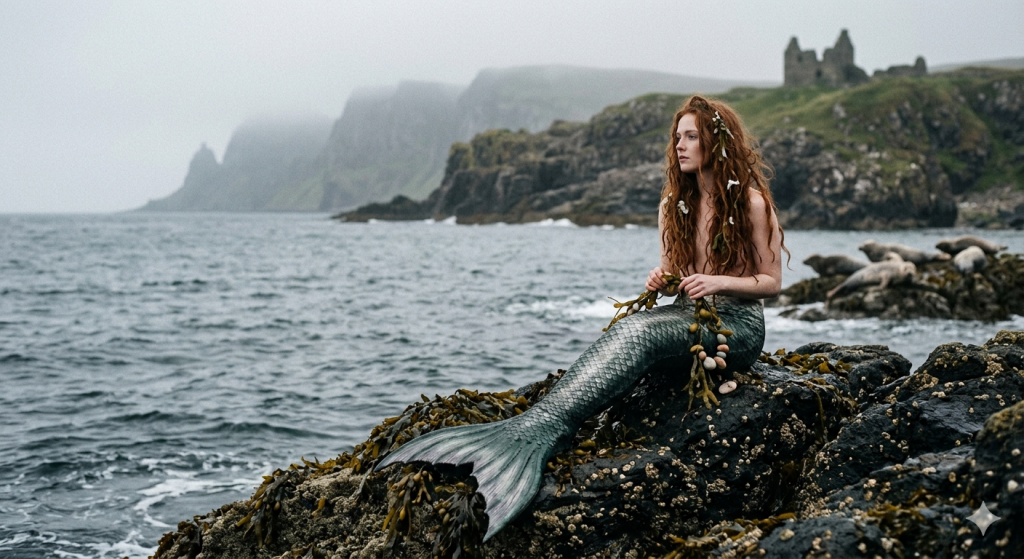
She is not the creature you have seen on the side of a coffee cup or painted on the wall of a seafood restaurant. She is not a gentle, curious thing peering up from the shallows with wide eyes and a fish tail, enchanted by the human world above the waterline. The Maighdean Mhara, the maid of the sea in Scottish Gaelic tradition, is beautiful in the way that the sea itself is beautiful, completely and dangerously and without any particular concern for what that beauty does to the people who encounter it.
She has been luring men to their deaths off the Scottish coastline for as long as there have been Scottish coastlines and men foolish enough to follow beauty toward deep water. The tradition attached to her is old and consistent and carries none of the sentimentality that later centuries layered over the mermaid figure. She is not lonely. She is not longing for legs or for love or for a life on land. She is exactly what she is, and what she is does not require human company for its own sake.
What she requires human company for is considerably less comfortable to contemplate.
What She Is and What She Is Not
Before going further it is worth being precise about where the Maighdean Mhara sits in relation to the other sea beings of Scottish tradition, because the waters here, both literal and metaphorical, can become confused.
If you have read the articles on this site about the Selkie and the Finfolk, you will already know that Scotland’s supernatural sea tradition is richer and more varied than most people realise, containing multiple distinct figures with different natures, different behaviours, and different relationships to the human world.
The Selkie is a being of profound ambiguity and melancholy, neither fully of the sea nor fully of the land, capable of genuine emotional connection with humans even when that connection ends in loss. The tragedy in Selkie stories belongs to everyone involved. The Finfolk are sorcerers and predators, intelligent and deliberate in their acquisition of human spouses, operating through deception and force but within a comprehensible social logic of their own.
The Maighdean Mhara is different from both. She is not ambiguous in the way the Selkie is ambiguous. She does not have the Finfolk’s social structure or their specific motivation. She is a creature of the deep water whose relationship with human beings is defined almost entirely by the catastrophic effect her presence has on them, an effect she may not always intend but never particularly troubles herself to prevent.
She is, in the oldest and most direct sense of the word, a siren. And Scotland’s coastline gave her plenty of opportunities to be exactly that.
The Shape of Her
The Maighdean Mhara appears in Scottish tradition as a woman from the waist up and a fish or seal from the waist down, the classical mermaid form that appears in cultures from the Mediterranean to the Pacific with enough consistency to suggest it is pointing at something real in the human experience of the sea, some quality of the water that the human imagination has always wanted to give a face and a form.
Her upper half is invariably described as beautiful in an extreme and somewhat inhuman way, the kind of beauty that registers as wrong even as it compels attention. Her hair is long and dark or long and pale depending on the account and the region, and she is often found sitting on rocks near the waterline combing it with a comb made from the bones of those she has already taken, which is the kind of detail that the tradition includes with a matter-of-factness that makes it more disturbing than any amount of Gothic elaboration would.
Her lower half, the fish tail or the seal body, is where the Maighdean Mhara tradition begins to overlap with the Selkie tradition in ways that some scholars have found confusing and others have found significant. The seal-bodied variant in particular suggests either a genuine blending of traditions at a regional level or a common root from which both the Selkie and the Maighdean Mhara eventually diverged. What distinguishes them in practice is not always the physical form but the behaviour. The Selkie can shed her skin and walk on land. The Maighdean Mhara does not shed anything. She is what she is, and what she is belongs entirely to the water.
What She Does
The Maighdean Mhara’s interactions with human beings in the tradition fall into several patterns, not all of them immediately lethal but none of them entirely safe.
The most straightforward is the simple luring. A man alone on the shore or on a boat in calm conditions becomes aware of a figure in the water, a face and a form of extraordinary beauty, and the compulsion to move toward it is described in the accounts as something beyond ordinary attraction. It is not that the man decides to follow her. It is that following her becomes the only thing that makes sense, the one obvious action in a world that has suddenly rearranged itself around her presence. He goes into the water, or he leans too far over the side of his boat, and the sea takes him, and the Maighdean Mhara is gone before anyone else arrives to see what has happened.
Whether she is deliberately luring him or simply existing in a way that has this effect on human men is a question the tradition does not always answer clearly. Some accounts treat her as a conscious predator, actively using her appearance and her voice to draw men toward the water. Others present her as something more like a natural hazard, a feature of the coastal environment whose danger is real but not intentional, no more malicious than a cliff edge or a rip current. In either case, the outcome for the man is the same.
Her voice is consistently noted in the accounts that describe direct encounters. She sings, or she makes sounds that function as singing, and the effect on those who hear it is similar to the effect of her appearance, a compulsion that bypasses the rational mind entirely and goes straight to something older and less easily reasoned with. Fishermen who heard singing from the water when no boat was visible knew to row in the opposite direction without looking back. The ones who turned to look were the ones who did not come home.
Omens and the Fate of Ships
Beyond the direct predation, the Maighdean Mhara functions in Scottish tradition as an omen figure, her appearance connected to maritime disaster in ways that were taken seriously by coastal communities as practical navigational intelligence.
To see a Maighdean Mhara was to see bad weather coming. The tradition was specific about this: a mermaid sighted near a headland or sitting on the rocks offshore meant a storm was on its way, and the storm would be severe. Fishermen who reported mermaid sightings were not laughed at by their communities. They were listened to, and the fleet stayed in harbour, and more often than not the storm came.
This omen function connects the Maighdean Mhara to a broader tradition of the sea producing signs that the experienced observer could read and act on. Certain cloud formations, certain animal behaviours, certain qualities of light on the water all carried predictive content for communities whose lives depended on getting the weather right. The Maighdean Mhara was part of this system of signs, the most dramatic and the most unambiguous: if you could see her clearly enough to recognise what she was, the conditions that would follow were going to be serious.
Some accounts extend this omen function to shipwrecks specifically. A Maighdean Mhara seen in the vicinity of a particular stretch of water was understood in some coastal communities as a sign that a wreck would occur there in the coming days. Whether she was predicting the wreck, causing it, or simply present in the areas where wrecks were most likely because those areas were already the most dangerous, the tradition did not always distinguish. She was there before disaster, and that was enough.
When She Was Caught
Several accounts in the Scottish tradition describe the capture of a Maighdean Mhara, and these stories are among the most interesting in the tradition because of what they reveal about the nature of the relationship between the creature and the human world.
The captured Maighdean Mhara is always a figure of extraordinary power even in captivity. She does not beg or weep or promise reformation. She waits, with the patience of something that knows the sea is not going anywhere and neither is she, and when she speaks it is to make specific and usually dire predictions about what will happen to her captor and his community if she is not released.
These prophecies in the accounts tend to be accurate. The fisherman who catches a Maighdean Mhara and refuses to release her finds that what she told him would happen does happen, often in the specific sequence she described. The tradition here intersects with the broader Scottish folklore of gifts and curses given by supernatural beings, the understanding that some things are better released than kept regardless of the short-term advantage their capture might seem to offer.
The correct response to catching a Maighdean Mhara, in the tradition, is to let her go. Quickly, respectfully, and without attempting to extract anything from her first. The man who releases her promptly may receive a gift, a piece of knowledge about fish or weather or hidden things in the sea that proves valuable. The man who tries to bargain with her, or who keeps her to show others, tends to feature in the darker category of Maighdean Mhara story, the kind that ends with loss and does not soften it.
If you want more like this, the Tales of Myth and Magic newsletter delivers new creatures, legends, and forgotten folklore straight to your inbox.
No fixed schedule. No noise. Just the stories, when they are ready.
Sign up here →The Children She Left Behind
Like the Finfolk and the Selkie, the Maighdean Mhara appears in some traditions in connection with human children, specifically with the children produced by unions between Maighdean Mhara and human men, though the nature of these unions in the Maighdean Mhara tradition is considerably less romantic than the Selkie stories and considerably less systematic than the Finfolk’s deliberate spouse-acquisition.
The children of a Maighdean Mhara are marked in the tradition by specific physical characteristics, webbing between the fingers, an unusual comfort in the water, an affinity for the sea that goes beyond ordinary familiarity. Several Scottish families, particularly in the island communities, claimed descent from a Maighdean Mhara ancestor, and this ancestry was understood as explaining certain family characteristics the way the MacCodrum family’s Selkie ancestry explained their prohibition on killing seals.
What the Maighdean Mhara herself felt about these children is not recorded with any consistency. In some accounts she watches over them from the water, appearing near them when they are at the shore, recognisable by a quality of attention that is not quite the attention of a seal and not quite the attention of anything else. In others she is simply gone, back to the deep water, the children a consequence of something that belonged to a specific time and place and is now over.
The children grow up knowing what they are, or half of what they are, and the sea calls to them in a way it does not call to others. Whether this is gift or burden depends on the story and on what the child eventually does about it.
The Long Tradition and What It Was For
The Maighdean Mhara tradition, like most of the supernatural traditions of Scotland’s coastal communities, was not decorative. It was functional. It encoded real and specific dangers in a form that was memorable, transmissible, and emotionally compelling enough to actually change behaviour.
The sea off the Scottish coast is genuinely dangerous in ways that are easy to underestimate if you have not spent time on it. The waters are cold enough to incapacitate a swimmer within minutes. The currents are powerful and unpredictable. The weather changes faster than any forecast can reliably track. The coastline is beautiful in ways that encourage people to go closer to it than is entirely wise, to stand at cliff edges for the view, to wade out into shallows that are not as shallow as they appear, to linger on rocks that the tide will cut off before they notice.
The Maighdean Mhara is what happens when a community decides to give that danger a face. A face that is beautiful and compelling and that will draw you toward the water if you let it, that requires active resistance rather than passive avoidance, that punishes not stupidity but something closer to enchantment, the natural human response to extraordinary beauty in an unexpected place.
She is still out there in the tradition of the communities that made her, sitting on the rocks at low tide with her comb in her hand and her hair down, singing something that carries across the water in a way that bypasses everything sensible you have ever been told about the sea.
Do not go closer.
Do not listen too long.
Do not, whatever you do, look back if you have already started walking away.
The sea is patient. The Maighdean Mhara has been waiting on those rocks longer than anyone now living can remember, and she will still be there long after the last person who remembers her name is gone.
That is the thing about the deep water. It does not need you to believe in what it contains.
It just needs you to come close enough.
Further Reading
If this article sparked your interest, these are the books worth reading next.
Scottish Urban Legends: 50 Myths and True Stories
by Aaron Mullins — fifty Scottish urban legends including stories from Glasgow, Edinburgh, and the Highlands. The kind of tradition that Maggie Murphy belongs to, collected properly in one volume.
Scottish Urban Myths and Ancient Legends
by Grace Banks and Sheena Blackhall — vampires, werewolves, devil encounters, and the school playground legends of Scotland. A genuinely good collection of the stories Scots have been telling each other for generations.
The Lore of Scotland: A Guide to Scottish Legends
by Jennifer Westwood and Sophia Kingshill — the most comprehensive collection of Scottish legend in print, covering Glasgow to Shetland, exploring origins and historical basis. Endorsed by Terry Pratchett as the real macabre.
Never miss a myth
Thank you for being here. The site is brand new and every subscriber genuinely means something to me. If you're here, you care about this stuff as much as I do - and that's all the reason I need to keep going. New stories, videos and dark folklore from around the world, straight to your inbox. No algorithm. Just the stories, when they're ready.