There is a category of supernatural being in Scottish Gaelic tradition that occupies an uncomfortable middle ground between the helpful and the terrifying, creatures that will work alongside you and protect your household and do the labour of three men through the night if the relationship is handled correctly, and will make your life a misery of poltergeist activity and livestock disasters if it is not. The Uruisg belongs to this category, and he belongs to it in a form that is specific to the Highland landscape in ways that his lowland counterpart, the Brownie, is not.
He is associated with waterfalls. With the remote pools beneath them, the dark water that collects where the force of falling water has scoured out a hollow in the rock over centuries. With the lonely places of the Highland glens where the water is loud and the light is green and filtered and the sense of being watched from the surrounding rocks is not always entirely attributable to imagination.
He has been there longer than the farms he sometimes chooses to serve. He will be there long after they are gone.
What the Uruisg Is
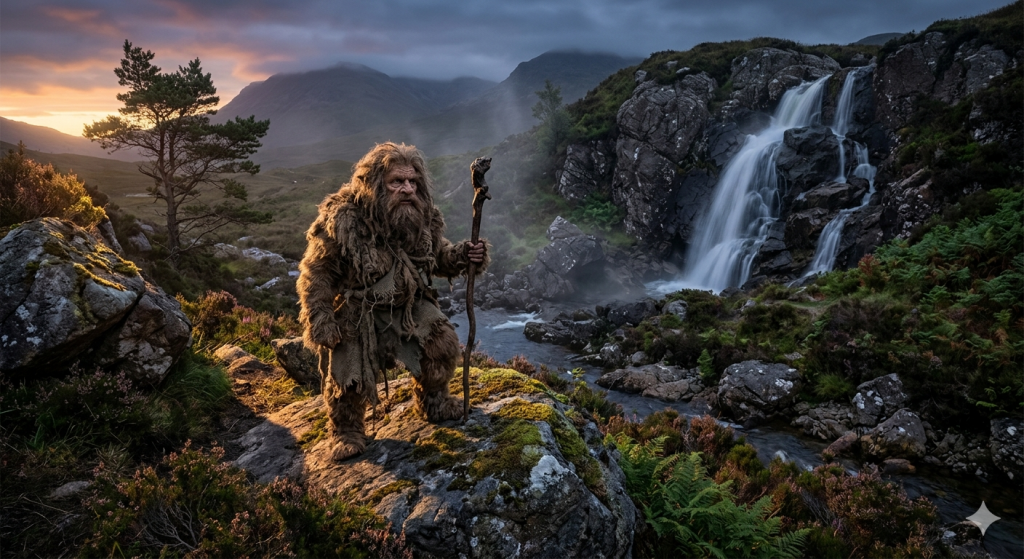
The Uruisg is a solitary supernatural being of Scottish Gaelic tradition, described as half human and half goat in his physical appearance, a combination that immediately connects him to the Glaistig in terms of the basic body plan while differing substantially in nature, behaviour, and the tradition attached to him.
His human half is typically described as large and rough, with long hair and a long beard, ungainly in his proportions and wild in his appearance in the way that solitary beings who have spent a long time alone in remote places tend to become wild. He is not beautiful in the way the Glaistig is beautiful. He is not trying to attract anyone. His appearance is the appearance of something that has adapted to its environment over a very long period and has long since stopped caring about the impression it makes.
The goat half gives him the sure-footedness of the Highland terrain he inhabits, the ability to move across the wet rocks beside waterfalls and through the steep ground of the glens with a confidence no purely human figure could manage. He is a creature of the vertical landscape, comfortable on ground that would require careful concentration from a human walker, and this physical ease in the difficult places of the Highlands is part of what makes him useful to the farming communities that occasionally benefit from his labour.
He is sometimes described as one of the Fuath, the family of malevolent water spirits in Highland tradition, though the Uruisg’s relationship with the people he attaches himself to is considerably more complex and considerably less straightforwardly hostile than the Fuath proper. The classification reflects the ambiguity that runs through his tradition rather than resolving it.
The Waterfall and the Pool
The Uruisg’s chosen habitat is specific enough to have generated a specific Gaelic term for the places he favours. The pools beneath waterfalls, the linne of the Highland landscape, are his natural domain, and certain specific pools in certain specific glens were known in regional tradition as Uruisg haunts, places where the creature had been seen or heard or felt across enough generations that the association had become as fixed as geography.
The Falls of Leny near Callander in the Trossachs are among the locations most consistently cited in the tradition. The pool beneath those falls was understood in regional folklore as an Uruisg haunt, and the quality of the place, the noise of the water, the enclosing rocks, the particular darkness of the pool even on a bright day, gives the tradition a physical plausibility that is easy to feel if you stand there and allow yourself to register the environment properly rather than simply taking a photograph.
This is characteristic of the better-grounded strand of Scottish supernatural tradition. The creatures are not placed in generic wild places. They are placed in specific locations, named and identifiable, with characteristics that make sense for the kind of being the tradition describes. An Uruisg haunt is always somewhere that has the right qualities, the falling water, the enclosing rock, the shadow, the sound that fills the space completely and makes it difficult to hear anything else, including whatever might be moving on the rocks above you.
The Household Uruisg
Like the Brownie of Lowland Scots tradition, the Uruisg could be persuaded to leave his waterfall and attach himself to a household, and when he did the benefits were substantial.
A household Uruisg worked. He worked through the night while the family slept, threshing grain, grinding meal, herding cattle, doing the heavy and repetitive labour of Highland farming with a tirelessness that no human worker could match. He asked for very little in return, typically a bowl of cream or the first milk of a new cow left in a specific location, the same kind of offering the Glaistig received but calibrated to the Uruisg’s specific preferences.
The management of a household Uruisg required the same careful attention to obligation and acknowledgement that the Glaistig tradition demanded. He had to be treated with respect rather than taken for granted. The offering had to be consistent and of the right quality. He could not be mocked or spoken of disrespectfully within his hearing, and given that he was almost certainly present in or around the house at all times, the assumption had to be that he was always within hearing.
An Uruisg who was well treated was an extraordinary asset to a Highland farming household. An Uruisg who was insulted or whose offerings were neglected became a source of chaos and destruction that made the original labour seem, in retrospect, a very reasonable price for his goodwill.
The Particular Sensitivity of the Uruisg
The Uruisg tradition is notably specific about the ways in which the creature could be offended, and the specificity is instructive about the values the tradition encodes.
He could not bear to be watched while he worked. The household that got up in the night to observe the Uruisg at his labour, however understandably curious, was a household that would find the work stopped and the Uruisg gone by morning. This prohibition on observation appears in Brownie traditions across Scotland and reflects a consistent understanding that the supernatural worker’s contribution depended on a specific kind of privacy, an acknowledgement that what was being done was being done as a gift rather than as a performance for an audience.
He was also, in many accounts, deeply sensitive to ingratitude. Not merely the neglect of offerings but the specific failure to acknowledge what he had done, the treating of his labour as simply something that happened rather than something that was given. The Uruisg who found that the household took his nightly work for granted without any recognition or appreciation was an Uruisg who was likely to make his feelings known in ways that were considerably less comfortable than the original service.
The most dangerous offence, in most accounts, was laughter. An Uruisg who was laughed at, whose appearance or behaviour became the subject of mockery within the household, departed immediately and with consequences. The Highland farming community that thought it was funny to have a half-goat creature doing their threshing did not have a half-goat creature doing their threshing for very much longer, and whatever it left behind when it went was worse than the work that would not get done.
The Uruisg Assembly
One of the most unusual and distinctive features of the Uruisg tradition is the account of their periodic gatherings, the assemblies in which the solitary creatures of different glens and different waterfalls came together in specific locations at specific times.
The traditional gathering place of the Uruisg was said to be a particular location near the Falls of Leny, and the gatherings were understood as a form of community among beings who were otherwise entirely solitary. For creatures whose normal existence was defined by isolation, the assembly represented something significant, a recognition that even the most solitary supernatural being had some form of social life, some need for contact with its own kind that the company of the humans it served could not provide.
What the Uruisgs did at these gatherings is not recorded in detail in the surviving tradition, which is itself suggestive. The assembly was known about. It was understood as a real event in the Uruisg calendar. But the details of what happened there belonged to the Uruisgs themselves rather than to the human communities who had some knowledge of their existence, a boundary between the supernatural world and the human one that the tradition apparently respected.
The gathering tradition connects the Uruisg to a broader pattern in Scottish supernatural folklore in which solitary beings have periodic communal gatherings, a pattern that appears in the fairy tradition and in various other supernatural traditions of the Highlands and Islands. It suggests that the supernatural world, in the Scottish Gaelic imagination, was not simply a collection of isolated individual beings but something with its own social organisation, its own gatherings and hierarchies and forms of community that ran parallel to the human world without quite intersecting with it.
The Trossachs Uruisg
The association of the Uruisg with the Trossachs region, the area of lochs and waterfalls and ancient woodland east of the Highland boundary fault, is strong enough in the tradition to make the Trossachs what might be called Uruisg country in the same way that Orkney is Finfolk country.
The landscape of the Trossachs is exactly what you would design if you were trying to create optimal Uruisg habitat. The waterfalls are numerous and dramatic. The pools beneath them are deep and dark. The ancient oak woodland that covers much of the valley sides creates the filtered, greenish light that the tradition consistently associates with Uruisg haunts. The rocks are wet with spray and covered in moss and fern in a way that makes them look as though they have been growing in place since before human memory begins.
Rob Roy MacGregor, whose own legend belongs to this landscape, is said in some accounts to have had an Uruisg as a companion or familiar, a detail that feels entirely appropriate for a figure who moved through the Trossachs with a knowledge of its terrain that seemed to contemporaries almost supernatural. Whether this tradition reflects a genuine folk belief about Rob Roy or a later addition to his legend is difficult to determine, but it speaks to the way the Uruisg became embedded in the specific human history of the region rather than remaining purely abstract.
If you want more like this, the Tales of Myth and Magic newsletter delivers new creatures, legends, and forgotten folklore straight to your inbox.
No fixed schedule. No noise. Just the stories, when they are ready.
Sign up here →Half and Half
The Uruisg’s hybrid form, half human and half goat, carries the same symbolic weight that it carries in the Glaistig tradition, the same positioning at the boundary between the settled domestic world and the wild landscape beyond it. He belongs to both and fully to neither, and this boundary position is precisely what makes him useful to the human world he sometimes chooses to serve.
He understands the wild places because he lives in them. He understands the domestic world because he has chosen, at various points in his existence, to participate in it. He moves between the two with an ease that no purely human or purely wild creature could manage, and that movement is the source of his value as well as the source of his dangerousness.
The goat legs that allow him to move across the wet rocks of his waterfall home are also what make him visually wrong in the domestic setting, a reminder that whatever comfort his labour brings, whatever trust the household has built up with him through careful management of the relationship, he is not a member of the household. He is a visitor from the wild places who has consented, for reasons of his own, to be useful for a while.
The consent can be withdrawn. The wild places are always there. The waterfall pool is always waiting.
The Sound of Falling Water
There is a quality to the sound of a Highland waterfall that is worth noting in the context of the Uruisg tradition. It fills space completely. It is not background noise in the way that wind or birdsong is background noise. It occupies the acoustic environment so thoroughly that other sounds become difficult to hear within it, and this creates a specific kind of sensory environment in which awareness of what is around you is simultaneously heightened and impaired.
You cannot hear footsteps over a waterfall. You cannot hear breathing. You cannot hear the specific sounds of something moving on the wet rocks above you or in the shadows beside the pool. The falling water tells you nothing about what is sharing the space with you, and the longer you stand beside it the more aware you become of the limits of what you can perceive.
The Uruisg lives inside that acoustic space. He has made his home in the place where your hearing fails you, and he has been there long enough to know every sound the waterfall makes in every season and every water level, to move within it with the confidence of something that does not need to be heard to know exactly where it is.
The farms he used to serve are mostly gone now. The waterfalls are still there.
He is patient. The water is loud. And the pool beneath is dark in a way that does not entirely respond to the light falling into it from above, as though something in the depth of it is absorbing more than its share.
Stand beside it long enough and you will understand why people left cream out at dusk.
It was not superstition. It was courtesy, extended to something that was there whether you acknowledged it or not.
The acknowledgement just made things go more smoothly.
Further Reading
If this article sparked your interest, these are the books worth reading next.
Scottish Urban Legends: 50 Myths and True Stories
by Aaron Mullins — fifty Scottish urban legends including stories from Glasgow, Edinburgh, and the Highlands. The kind of tradition that Maggie Murphy belongs to, collected properly in one volume.
Scottish Urban Myths and Ancient Legends
by Grace Banks and Sheena Blackhall — vampires, werewolves, devil encounters, and the school playground legends of Scotland. A genuinely good collection of the stories Scots have been telling each other for generations.
The Lore of Scotland: A Guide to Scottish Legends
by Jennifer Westwood and Sophia Kingshill — the most comprehensive collection of Scottish legend in print, covering Glasgow to Shetland, exploring origins and historical basis. Endorsed by Terry Pratchett as the real macabre.
Never miss a myth
Thank you for being here. The site is brand new and every subscriber genuinely means something to me. If you're here, you care about this stuff as much as I do - and that's all the reason I need to keep going. New stories, videos and dark folklore from around the world, straight to your inbox. No algorithm. Just the stories, when they're ready.