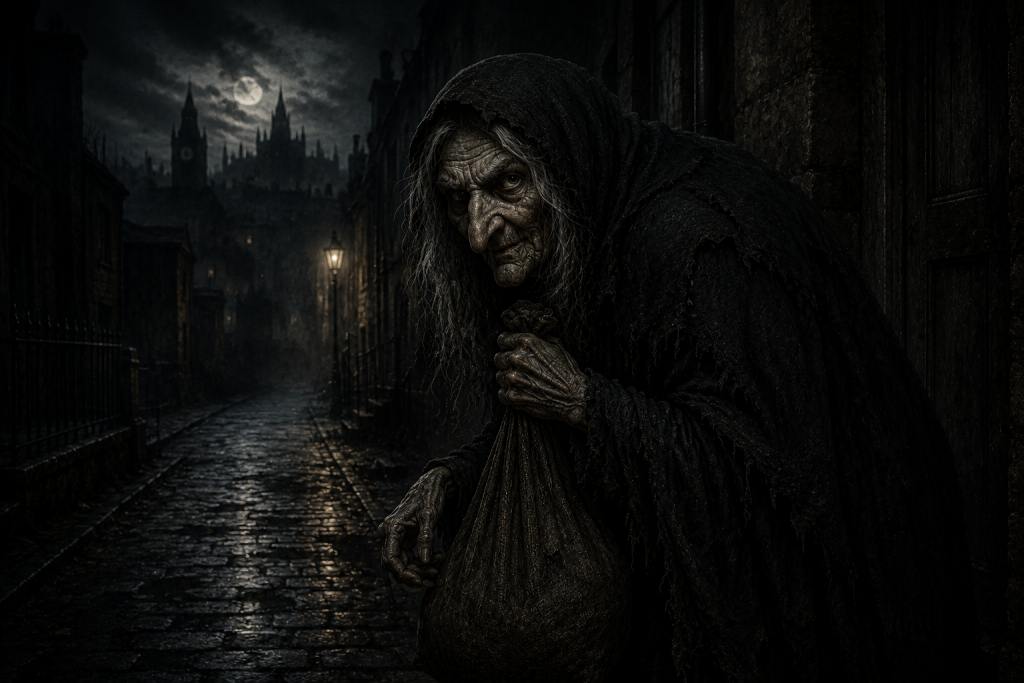
In 1576, a woman named Bessie Dunlop was brought before the authorities in Ayrshire and charged with witchcraft. The accusation was based on her reputation as a healer, someone who could cure the sick, find lost property, and provide counsel that worked. Bessie did not deny the reputation. What she said instead was that her knowledge came from a spirit, the ghost of a man named Thomas Reid who had died at the Battle of Pinkie in 1547. Reid, she explained, had introduced her to a company of people he told her belonged to the Court of Elfame.
The court records survive. Bessie Dunlop’s description of where her healing knowledge came from, who gave it to her, and what she saw when she visited that court is one of the earliest documented accounts of the fairy realm that Scottish tradition called Elphame. It is also a piece of legal testimony given by a woman who understood that what she was saying would likely get her killed. She said it anyway. She was executed in 1576.
The Queen of Elphame is not simply a fairy tale figure. She is a being who appears by name in the legal records of a society that took her existence seriously enough to execute people for associating with her.
What Elphame Was
The word Elphame, spelled variously as Elfame, Elphane, or Elphen in the historical sources, designated the fairy realm in Scottish and northern English tradition. The name is often etymologised as elf-home, though scholars note that this interpretation is speculative, derived from a 19th century editor’s emendation of the original texts rather than from the documents themselves. The Dictionary of the Older Scottish Tongue defines the term simply as Fairyland.
What the tradition is consistent about is what Elphame was like rather than what it was called. It existed alongside the human world rather than above or below it, accessible through hills, caves, ancient earthworks, and liminal spaces where the boundary between the ordinary world and whatever lay beyond it was understood to be thin. Time moved differently there: people who entered for what felt like days returned to find years had passed, or found themselves unable to account for stretches of time they could not remember. The beings who lived there were powerful, unpredictable, and operated according to rules that were not human rules, though they could be learned and navigated by those with the knowledge or the relationship to do so.
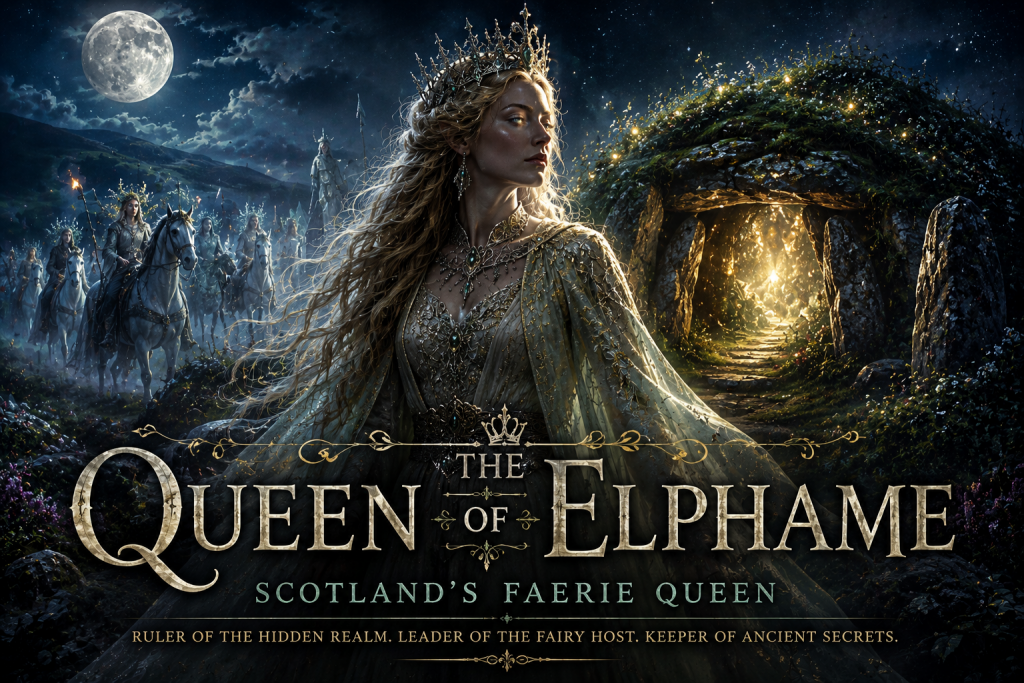
The Queen ruled over all of it. She appears in the sources under various titles: Queen of Elfame, Queen of Elphane, Queen of Elphen. She has a husband, named in at least one trial testimony as Christsonday, a name whose Christian-seeming structure sits oddly alongside the otherwise pagan character of the realm she governs. She can appear as a young woman or an old one, beautiful or terrifying, depending on the account and the circumstances of the encounter. She grants knowledge and healing ability to those she favours. She takes people when she chooses. She is not asked for permission and does not give explanations.
Thomas the Rhymer and the Road to Elphame
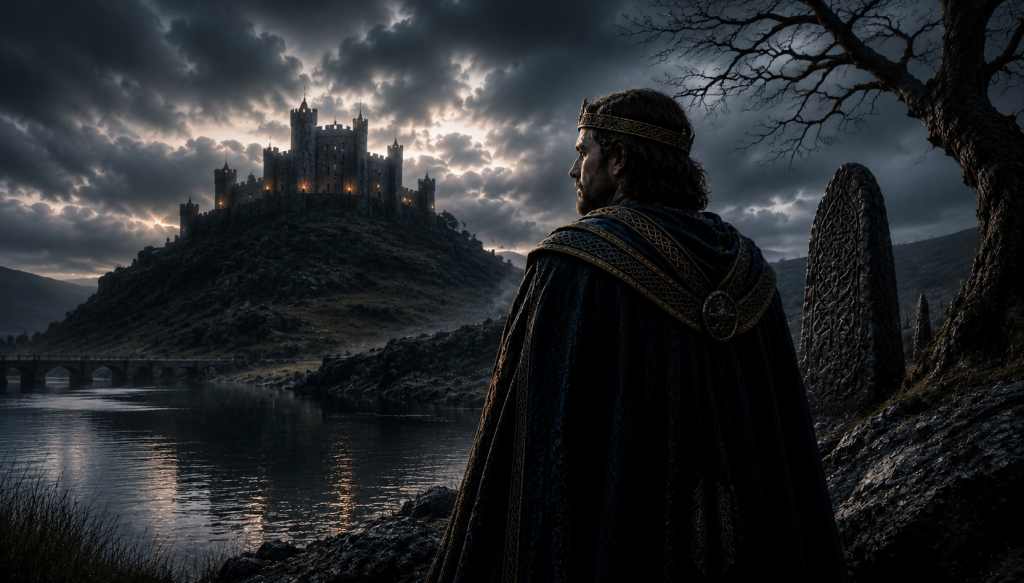
Before any of the witch trial testimony, the Queen appears in one of the most important pieces of medieval Scottish literature. Thomas of Erceldoune, known as Thomas the Rhymer, was a real historical figure: a 13th century Scottish laird and poet from the village of Earlston in the Scottish Borders whose reputation for prophetic ability was well established enough to be documented in sources from his own lifetime. The romance built around him, probably composed in the 14th century, describes how his prophetic gifts were acquired.
He was sleeping or resting beneath the Eildon Tree, a specific and named location in the Borders, when a woman of extraordinary beauty appeared on a white horse with silver bells on its mane. Thomas assumed she was the Queen of Heaven and addressed her as such. She corrected him. She was not the Queen of Heaven, she told him. She was the Queen of fair Elphame, come out to hunt in her forest. She invited him to travel with her and he went, without, the romance implies, being given a meaningful choice about it.
She showed him three roads before they reached Elphame: a narrow thorny path that was the road of righteousness, a broad easy road that was the road of wickedness, and a third, bonny road that wound across a hillside that was the road to fair Elfland. They took the third. They rode through rivers of blood in the dark, through a land where no sun or moon was visible, until they reached a garden where she gave him an apple and told him it would give him a tongue that could never lie. He spent, in his perception, a short time in Elphame. When he returned to the human world, seven years had passed. He brought back with him the gift of prophecy and the inability to speak falsehood, which in the tradition was understood as both a gift and a constraint.
The Thomas legend is significant for several reasons. It establishes the Queen as a figure who operates at the intersection of the fairy and human worlds with specific and consistent rules: the journey, the threshold crossing, the altered time, the gift with conditions. These elements appear again in the witch trial testimony two and three centuries later with enough consistency to suggest a genuine tradition rather than independent invention.
The Witch Trials: When the Queen Became Evidence
Between the 1570s and the 1660s, the Queen of Elphame appears repeatedly in the records of Scottish witch trials, named by accused men and women who described their relationship with her in specific and detailed terms. These accounts are remarkable documents. They were recorded by interrogators who understood the Queen of Elphame as a demonic figure, a manifestation of the devil or a servant of evil, and who were trying to use the testimony as evidence of diabolical pact. What the accused were describing was something considerably older and considerably more complex than the demonological framework their interrogators were trying to force it into.
Bessie Dunlop’s 1576 trial is the earliest of the major cases. Her guide to the Court of Elfame was Thomas Reid’s ghost rather than the Queen herself, but the court she described was organised around a female authority whose knowledge was the source of Bessie’s healing ability. The detail that Reid had been dead for nearly thirty years before appearing to her, that he was a specific named individual who had died in a specific documented battle, gives the testimony a particularity that distinguishes it from generic fairy tale material.
Alison Pearson’s 1588 trial provides the most direct testimony about the Queen herself. Pearson, a healer from near St Andrews in Fife, described being abducted as a child by a fairy named William Sympson and taken to Elphame, where she encountered the Queen directly. She returned repeatedly over the years and described making good acquaintance with the Queen, learning healing knowledge and other abilities from her. The trial documents use the specific phrase Court of Elfane in recording her testimony, making this one of the earliest written uses of the name. Pearson was executed in 1588.
Andro Man’s trial in Aberdeen in 1597 provides the most detailed account of the Queen’s physical appearance and domestic arrangements. Man described a sustained relationship with the Queen spanning decades, during which she had borne him several children. He described her husband Christsonday, named in a way that mixed Christian and pagan associations in exactly the manner that characterises the broader Elphame tradition. He noted that she could be old or young as she pleases, a shapeshifting quality consistent with the broader Scottish fairy tradition. Marion Grant, who was tried alongside Man, described the Queen as a fine woman clad in white.
Isobel Gowdie and What She Saw
The most extraordinary witch trial testimony involving Elphame comes from Isobel Gowdie, tried in Auldearn in Moray in 1662. What makes Gowdie’s case unique in the history of Scottish witchcraft is that she confessed voluntarily, over four separate sessions, without any apparent evidence of torture, in extraordinary and specific detail. Nobody has fully explained why she did this.
Gowdie described entering Elphame through a hillside, travelling to the fairy court, and receiving from the Queen the ability to make elf arrows, small flint projectiles that the fairy folk used to shoot cattle and people. She described the court in detail: the Queen dressed in white, the king of Elphame beside her, the activity and organisation of the fairy realm going on around her. She named specific locations where she had entered and exited the hill. She described what she had been taught and by whom.
Her testimony is consistent with the earlier accounts from Bessie Dunlop, Alison Pearson, and Andro Man in its structural elements: the court, the Queen, the gift of knowledge, the crossing of a threshold into another realm. The consistency across accounts separated by nearly a century suggests she was drawing on a genuine tradition rather than inventing material under interrogation. Whether that tradition described real supernatural encounters, the inherited symbolic language of a folk practice, or something else entirely is a question that scholars have debated since the 17th century without reaching consensus.
Gowdie was executed in 1662.
What Was She
The most persistent question about the Queen of Elphame is what she actually was in the belief system of the people who described her. The interrogators who conducted the witch trials understood her as a demonic figure, the devil in disguise or a powerful evil spirit. The accused, consistently and under considerable pressure, described something quite different: a being who was neither straightforwardly good nor evil, who governed a realm with its own logic, who gave knowledge that was genuinely useful, and who operated according to ancient rules rather than Christian categories of good and evil.
Some scholars have argued she preserves the memory of a pre-Christian goddess, one of the female divine figures of the Celtic or pre-Celtic traditions of Scotland whose cult survived into the medieval period in the form of fairy belief. The characteristics support this reading: her control over a supernatural realm, her association with prophecy and healing knowledge, her ability to take human consorts, her governance of the dead or the not-quite-dead who populate her court. These are the characteristics of a sovereignty goddess, a divine female figure whose relationship to the land and its rulers is one of the oldest patterns in British mythological tradition.
Others have argued more cautiously that the consistency of the trial testimony reflects a genuine folk tradition of ritual practice involving trance states, altered consciousness, and the symbolic journey to an otherworldly court, a tradition that may have shamanic roots considerably older than the Christian period. The historian Emma Wilby, in her 2005 study Cunning Folk and Familiar Spirits, argued that figures like Bessie Dunlop and Alison Pearson were operating within a real folk magical practice whose cosmology included genuine beliefs about fairy courts and the Queen who governed them, beliefs that were then forced into a demonic framework by their interrogators.
What the trial records cannot tell us is whether the accused actually encountered something, whether their experiences were the product of trance, dream, or genuine altered states produced by folk practices that have not survived, or whether they were drawing on a shared symbolic vocabulary to describe experiences that had no supernatural component. What they can tell us is that the Queen of Elphame was real enough to the people who described her that several of them chose to keep describing her even when doing so was costing them their lives.
If you want more like this, the Tales of Myth and Magic newsletter delivers new creatures, legends, and forgotten folklore straight to your inbox.
No fixed schedule. No noise. Just the stories, when they are ready.
Sign up here →Thomas the Rhymer and Tam Lin
Outside the trial records, the Queen of Elphame appears most prominently in two ballads that belong to the Border tradition: Thomas the Rhymer, which we have already discussed, and Tam Lin, which covers related territory from a different angle. In Tam Lin, a young man has been taken by the Queen of Faerie and is held in her court, tithe-bound as part of an arrangement in which the fairy folk pay a debt to hell every seven years using one of their number. He is rescued by a woman who loves him, who must hold onto him through a series of terrifying transformations the Queen forces him through before he is finally freed.
The teind to hell, the payment of a human soul as tribute, appears also in Alison Pearson’s trial testimony, where it is referenced in the context of her relationship with the fairy court. The parallel between the ballad material and the trial testimony is precise enough that scholars have used each to illuminate the other, suggesting that the Tam Lin story and the Elphame trial confessions were drawing on the same underlying body of folk belief about the fairy realm and its relationship to the human world and the afterlife.
The Queen in Tam Lin is not a sympathetic figure. She tries to prevent Tam Lin’s rescue and nearly succeeds. She is furious when she fails. But she is also, in the logic of the ballad, operating within a system that has its own rules: the teind is a genuine obligation, Tam Lin’s rescue is possible because the rules allow it, and the Queen’s anger at the end is the anger of someone who has lost within a framework she herself administers. She is not evil. She is simply the governing authority of a world that does not share human values, and the encounter with her demands that the humans in the story understand her world well enough to navigate it.
That is the Queen of Elphame in her fullest form: a figure of genuine and ancient power, governing a realm that operates by rules different from human rules, encountered in literature and in legal testimony over centuries, never entirely explained, never entirely tamed, and still present in the landscape of the Scottish Borders in the names of hills and trees and places where the boundary between the human world and whatever lies beyond it has always been understood to be thinner than it looks.
Further Reading
If this article sparked your interest, these are the books worth reading next.
Scottish Urban Legends: 50 Myths and True Stories
by Aaron Mullins — fifty Scottish urban legends including stories from Glasgow, Edinburgh, and the Highlands. The kind of tradition that Maggie Murphy belongs to, collected properly in one volume.
Scottish Urban Myths and Ancient Legends
by Grace Banks and Sheena Blackhall — vampires, werewolves, devil encounters, and the school playground legends of Scotland. A genuinely good collection of the stories Scots have been telling each other for generations.
The Lore of Scotland: A Guide to Scottish Legends
by Jennifer Westwood and Sophia Kingshill — the most comprehensive collection of Scottish legend in print, covering Glasgow to Shetland, exploring origins and historical basis. Endorsed by Terry Pratchett as the real macabre.
For more on the fairy tradition of Scotland, the Scotland category covers the broader range of creatures and beings from Scottish folklore. The Bodach and the Glaistig belong to the same tradition of Scottish supernatural figures whose relationship to the human world is defined by ambivalence rather than simple malevolence.
Never miss a myth
Thank you for being here. The site is brand new and every subscriber genuinely means something to me. If you're here, you care about this stuff as much as I do - and that's all the reason I need to keep going. New stories, videos and dark folklore from around the world, straight to your inbox. No algorithm. Just the stories, when they're ready.