In most Scottish folklore, the supernatural beings that appear in the record are dangerous. The Kelpie drowns you. The Each-Uisge eats you. The Baobhan Sith dances with you and then drains your blood. The Sluagh carry off the dying. The Bean Nighe washes your grave clothes. The tradition is not short of things that will kill you if you encounter them in the wrong place at the wrong time.
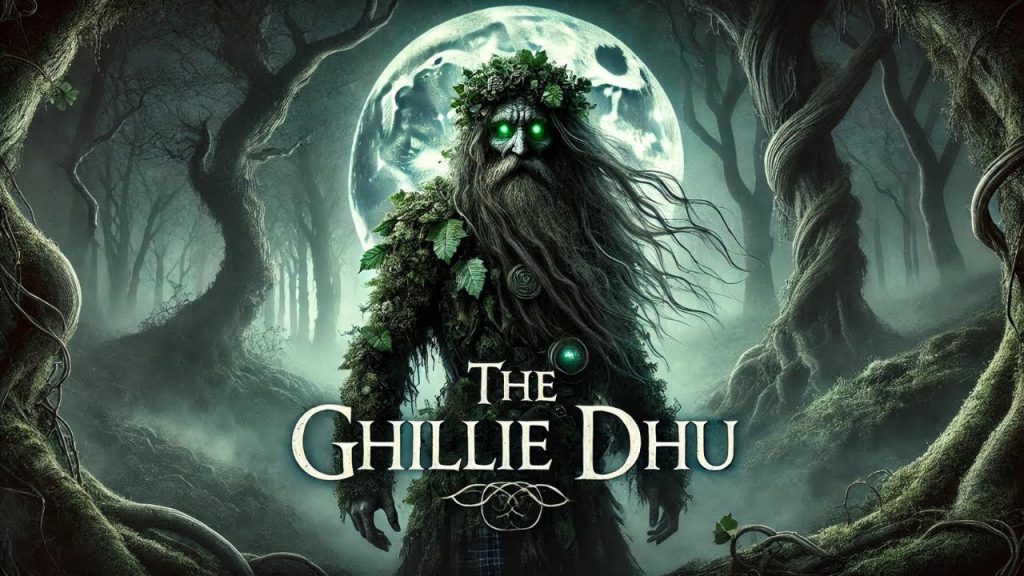
The Ghillie Dhu is different. He lives in birch woods, he is clothed in leaves and moss, he is shy of human company, and on at least one documented occasion he helped a lost child find her way home. He is the exception in a tradition built on threat, and that exceptionalism is a large part of why he has attracted as much interest as he has.
His name translates from Scottish Gaelic as dark-haired lad or dark servant, the second element being the same dhu that appears in Black Watch and in dozens of Highland place names where it indicates darkness or blackness. He is called dark not because he is sinister but because of his colouring: black hair, dark skin in some accounts, and the deep green and brown of the forest materials that make up his clothing and his camouflage.
What the Primary Sources Actually Say
The Ghillie Dhu is more thinly documented in the primary sources than most Scottish folklore figures of equivalent fame, and being honest about that is important for understanding what the tradition actually contains.
The most substantial early reference comes from John Gregorson Campbell, a minister from Tiree whose Superstitions of the Highlands and Islands of Scotland, published posthumously in 1900, documented oral traditions gathered across the Highland region. Campbell places the Ghillie Dhu at Gairloch on the northwest coast of the Scottish mainland rather than on Skye, which is where many later accounts locate him, and describes him as a solitary fairy haunting the birch wood at Loch a Druing near Gairloch. Campbell’s account is brief but specific, and it is the foundation on which subsequent descriptions have been built.
The birch wood setting is consistent across every account, which suggests it was a fixed element of the tradition rather than an embellishment. Birch woods in the Scottish Highlands have a specific quality that distinguishes them from other forest types: they are relatively open, with thin trunks and pale bark, and they allow light through in a way that creates a particular kind of dappled, moving illumination that changes with the wind. They are also genuinely ancient in some locations. The Black Wood of Rannoch in Perthshire, one of the few surviving fragments of the ancient Caledonian Forest, is predominantly Scots pine rather than birch, but it shares the quality of deep antiquity that the Ghillie Dhu’s habitat is associated with.
The Jessie MacRae Story
The account most frequently attached to the Ghillie Dhu involves a young girl named Jessie MacRae who became lost in woodland on Skye in the late 18th or early 19th century, the date varying across different tellings. The exact location also varies: some accounts place it near Gairloch, which would align with Campbell’s geographical association, while others place it firmly on Skye.
What the accounts agree on is the core narrative. Jessie became lost while out gathering, darkness fell, and her family and neighbours organised a search that failed to find her. She returned home during the night or the following morning, unharmed, and told her family that a small man dressed in leaves had found her when she was frightened, sheltered with her, and guided her back toward familiar ground. She was consistent in her account and the family believed her. The community interpreted what she described as an encounter with the Ghillie Dhu.
The story that follows in some versions, that local landowners subsequently organised a hunting party to capture the Ghillie Dhu and that after this intrusion he was never seen again, is the part of the tradition worth dwelling on. Whether it reflects a genuine attempt to hunt a creature that the community believed was real, or whether it is a narrative element that explains the absence of subsequent sightings, it functions as a commentary on the relationship between human curiosity and the survival of the things that curiosity disturbs. The Ghillie Dhu retreats from human attention. The search for him is what makes him unfindable.
This is a pattern that appears elsewhere in the British and Irish fairy tradition: the fairy being that withdraws when it becomes too well known, too watched, too pursued. The Brownie leaves when offered clothes. The Wulver of Shetland is rarely seen by those who go looking. The Ghillie Dhu disappears when people organize to find him. The tradition seems to be saying something about the conditions under which these beings can exist, and one of those conditions appears to be that they are not the direct object of human investigation.
The Birch Tree Connection
The Ghillie Dhu’s specific association with birch woods is the detail in the tradition that most repays examination, because birch is not an arbitrary choice in the context of Scottish and wider Celtic nature belief.
Birch is the first tree to colonise cleared or disturbed ground in the Scottish Highlands, which makes it both the most ephemeral and the most persistent of the native trees: it arrives first, it grows quickly, and it eventually gives way to longer-lived species like Scots pine and oak. In the Ogham alphabet of early medieval Ireland, birch is the first letter, associated with beginnings and with the transition from one state to another. In Scottish Gaelic tradition, birch branches were used to drive out the spirits of the old year and welcome the new, a function that connects the tree to threshold moments and to the clearing of space for what comes next.
A fairy being who lives specifically in birch woods is a being associated with these qualities: with edges and transitions, with the beginning of things, with the kind of space that is neither fully wild nor fully cultivated. The Ghillie Dhu inhabits the threshold zone between the managed landscape and the deep forest, which is precisely where a being that both avoids humans and occasionally helps them would naturally operate.
The Black Wood of Rannoch
The Ghillie Dhu tradition is primarily associated with Gairloch and Skye, but the Black Wood of Rannoch in Perthshire is worth mentioning in connection with him because it represents the kind of ancient Scottish woodland that the tradition seems to be reaching for even if it does not name this specific location.
The Black Wood is one of the largest surviving fragments of the ancient Caledonian Forest, the vast woodland that covered much of Scotland after the last Ice Age and has been reduced over millennia by climate change, clearance, and the grazing of sheep and deer to a series of isolated remnants. Walking in the Black Wood is a different experience from walking in planted commercial forest or in the younger birch and rowan woodland that has regrown across much of the Highlands. The trees are old enough to have developed their own internal ecology, with fallen trunks in various stages of decay, moss covering every horizontal surface, and the particular quality of light and sound that comes from a place that has been undisturbed for long enough to develop its own character.
This is the kind of environment the Ghillie Dhu belongs to in the imagination if not necessarily in the specific documented tradition. Whether he is there or not is a question that the tradition has consistently refused to answer directly.
What He Represents
The Ghillie Dhu sits within a small but significant tradition of benevolent or at least neutral supernatural beings in Scottish folklore: beings whose relationship to humans is protective or indifferent rather than predatory. The Wulver of Shetland leaves fish on windowsills. The Brownie does household work in exchange for a bowl of cream. The Ghillie Dhu guides lost children home. These figures suggest that the folk tradition was not simply a catalogue of dangers but a more complex attempt to populate the non-human world with beings that reflected the full range of relationships that humans had with the landscape they lived in.
A supernatural being that protects the forest and occasionally helps people who are lost in it encodes a specific kind of knowledge about woodland environments: that they are dangerous to the uninitiated, that disorientation can be fatal in certain conditions, and that the forest has its own logic that human beings can access if they approach it correctly. The Ghillie Dhu is benevolent toward Jessie MacRae. He retreats from the hunting party. The difference in outcome reflects the difference in approach: a frightened child is not a threat to the forest or to him, and a group of armed men looking to capture him is.
That reading is not mystical. It is practical woodland knowledge given a supernatural form, which is what the most durable elements of British and Irish folklore tend to be.
Further Reading
If this article sparked your interest, these are the books worth reading next.
Scottish Urban Legends: 50 Myths and True Stories
by Aaron Mullins — fifty Scottish urban legends including stories from Glasgow, Edinburgh, and the Highlands. The kind of tradition that Maggie Murphy belongs to, collected properly in one volume.
Scottish Urban Myths and Ancient Legends
by Grace Banks and Sheena Blackhall — vampires, werewolves, devil encounters, and the school playground legends of Scotland. A genuinely good collection of the stories Scots have been telling each other for generations.
The Lore of Scotland: A Guide to Scottish Legends
by Jennifer Westwood and Sophia Kingshill — the most comprehensive collection of Scottish legend in print, covering Glasgow to Shetland, exploring origins and historical basis. Endorsed by Terry Pratchett as the real macabre.
For more on the benevolent and ambivalent figures of Scottish tradition, the Wulver article covers Shetland’s gentle wolf-man in similar depth. The Queen of Elphame article covers the ruling figure of the Scottish fairy tradition, who represents a very different and considerably more dangerous aspect of the same supernatural world. The broader Scotland category has more on the creatures and legends of the Scottish tradition.
Never miss a myth
Thank you for being here. The site is brand new and every subscriber genuinely means something to me. If you're here, you care about this stuff as much as I do - and that's all the reason I need to keep going. New stories, videos and dark folklore from around the world, straight to your inbox. No algorithm. Just the stories, when they're ready.