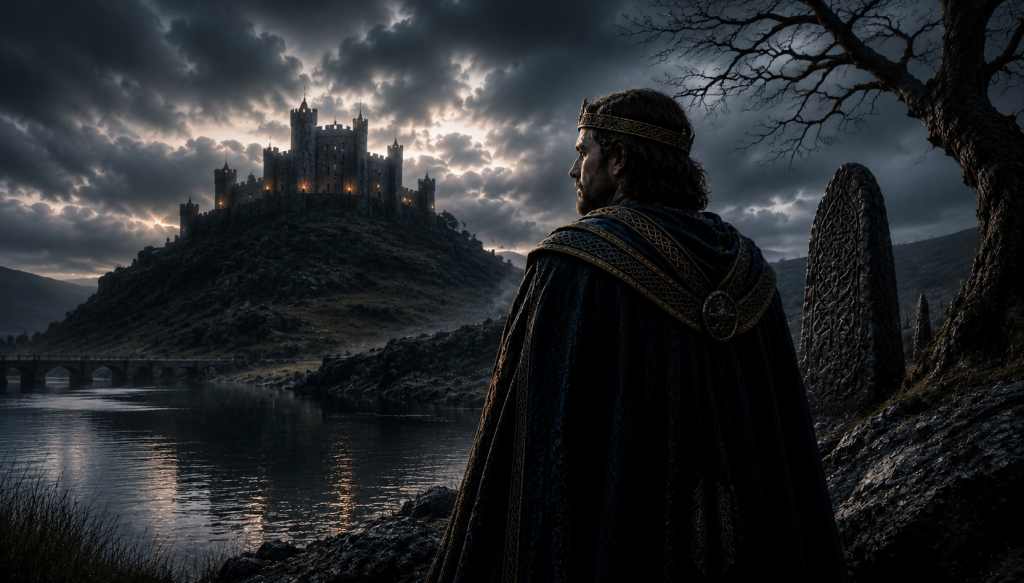
In Act Four of The Merry Wives of Windsor, Mistress Page proposes a scheme. She knows the legend of a hunter named Herne who used to haunt Windsor Forest, appearing at a particular oak tree with great ragged horns on his head. She knows that locals believe the spirit still walks there on certain winter nights. She proposes to use this legend as the setting for a trick on Falstaff, dressing the children as fairies to terrify him while he waits in disguise beneath Herne’s Oak.
Shakespeare is writing comedy and the scene is designed for laughs. But the way he introduces Herne is worth examining. He does not explain the legend. He does not tell the audience who Herne is or why he has antlers or what he wants when he walks through the forest. He mentions the name and assumes the audience knows the rest. He treats Herne as something his Elizabethan audience already understood, which suggests the legend was well established in the popular imagination by the time the play was written, probably in the 1590s.
What the play cannot tell us is how much older the tradition is than Shakespeare, or whether Shakespeare created a figure that subsequent generations then treated as ancient. That question has been argued over for centuries without a satisfying resolution, and it is the most interesting thing about Herne the Hunter.
What the Tradition Says
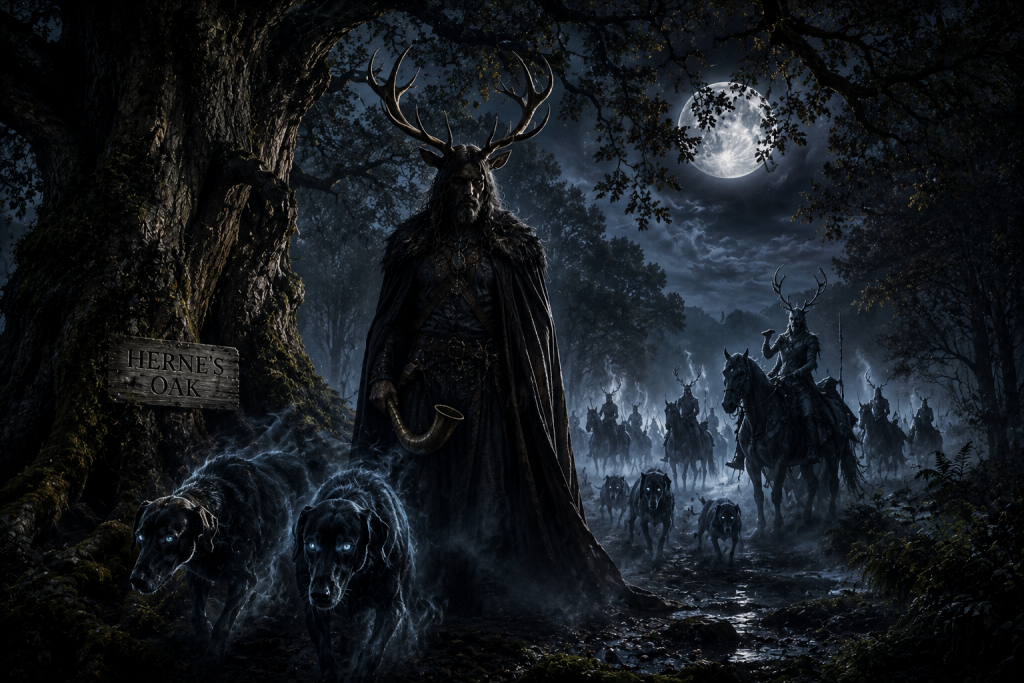
The core description of Herne is consistent across the sources that follow Shakespeare: an antlered figure on horseback, accompanied by hounds, riding through Windsor Forest at night and particularly during storms. He is associated with a specific oak tree, Herne’s Oak, which became one of the most visited folkloric locations in England despite the original tree having died and been replaced multiple times over the centuries. The current candidate for Herne’s Oak in Windsor Great Park is not the original tree or even close to it in age, but the association has shifted to accommodate the new tree because the tradition requires a specific location to remain attached to.
The story that provides Herne with a human origin, told in various versions across the subsequent tradition, goes roughly as follows. Herne was a royal huntsman in the service of a king, usually identified as Richard II though the identification is not consistent. He was the best hunter in the royal forest. During a hunt, a wounded stag turned on the king and Herne threw himself between the beast and the monarch, saving the king’s life but receiving a terrible wound in the process. A mysterious stranger, sometimes described as a wizard or a dark figure, appeared and told the assembled huntsmen that he could save Herne’s life but the price would be the removal of the stag’s antlers and their attachment to Herne’s head. The king agreed. Herne recovered but lost all his hunting skill as a result. Shunned and mocked by the other huntsmen, he fell into despair and hanged himself from an oak in the forest. His ghost has ridden there ever since.
This story reads like a later elaboration designed to give a ghostly figure a human history, and most folklorists treat it as exactly that. The structural elements, the royal connection, the miraculous healing with a supernatural price, the descent into despair, are the elements of a literary origin story rather than oral folk tradition. They provide a why for the antlers and an explanation for the haunting without resolving the deeper question of what Herne actually is.
The Shakespeare Problem
The central difficulty with Herne the Hunter as a piece of English folklore is that the earliest clear documentary evidence for him is a Shakespeare play written in the 1590s. Everything before that is either absence or inference. This creates a problem that folklore scholars have handled in different ways.
One position is that Shakespeare invented Herne, drawing on the general tradition of horned forest spirits and the specific setting of Windsor Forest to create a figure that was then adopted into popular belief so thoroughly that later generations assumed it had always been there. This happens with literary figures, the most famous example being Robin Hood, whose folklore is considerably older than any single source but whose specific characteristics have been shaped by centuries of written and performed retellings. Herne could be a similar case: a figure whose name and specific form were created or consolidated by Shakespeare and whose subsequent career in the popular imagination then gave him the appearance of antiquity.
The other position is that Shakespeare was drawing on a genuine local tradition that existed before the play and that the absence of earlier written sources reflects the nature of oral tradition rather than the absence of the belief. Windsor Forest had been royal hunting ground for centuries before Shakespeare, and a ghost associated with the forest’s hunting tradition is exactly the kind of figure that oral tradition produces without generating documentary evidence until someone happens to write it down. The fact that Shakespeare uses Herne casually, without introduction or explanation, is the strongest evidence for this position: you do not introduce a brand new character to an audience by assuming they already know who he is.
The most honest position is that we do not know, and that both possibilities are consistent with the evidence available. Herne may be ancient. He may be Elizabethan. He may be somewhere between: an older tradition of a forest spirit at Windsor that Shakespeare crystallised into a specific named figure. The uncertainty is genuine rather than false modesty.
The Cernunnos Question
The connection between Herne and the Celtic horned deity Cernunnos is one that has been made repeatedly in popular accounts of the English tradition, and it deserves careful handling because the evidence for it is much thinner than the frequency of the claim suggests.
Cernunnos is depicted on the Gundestrup Cauldron and on various other Celtic artefacts as an antlered deity associated with wild animals, fertility, and the forest. He is a genuine figure from the ancient Celtic tradition with documented iconographic evidence. The suggestion is that Herne represents a survival of Cernunnos worship in the English tradition, a pagan horned deity who persisted in folk memory long after Christianity suppressed his formal cult and eventually re-emerged as the ghostly hunter of Windsor Forest.
The problem is that there is no documented evidence for a cult of Cernunnos in Britain specifically, as opposed to Gaul, and no documented connection between Cernunnos and the Windsor region or the English hunting tradition. The name Herne has been connected by some scholars to a Germanic root meaning army or host, which would align him with Woden rather than with a Celtic deity, or to a word simply meaning hunter. The antlers are the most suggestive element of a possible Celtic connection, but antlered supernatural figures appear in many traditions without requiring a specific Cernunnos lineage.
The connection is possible and interesting as a hypothesis. It is not established as fact, and presenting it as such flattens a genuine scholarly debate into a convenient narrative about ancient origins that the evidence does not support.
Herne and the Wild Hunt
The more solidly grounded connection is between Herne and the Wild Hunt tradition, which is covered in detail in the Wild Hunt article on this site. The Wild Hunt, the nocturnal procession of spectral riders and hounds led by a powerful figure, appears across Germanic and Norse tradition and has identifiable versions in the English folk record. Herne with his hounds and his horse, riding through Windsor Forest at night during storms, fits the template of an English Wild Hunt leader more closely than he fits the template of a static haunting.
The leader of the English Wild Hunt varies by region: Woden in some accounts, King Herla in others, Wild Edric in Shropshire, and Herne in the south of England. The consistency of the Hunt’s structure across these different leaders, the hounds, the horse, the nocturnal riding, the association with storms, suggests that Herne is the southern English manifestation of a tradition rather than a free-standing individual figure.
If this reading is correct, then the question of whether Herne predates Shakespeare becomes less important than the question of how old the Wild Hunt tradition itself is in England, which takes you back to the Anglo-Saxon period at minimum and possibly considerably earlier. Herne the name may be Elizabethan or earlier. Herne the phenomenon, the antlered hunter riding at night with his hounds through a royal forest, belongs to something considerably older.
Herne’s Oak
The oak tree associated with Herne has had a complicated history that reflects the strength of the tradition’s attachment to specific landscape features. The original tree that Shakespeare would have known was almost certainly a medieval oak in the old Windsor Forest. That tree died at some point in the 17th or 18th century. A replacement was identified and became the focus of the tradition. That tree was allegedly blown down in 1863, an event Queen Victoria recorded in her diary with evident feeling for the loss of such a landmark.
Subsequent trees have been designated as Herne’s Oak in the Windsor Great Park, the current candidate being a relatively young tree by comparison with the centuries of tradition attached to the name. The tradition has simply moved to wherever the oak is, which says something about what the tree is actually doing in the legend: it is not a specific ancient tree that is sacred in itself but a marker, a place where the human world and Herne’s world are understood to overlap, and that function can be transferred to a new tree when the old one dies.
This is consistent with how sacred trees work across the British and Irish tradition more broadly. The tree matters because of what it marks rather than because of what it is in itself, and the tradition’s willingness to shift the designation to a new tree reflects a sophisticated understanding of what the tree’s role in the story actually is.
Who He Is and What He Does
Whether Herne is a ghost, a nature spirit, a pagan survival, or a Shakespearean invention given supernatural weight by centuries of belief, what he does in the tradition is consistent: he appears during storms and on winter nights, he rides through Windsor Forest with his hounds, and those who see him tend to remember the experience as significant rather than simply frightening.
He is not described as malevolent in most accounts. He is not a figure who kills the people who see him or drags them into another world. He is a presence, a rider in the forest at night, an antlered figure that should not exist but keeps appearing to people who are paying attention to the dark. The tradition treats him as an omen in some accounts, a sign that something significant is about to happen, but the specific nature of what he heralds varies too much across the sources to settle into a pattern.
What is consistent is the forest itself. Windsor Forest, now Windsor Great Park, is the fixed point around which the entire tradition revolves. Herne belongs to that specific landscape in a way that is not transferable: you could not move the tradition to a different forest and have it retain its character. The antlered hunter is inseparable from the royal hunting ground he haunts, and that specificity of location is one of the things that gives the tradition its feeling of genuine depth, whatever its ultimate origins.
For more on the broader tradition he belongs to, the Wild Hunt article covers the pan-European tradition of spectral riders and what it means that England has its own version. The England category has more on the supernatural tradition of the English landscape, including Black Shuck and other figures whose antiquity is similarly contested.
Never miss a myth
Thank you for being here. The site is brand new and every subscriber genuinely means something to me. If you're here, you care about this stuff as much as I do - and that's all the reason I need to keep going. New stories, videos and dark folklore from around the world, straight to your inbox. No algorithm. Just the stories, when they're ready.