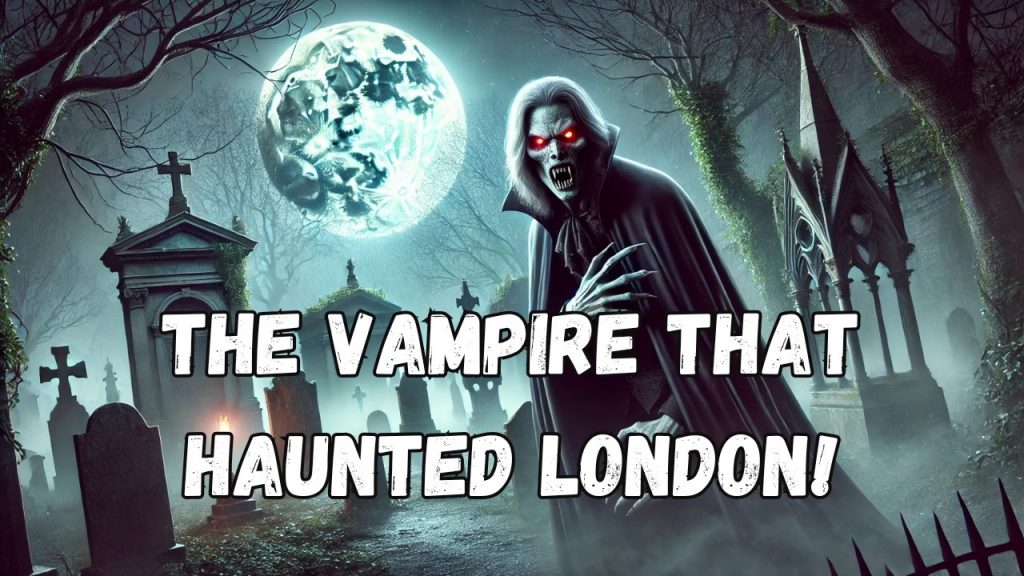
Friday the 13th of March, 1970. Within two hours of a single television broadcast, hundreds of people climbed the gates and walls of Highgate Cemetery in North London, armed with homemade stakes, crucifixes, and garlic. Forty police officers tried to hold them back. They failed.
This was not the 1600s. This was the heart of modern London, less than two years before Britain joined the European Economic Community.
A Cemetery Already Built for Ghost Stories
By 1970, Highgate Cemetery did not need much encouragement to feel haunted. Once one of Victorian London’s grandest burial grounds, its Gothic monuments and tangled, overgrown pathways had fallen into decades of neglect by the time the events of the Highgate Vampire began to unfold. Ivy swallowed entire mausoleums. Statues leaned at odd angles among the weeds. It was, by every visual measure, exactly the kind of place where people expect to see something they cannot explain.
And people had been seeing things, on and off, for years before anyone used the word vampire. Local reports collected throughout the late 1960s described a genuinely strange and inconsistent catalogue of apparitions around the cemetery and the adjoining Swain’s Lane: a tall man in a hat, a spectral cyclist, a woman dressed entirely in white, a face glaring through iron gate bars, a figure wading into a nearby pond, a pale gliding shape, the sound of bells ringing with no source, and voices calling out from empty paths. No two witnesses ever seemed to describe quite the same thing, which is itself a telling detail. Whatever was happening in Highgate before 1970, it had not yet settled into a single coherent legend.
If you are interested in reading more about vampires, you can check out the main vampire page here. The video below covers Vlad the Impaler and many others, if you are interested!
The Letter That Started Everything
The shift from scattered ghost stories into something far larger began on Christmas Eve 1969, when a young man named David Farrant, a self-taught occultist and member of the British Psychic and Occult Society, claimed to have seen a tall, dark figure with unsettling eyes near the cemetery, accompanied by a sudden and unnatural drop in temperature.
Farrant wrote to the local newspaper, the Hampstead and Highgate Express, in February 1970, asking whether anyone else in the area had experienced anything similar. The response was immediate and substantial. Letters poured in describing the same scattered, contradictory apparitions that had apparently been circulating locally for years: the man in the hat, the cyclist, the woman in white, the face at the gate. None of these letters mentioned a vampire. Farrant himself never used the word.
That changed when a second local man entered the story.
Enter the King Vampire of the Undead
Sean Manchester, a self-described bishop of the Old Catholic Church and self-proclaimed exorcist, read the growing correspondence in the Ham and High with considerable interest, and on 27 February 1970 the paper published an interview with him under the headline “Does a Wampyre Walk in Highgate?”
Manchester’s explanation went considerably further than anything Farrant had suggested. According to Manchester, the entity haunting the cemetery was nothing so mundane as a ghost. It was, in his words, a King Vampire of the Undead, a medieval nobleman who had practised black magic in Wallachia, the historical region of Romania associated with Vlad the Impaler and, by extension, with Bram Stoker’s Dracula. This vampire, Manchester claimed, had been transported to England in a coffin during the early eighteenth century by followers who purchased a house for him in London’s fashionable West End. He had eventually been interred on the grounds that would later become Highgate Cemetery, and according to Manchester, modern Satanists practising in the neglected graveyard had inadvertently roused him from his centuries-long rest.
It was a remarkably specific story for a man who, by his own account, had no concrete evidence for any of it. But specificity is exactly what turns scattered ghost sightings into a legend people can rally around, and rally they did.
A Rivalry That Built a Legend
What happened next had less to do with the supposed vampire itself and considerably more to do with the escalating rivalry between the two men who had each, separately, decided they were going to be the one to deal with it.
Farrant, for his part, never endorsed Manchester’s vampire theory, consistently describing what he had seen as a conventional ghost rather than anything bloodsucking. Manchester, by contrast, fully committed to the vampire narrative and made it clear he intended to act on it. He announced he would personally conduct an exorcism at the cemetery, and ITV, sensing a story too strange to ignore, arranged to interview both men on the evening of Friday the 13th of March 1970, deliberately chosen, it seems, for the date’s ominous reputation.
The broadcast aired early that evening. Within two hours, a crowd estimated at somewhere between one hundred and several hundred people had gathered outside Highgate Cemetery’s locked gates. Some climbed over the walls. Others forced their way through. Roughly forty police officers attempted to manage the crowd and were, by every account, completely overwhelmed. People wandered the grounds carrying homemade wooden stakes, crucifixes, and garlic, searching the Victorian tombs and overgrown pathways for a vampire that none of them had ever actually seen.
Manchester later claimed that during the chaos of that night, he was led by a psychic companion, a young woman he described as a sleepwalker drawn to the vampire’s presence, to a specific catacomb believed to house the creature’s resting place. Finding the door locked, Manchester and his companions reportedly found a hole in the structure’s roof and used a rope to climb down into the tomb itself, where they discovered only empty coffins. Undeterred, they scattered holy water and placed garlic inside the empty caskets, in case the vampire intended to return.
No vampire was found that night. No stake was driven through anything resembling a heart. Several attendees did report glimpsing a tall, dark figure somewhere on the grounds, though under the circumstances, with hundreds of frightened, excited people stumbling through a dark Victorian cemetery at night, that is perhaps the least surprising outcome of the entire evening.
The Discovery That Changed the Tone
For several months after the mass hunt, the Highgate Vampire story might have simply faded the way most local media panics eventually do. Then, on the first of August 1970, everything changed.
Two schoolgirls walking through the cemetery discovered the remains of a woman, roughly a century old, who had been removed from her coffin. The body had been decapitated and showed signs of having been staked through the chest, and was left out in the open along a cemetery pathway. Later accounts also described the remains as partially burned.
Whatever had been happening in Highgate before that discovery, this was something else entirely: a genuine act of desecration, deliberately staged in a manner that mimicked the exact rituals associated with destroying a vampire in folklore and fiction. It triggered a formal police investigation and, predictably, an enormous resurgence in public interest in the case. One woman came forward shortly afterward claiming she had been physically thrown to the ground by a tall, pale figure dressed in black inside the cemetery grounds, an escalation from sightings to direct, violent contact.
In response, Farrant and members of his occult society organised a seance at the cemetery on the 17th of August 1970, drawing protective circles on the ground sealed with salt, holy water, and protective symbols, attempting to draw out and confront whatever had been responsible for the desecrated grave. The seance was interrupted almost immediately by the arrival of police, and Farrant was arrested while attempting to flee the scene.
A Feud That Outlasted the Decade
The rivalry between Farrant and Manchester did not end with the events of 1970. If anything, it calcified into something closer to a decades-long public feud, each man publishing his own book detailing his version of events, Manchester with The Highgate Vampire and Farrant with his own response, Beyond the Highgate Vampire, each presenting the other as either a fraud, a publicity seeker, or simply wrong about the fundamental nature of whatever had haunted the cemetery.
The animosity occasionally took stranger turns. Rumours circulated in the early 1970s of a planned magicians’ duel between the two men, with flyers reportedly distributed around London advertising a confrontation at Parliament Hill on, fittingly, another Friday the 13th in April 1973. The duel, whatever it was actually meant to involve, never took place. Farrant was also separately arrested later in 1970, found near the cemetery carrying a crucifix and a wooden stake, continuing his own investigations independent of Manchester’s increasingly elaborate vampire mythology.
The feud between the two men persisted, by most accounts, right up until Farrant’s death in 2019, nearly fifty years after a Christmas Eve sighting of a tall figure in the dark first set the entire saga in motion.
If you want more like this, the Tales of Myth and Magic newsletter delivers new creatures, legends, and forgotten folklore straight to your inbox.
No fixed schedule. No noise. Just the stories, when they are ready.
Sign up here →What Was Actually Happening in Highgate
Stripped of the rivalry and the showmanship, what actually occurred in Highgate Cemetery in 1970 is, in its own way, just as interesting as any vampire would have been.
The cemetery itself had become a magnet for occult activity in the years leading up to the panic, with evidence of magical rituals found among its neglected, overgrown grounds well before Farrant’s first reported sighting. A separate act of grave desecration had occurred not far away at Tottenham Park Cemetery on Halloween of 1968, involving flowers arranged in ritual patterns and a stake driven through a coffin lid, suggesting that whatever was drawing people to interact with the dead in this particular corner of North London predated the Highgate Vampire story by at least a year. The cultural climate mattered too. The era was awash with renewed public fascination with vampires and the occult, fed by Hammer Horror films, several of which had been shot in the immediate vicinity, including one filmed at Highgate Cemetery itself only a year before the panic began.
What folklorists studying the case have generally concluded is that the Highgate Vampire represents something genuinely valuable as a case study: a modern, fully documented example of how legends actually form in real time. Scattered, inconsistent ghost sightings, amplified by a local newspaper looking for an engaging story, sharpened into a single coherent narrative by a charismatic figure willing to give the phenomenon a name and a backstory, then inflated into mass hysteria by media coverage and the irresistible pull of Friday the 13th, before finally being made to feel terrifyingly real by a genuine act of human desecration that gave the entire story physical, undeniable evidence to point to.
No vampire was ever found in Highgate Cemetery. But for one extraordinary night in March 1970, several hundred ordinary Londoners climbed cemetery walls in the dark, stakes in hand, entirely convinced that one was waiting for them inside.
Further Reading
If this article sparked your interest, these are the books worth reading next.
The Encyclopedia of Vampires, Werewolves and Other Monsters
by Rosemary Ellen Guiley — the most comprehensive reference on the vampire tradition across world cultures.
In Search of Dracula
by Raymond McNally and Radu Florescu — the book that connected Bram Stoker’s Dracula to the historical Vlad the Impaler.
Dracula (Penguin Classics)
by Bram Stoker — if you have not read the original, it is considerably better and considerably stranger than you expect.
Want to learn more about the history of Vampies? Click below to watch the documentary
Never miss a myth
Thank you for being here. The site is brand new and every subscriber genuinely means something to me. If you're here, you care about this stuff as much as I do - and that's all the reason I need to keep going. New stories, videos and dark folklore from around the world, straight to your inbox. No algorithm. Just the stories, when they're ready.