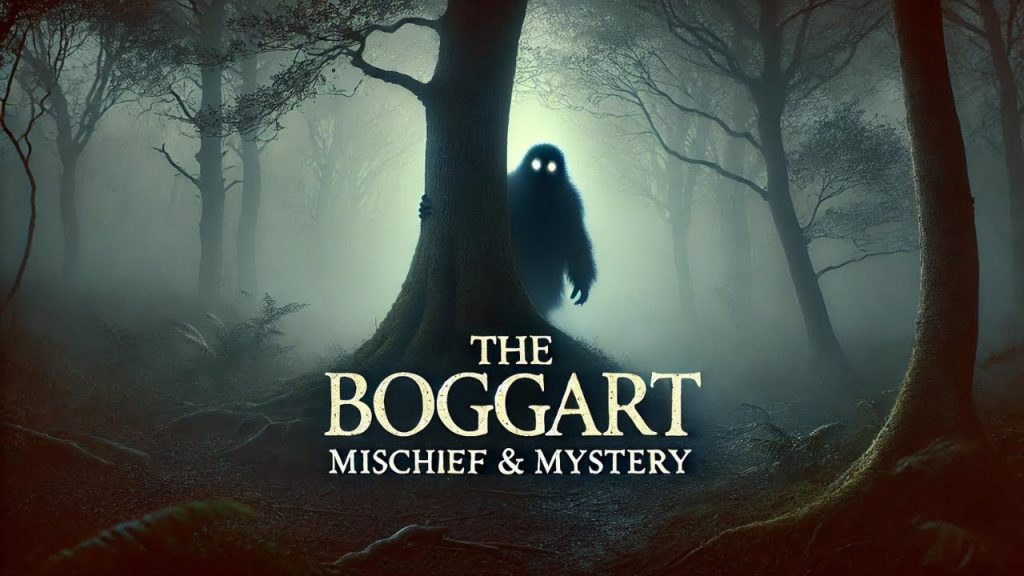
George Cheetham had finally had enough. The disturbances in his house had gone on for months, and now his family’s belongings were loaded onto a cart, ready to start again somewhere else. A neighbour stopped to ask if they were moving. Before George could answer, a small voice called out from inside the cart itself. “Ay, neighbour, we’re flitting.”
The boggart had no intention of being left behind.
A Creature That Refuses to Be Defined
Of all the creatures in British folklore, the boggart might be the hardest to pin down, and that difficulty is, in itself, the most interesting thing about it.
According to Simon Young, an English historian of folklore and currently one of the foremost academic authorities on the subject, the boggart was never a single, consistent type of being to the people of Victorian and Edwardian northern England who told stories about it. In Young’s own description, drawn from years of archival research into nineteenth century sources, a boggart could be almost any ambivalent or evil solitary supernatural spirit, a category broad enough to include ghosts, hobs, shape-changers, demons, will o’ the wisps, or local entities like Jenny Greenteeth. Almost anything frightening and unexplained could be called a boggart by someone, somewhere, in the parts of England where the word was used. The only things excluded from the category, by Young’s account, were angels, considered too virtuous to qualify, and trooping fairies, who lived in groups rather than alone.
This is a considerably stranger and more interesting picture than the one most people carry today, largely thanks to the influential twentieth century folklorist Katharine Briggs, whose work helped narrow the boggart down into something closer to a single, recognisable type: a household spirit, mischievous at best and genuinely malevolent at worst. Young refers to this narrowing process as the goblinification of the boggart, a simplification that made the creature easier to summarise in encyclopedias and easier to borrow for modern fantasy fiction, but one that erased much of the genuine variety and regional specificity of the original folklore.
Where the Name Comes From
The word itself carries a tangle of possible origins, reflecting just how widely the belief spread across different regions and language traditions within Britain.
Some sources trace the term back to the Welsh word bwg, while others point to Old English or Norse roots connected to bogge, a word carrying the general sense of something frightening or spectral. The name shifted across regional dialects too. In parts of Yorkshire the same creature was known as a boggard, and the wider family of related terms, bogey, bogeyman, bogle, and bugbear, all appear to share the same linguistic root, branching outward across England and Scotland like dialect versions of a single underlying fear.
This linguistic messiness mirrors the creature’s behavioural messiness. The boggart was never tidy, never standardised, and the people who told stories about it were never especially concerned with making sure their version matched their neighbour’s.
The House Boggart and the Country Boggart
Nineteenth century Lancashire folklore did draw at least one consistent distinction, separating boggarts into two broad categories based on where they were believed to live and how they tended to behave.
House boggarts attached themselves to a home or a family, behaving in ways that closely resembled the household spirits found across much of Northern European folklore, brownies, hobs, and similar domestic entities that existed somewhere between helpful and hostile depending on how they were treated. A house boggart might cause minor disruptions, souring milk overnight, hiding household items, pulling bedcovers off sleeping occupants, or making dogs go inexplicably lame. In other tellings, the same boggart could become something closer to a guardian, watching over a home or a field in exchange for proper respect and the occasional offering.
Country boggarts were a different proposition entirely. These dwelt in the wilder corners of the landscape, caves, hollows, dense woodland, and the edges of bridges and crossings, and were generally described in far more menacing terms than their domestic cousins. Some early folklore suggests these wilderness boggarts may have originated as spirits believed to guard hidden pathways or sacred natural sites, helping keep the curious or the careless away from places better left undisturbed.
What both types shared was a fundamentally unpredictable nature. A boggart was never simply good or simply evil. It existed in the uncomfortable space between the two, capable of playful mischief one night and genuine cruelty the next, and entirely unconcerned with which mood a household might prefer.
The Story of Boggart Hole Clough
The single most famous boggart legend, and the one that gave an entire piece of Manchester real estate its name, comes from a wooded dell in Blackley, now an inner city park known as Boggart Hole Clough.
The earliest written version of the story appears in Traditions of Lancashire, an 1829 collection compiled by the banker, poet, and writer John Roby, who gathered oral folklore from across the county and shaped it into something closer to literary storytelling. According to Roby’s account, a local farmer named George Cheetham and his family had endured months of escalating torment at the hands of a boggart that had taken up residence in their home. Roby’s description of its behaviour reads very much like a poltergeist: disturbances in the night, objects moved or vanished, an oppressive and unwelcome presence that simply would not leave them in peace.
Eventually the Cheethams reached their breaking point and decided to flit, the regional term for moving house entirely, in the hope that putting distance between themselves and their home would put an end to the haunting. As they loaded their possessions onto a cart and began the journey to a new house, a neighbour stopped them on the road and asked whether they were on the move. Before any of the Cheethams could answer, a small voice piped up from somewhere inside the cart itself: ay, neighbour, we’re flitting.
The boggart had been hiding among their belongings the entire time, and it had no intention whatsoever of being left behind.
This narrative pattern, now generally referred to by folklorists as the flit legend, turns out to be far less unique to Lancashire than Roby’s original telling suggested. Later researchers, including the folklorist Jennifer Westwood, identified strikingly similar stories told about an Irish leprechaun and a Scottish brownie, and it now appears likely that Roby borrowed or adapted the tale from an earlier version published by the folklorist Thomas Crofton Croker in his own collection of fairy legends, attaching it to the Boggart Hole name specifically because the location already carried that evocative title and needed a story to match it.
None of this makes the Boggart Hole Clough story any less significant. If anything, it demonstrates exactly how folklore actually spreads and evolves, travelling between regions and cultures, picking up local names and local details, until a story with roots in Ireland or Scotland becomes, for all practical purposes, a thoroughly Lancastrian tale.
If you want more like this, the Tales of Myth and Magic newsletter delivers new creatures, legends, and forgotten folklore straight to your inbox.
No fixed schedule. No noise. Just the stories, when they are ready.
Sign up here →A Belief in Decline, Then a Quiet Revival
Simon Young’s research, compiled through what he describes as a boggart census conducted across the regions where the belief once thrived, paints a clear picture of decline. References to boggarts were genuinely common across many northern English communities during the Victorian and Edwardian periods, frequently enough that the word would have needed no explanation to anyone living there. By the 1920s, that familiarity was fading rapidly, and Young’s research found a substantial number of people born in the twentieth century, within the very communities he terms Boggartdom, who had simply never heard of the creature at all.
And yet the boggart never entirely vanished. It persisted in academic folklore collections, found new audiences through twentieth century fantasy fiction, and has experienced something of a quiet revival in recent years through ongoing local interest in places like Boggart Hole Clough itself, where a wooden sculpture of the creature now stands among the trees, created by the studio Incredible Creations as a permanent, physical nod to the legend that gave the park its name.
Contemporary research into the area has also turned up an interesting generational pattern. Older residents interviewed about local boggart folklore tend to recall gentler, more mischievous versions of the creature, closer to Roby’s original prankster. Younger residents, by contrast, frequently describe darker and more frightening interpretations, suggesting that even now, nearly two centuries after Roby first wrote the story down, the boggart continues to shift and change shape depending on who is doing the telling.
Never miss a myth
Thank you for being here. The site is brand new and every subscriber genuinely means something to me. If you're here, you care about this stuff as much as I do - and that's all the reason I need to keep going. New stories, videos and dark folklore from around the world, straight to your inbox. No algorithm. Just the stories, when they're ready.