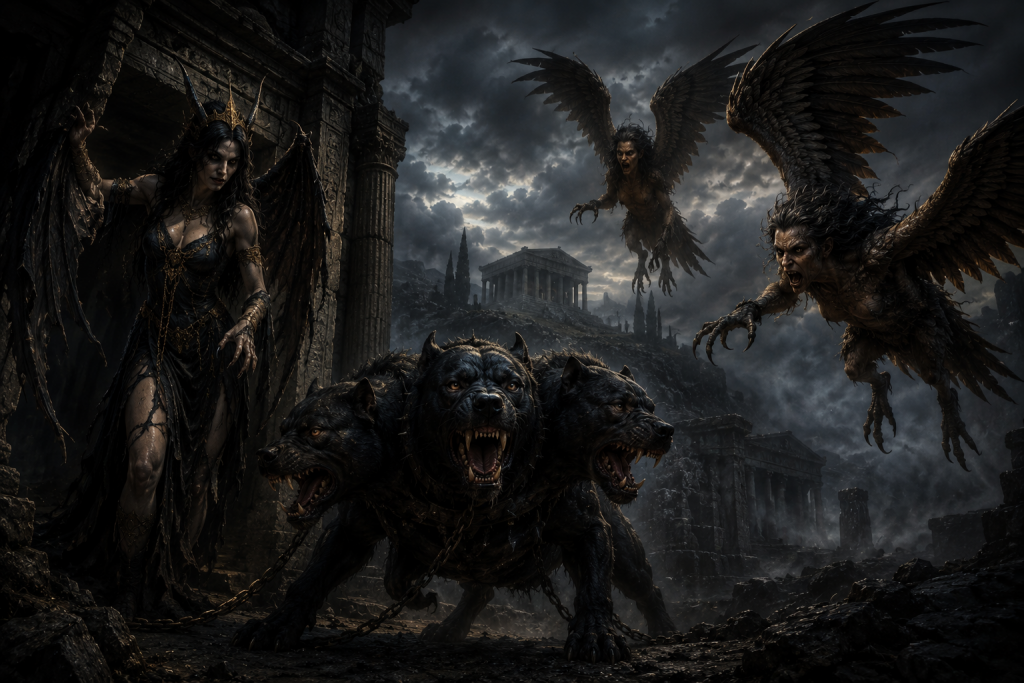
A severed head, eyes still open, snakes still moving where hair should be. Carry it the wrong way and it can still kill you. This is the head that Perseus carried across the ancient world, and the face that ancient Greeks carved onto temples, shields, and doorways for over a thousand years, hoping its terror would work for them instead of against them.
Three Sisters, One Name Remembered
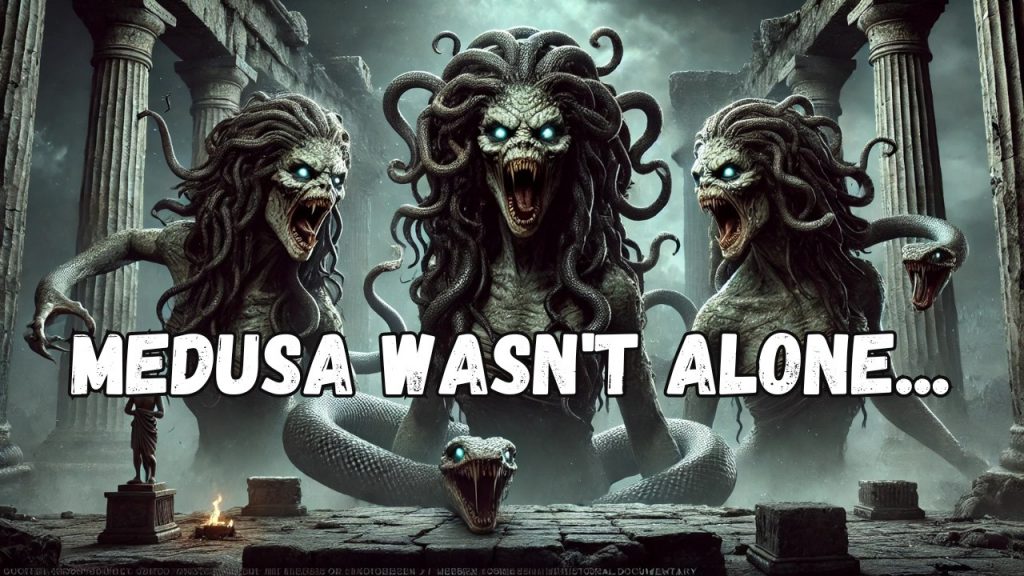
Ask almost anyone to name a Gorgon and they will say Medusa. It is the name that survived, the one that ended up on fashion logos and horror films and the covers of mythology books. But Medusa was never alone. She was one of three sisters, and in the oldest versions of the myth, she was not even the most dangerous one.
According to Hesiod’s Theogony, written around 700 BC and one of the earliest surviving sources for Greek mythology, the Gorgons were three monstrous sisters named Stheno, Euryale, and Medusa, born to the primordial sea deities Phorcys and Ceto. Their names carried meaning even in their own language. Stheno meant the mighty or the forceful, and according to several ancient sources, she was the most lethal of the three, said to have killed more men in her lifetime than her two sisters combined. Euryale’s name translated to far-roaming or of the wide sea, tying her back to her oceanic parentage. Medusa’s name meant the queen, or one who guards and protects, an oddly dignified title for the sister whose story would eventually eclipse the other two entirely.
The Gorgons were closely related to a cast of equally strange siblings. Their parents, Phorcys and Ceto, were also responsible for the Graeae, three elderly sisters who shared a single eye and a single tooth between them, passing each back and forth as needed. The family tree of Greek monsters frequently worked this way, terror and strangeness running through entire bloodlines rather than appearing as isolated incidents.
If you are interested in creatures from Greek Mythology, check out this page for more!
What the Gorgons Actually Looked Like
The image most people carry of a Gorgon, a beautiful woman with snakes for hair, is largely a later invention. The earliest sources describe something considerably less human.
Homer, writing in both the Iliad and the Odyssey, mentions only a single Gorgon and focuses almost entirely on the head, as though the creature existed only as a face with no body attached. The classicist Jane Ellen Harrison observed that in the earliest tradition, the Gorgon was, in essence, only a mask, with a body added by later storytellers who felt a monster needed more than just a terrible face. By the time of the playwright Aeschylus in the fifth century BC, the Gorgons had become fully formed: three winged sisters, described as loathed enemies of humankind, snake-haired, impossible for any man to look upon and survive.
Other ancient accounts add further detail to the horror: wings of gold, hands tipped with brass claws, boar-like tusks, scaled skin, and a gaze capable of turning any living thing to stone the instant eye contact was made. They were said to live on the far western edge of the world, near the realm of Night, in a location some later writers identified specifically as Libya, on the edge of everything the Greeks considered familiar.
Crucially, in this oldest tradition, all three sisters were monstrous by nature. There was no fall from beauty, no tragic backstory. They had simply always been this way.
The Story That Changed Everything
That changed nearly seven hundred years after Hesiod, when the Roman poet Ovid wrote his Metamorphoses around 8 CE and gave Medusa a past that none of the earlier Greek sources had ever mentioned.
In Ovid’s telling, Medusa had not always been a monster. She had been a stunningly beautiful young woman, celebrated above all for her hair, and she served as a priestess in the temple of Athena, a position that required her to remain chaste. Her beauty drew the attention of Poseidon, who pursued her and, in Ovid’s account, assaulted her inside Athena’s own temple. The desecration of sacred space combined with the violation of Medusa’s vow created what the ancient Greek and Roman world understood as miasma, a kind of ritual pollution that demanded a response.
Athena’s response was not directed at Poseidon. As a fellow Olympian, he was simply beyond her power to punish. Instead, Athena turned her fury on Medusa herself, transforming her famous hair into a writhing mass of venomous snakes and cursing her eyes so that anyone who met her gaze directly would turn instantly to stone.
It is worth being honest about how uncomfortable this story is by modern standards, and how aware ancient and modern commentators alike have been of that discomfort. Medusa, in Ovid’s version, was the victim of an assault and was punished for it rather than her attacker. Hesiod’s far earlier account, by contrast, says only that Poseidon and Medusa came together in a meadow, with no mention of force, and gives no indication that Medusa was ever beautiful or human in appearance to begin with. The transformation into a sympathetic, wronged woman appears to be substantially Ovid’s own invention, made for an audience seven centuries removed from Hesiod’s original telling, and the two versions of Medusa, monster from birth or beautiful woman cursed, have coexisted in retellings of the myth ever since.
Perseus and the Impossible Quarry
Whichever version of Medusa’s origin you follow, her story always ends the same way, with a hero arriving to take her head.
Perseus, a demigod son of Zeus, was given the task of killing Medusa as part of a larger chain of obligations that began with a boastful promise to a king. It was, by any reasonable measure, a suicide mission. Medusa’s gaze killed instantly and without exception, which meant any hero foolish enough to look directly at her would never get the chance to land a blow.
Perseus did not go in unprepared. With help gathered from multiple gods, he assembled a small arsenal built specifically around the problem of fighting something you cannot look at. Hermes provided winged sandals for swift flight. Hades lent his cap of invisibility. Athena gave him a polished bronze shield, and it was this shield that solved the central problem of the entire quest. Rather than looking at Medusa directly, Perseus approached while watching only her reflection in the shield’s surface, allowing him to navigate and strike without ever meeting her petrifying gaze head on.
He found Medusa asleep and beheaded her in a single stroke, watching the act unfold safely in reflection rather than reality. The moment her head was severed produced one of the myth’s stranger details: from her neck sprang two fully formed beings, the winged horse Pegasus and a warrior named Chrysaor, both said to be the offspring of her earlier encounter with Poseidon, suddenly released now that her body could no longer contain them.
Medusa’s immortal sisters, Stheno and Euryale, woke and gave chase the instant they discovered what had happened, but Perseus’s stolen invisibility kept him hidden as he fled. According to several ancient sources, Euryale’s grief and rage produced a sound so piercing that the goddess Athena was later said to have invented the music of the flute specifically to imitate it, an oddly beautiful legacy for one half of a chase scene built on fury and loss.
A Head That Kept Working After Death
Medusa’s death did not end her usefulness. If anything, it began the most significant part of her story.
Perseus carried her severed head, still retaining its power to petrify anyone who looked at it directly, using it as a weapon throughout the remainder of his adventures. Eventually he gave it to Athena, who mounted it at the centre of her aegis, the goat skin breastplate that formed part of her divine armour, transforming the very thing that had been used to punish and destroy a woman into the goddess’s own personal symbol of protection and warning.
This is where the myth steps fully out of the realm of fictional adventure and into something the ancient Greeks treated as genuinely, materially important. The image of Medusa’s face, eyes wide, mouth open, snakes coiled around her head, became known as the Gorgoneion, and it may be one of the most widely reproduced single images to survive from the ancient world.
The Gorgoneion was apotropaic, meaning it was believed to actively ward off evil rather than simply symbolise protection in the abstract. The logic, by ancient Greek reasoning, was direct: if a Gorgon’s face was terrifying enough to turn a person to stone, then placing that same face on your shield, your doorway, or your temple roof might frighten away whatever malicious forces, evil spirits, or hostile intent were heading your way.
The evidence for how seriously this was taken is everywhere in the archaeological record. A bronze shield decoration recovered from excavations at Olympia, dating to the early sixth century BC, depicts a winged Gorgoneion at its centre and remains on display in the Archaeological Museum of Olympia today. Gorgon imagery has been found on temple pediments, rooftops, drinking vessels, coins struck in dozens of separate Greek cities, military standards, mosaic floors, and household items recovered from sites stretching from Etruria in Italy to the Black Sea coast. On many ancient mosaic floors, the Gorgoneion was deliberately placed near the threshold of a building, positioned as though it were standing guard over the doorway against anything hostile attempting to cross it.
The image proved durable enough to outlast the religion that produced it. The Romans inherited and continued using the Gorgoneion as both protective emblem and decorative motif long after their conquest of Greece, and the symbol remained recognisable and meaningful well into the Byzantine period, centuries after the worship of Athena and Poseidon had given way to Christianity.
If you want more like this, the Tales of Myth and Magic newsletter delivers new creatures, legends, and forgotten folklore straight to your inbox.
No fixed schedule. No noise. Just the stories, when they are ready.
Sign up here →The Sisters Who Survived
Stheno and Euryale rarely receive the attention given to their sister, and it is worth pausing on what becomes of them after Medusa’s death.
Both remained immortal, untouched by Perseus’s blade, and both continued to exist within Greek mythology as figures of genuine danger rather than footnotes to a more famous sibling’s story. Some traditions describe Euryale specifically as a fierce guardian of the space she and her sister inhabited following Medusa’s death, continuing to embody the same terrifying qualities that had defined all three sisters from the beginning. Ancient depictions occasionally distinguished the surviving sisters by their tusks and their distinctly inhuman features, retaining the older, pre-Ovid image of the Gorgons as creatures that had simply always been monstrous, never beautiful, never wronged, simply and consistently dangerous.
Further Reading
If this article sparked your interest, these are the books worth reading next.
The Iliad — Homer (Penguin Classics)
by Homer — the primary source for everything in this article, and still the most vivid account of the Trojan War ever written.
The Odyssey — Homer (Emily Wilson translation)
by Homer, translated by Emily Wilson — the best modern English translation, and the book that contains Odysseus’s own account of the horse.
The Trojan War: A Very Short Introduction
by Eric Cline — the clearest and most up to date account of what archaeology actually tells us about Troy and whether any of it happened.
Never miss a myth
Thank you for being here. The site is brand new and every subscriber genuinely means something to me. If you're here, you care about this stuff as much as I do - and that's all the reason I need to keep going. New stories, videos and dark folklore from around the world, straight to your inbox. No algorithm. Just the stories, when they're ready.