Every nine years, seven young men and seven young women were sent from Athens to Crete. They were never meant to come back. Somewhere beneath the palace of King Minos, in a maze with no clear way out, something was waiting to be fed.
A Monster Born From a Broken Promise
The Minotaur’s story does not begin with the monster itself. It begins with a king who tried to cheat a god, and a punishment that was far crueller than anything he could have imagined.
King Minos of Crete asked the sea god Poseidon for a sign that the gods favoured his rule. Poseidon answered by sending a magnificent white bull up from the waves, intended as a sacrifice back to the god once it had served its purpose. Minos took one look at the animal and could not bring himself to kill it. He kept the bull for himself and sacrificed an inferior animal in its place, assuming the substitution would go unnoticed.
It did not go unnoticed. Poseidon’s retaliation was not aimed at Minos directly but at his wife, Queen Pasiphae, who he caused to fall into an overwhelming and unnatural desire for the bull itself. Desperate and humiliated, Pasiphae sought the help of the Athenian inventor Daedalus, who had recently been exiled to Crete after a killing back home. Daedalus built her a hollow wooden cow, covered in real hide, convincing enough that she could climb inside it to be close to the bull undetected.
From that union, the Minotaur was born. A creature with the head and tail of a bull and the body of a man, named Asterion, which means the starry one, though almost nobody in the myth ever calls him that. To everyone who feared him, he was simply the Minotaur, the bull of Minos.
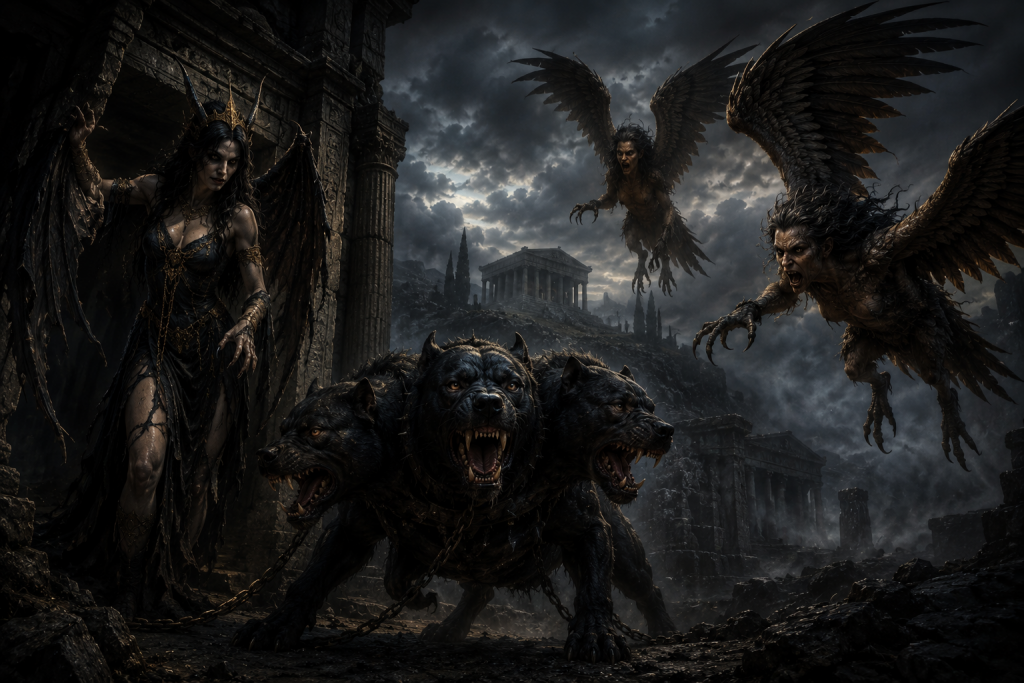
If you are interested in creatures from Greek Mythology, check out this page for more!
The Labyrinth Beneath the Palace
A creature like that could not simply be allowed to wander the palace grounds. Minos turned again to Daedalus, the same man whose invention had caused the problem in the first place, and commanded him to build a prison from which nothing could ever escape.
What Daedalus constructed was the Labyrinth, a structure of such elaborate, twisting complexity that anyone who entered without guidance would become hopelessly lost within its corridors. Ancient writers disagreed on its exact nature even at the time. Some described it as an actual building, others as a series of tunnels running beneath the palace itself. The Roman historian Pliny the Elder later wrote that Crete’s labyrinth had been inspired by an earlier one in Egypt, while noting that by his own time nothing of the original Cretan structure remained to be seen.
Into this maze the Minotaur was placed, and there it stayed, fed not on ordinary food but on people.
The Tribute of Athens
The arrangement that brought victims to the Minotaur’s door had its own bitter history. King Minos’s son Androgeos had travelled to Athens and been killed there, and Minos held the entire city responsible for his death. As punishment, he demanded that Athens send a tribute of seven young men and seven young women to Crete every nine years. Each group would be sent into the Labyrinth, where the Minotaur waited.
This went on for what the myths suggest was decades, an entire city living under the slow, recurring dread of a debt that could never be paid off, only deferred for another nine years at a time.
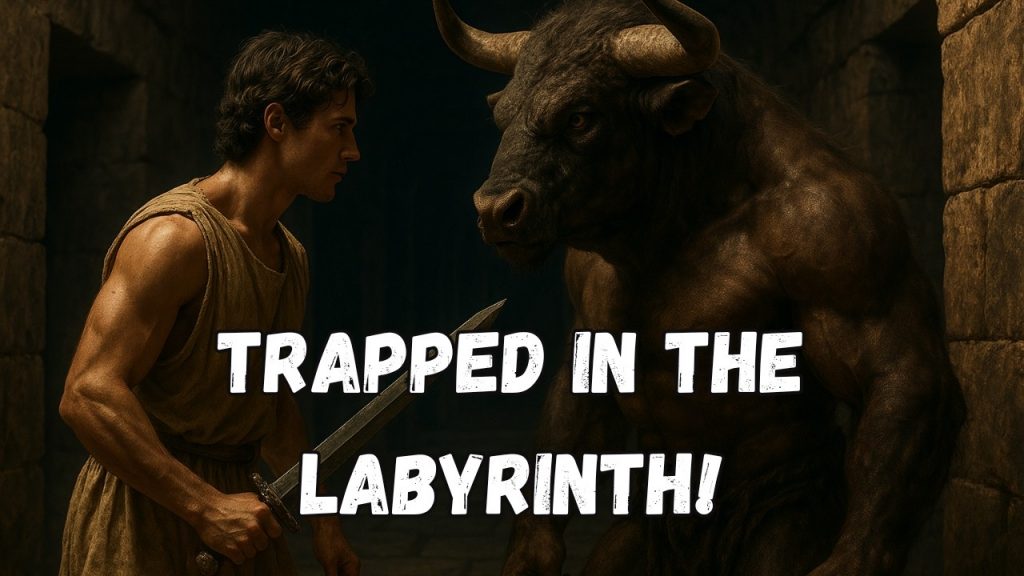
It was into this arrangement that Theseus, son of the Athenian king Aegeus, inserted himself. Rather than allow the lottery to choose another set of victims, Theseus volunteered to be one of the fourteen sent to Crete, with the explicit intention of finding and killing the Minotaur once he arrived.
Ariadne’s Thread
Theseus’s plan would have ended in his own death within the Labyrinth’s corridors were it not for Ariadne, Minos’s own daughter, who fell for the Athenian prince the moment she saw him.
Ariadne turned to Daedalus, the architect of the very maze her father intended to use against Theseus, and asked for a way to help him survive. Daedalus suggested the simplest possible solution to an impossibly complex problem: a ball of thread. Ariadne gave it to Theseus before he entered the Labyrinth, instructing him to unwind it as he walked deeper inside, so that the same thread could guide him back out again once his task was complete.
Theseus walked the corridors with the thread trailing behind him until he found the Minotaur at the heart of the maze. What followed is described differently across various ancient sources, some emphasising a desperate physical struggle, others a single decisive blow, but in every version the outcome is the same. Theseus killed the Minotaur, then followed Ariadne’s thread back through the Labyrinth to the entrance, freeing the remaining Athenian youths who had been brought with him.
The story does not end happily for everyone involved. Theseus took Ariadne with him as he fled Crete, only to abandon her on the island of Naxos during the journey home, continuing on to Athens without her. King Minos, discovering that Daedalus had aided in his daughter’s betrayal and the Minotaur’s death, imprisoned the architect and his young son Icarus inside the very Labyrinth he had built. Pasiphae, in one of the story’s few moments of mercy, secretly freed them. Daedalus constructed wings of feathers and wax so that he and Icarus could fly to safety, a plan that ended in tragedy when Icarus flew too close to the sun, the wax melted, and he fell into the sea and drowned.
The Civilisation Behind the Myth
For centuries the Minotaur was treated as pure invention, a story with no more historical grounding than any other Greek monster. That changed in 1900, when the British archaeologist Arthur Evans began excavating a site on Crete called Knossos.
What Evans uncovered was the palace complex of an entire lost civilisation, one that had thrived on Crete from roughly 2600 to 1100 BCE and that came to be known as the Minoan civilisation, named after the legendary King Minos himself. The palace at Knossos turned out to be staggeringly complex, a sprawling, multi-level structure of interconnected rooms, corridors, and storage chambers that could easily disorient anyone unfamiliar with its layout. To Evans and those who followed him, the resemblance to the mythical Labyrinth was difficult to ignore.
The bull, meanwhile, turned out to be everywhere in Minoan culture. Frescoes throughout the palace depict the practice of bull leaping, in which young athletes vaulted over charging bulls in displays that combined sport, ritual, and considerable danger. Bull horns, carved in stone, decorated shrines and rooftops across the island. The double headed axe known as the labrys, found repeatedly throughout Minoan religious sites, may be the actual origin of the word labyrinth itself, suggesting that the maze of myth and the axe of Minoan ritual were connected long before anyone wrote the story down.
Some historians have proposed a more pointed reading of the entire myth: that the tribute of Athenian youths represented a real historical memory of Crete’s dominance over the early Greek mainland, with the bull cult and the Minotaur encoding the uncomfortable reality of subjugation, eventually overturned, in the mythologised version, by Theseus’s victory.
If you want more like this, the Tales of Myth and Magic newsletter delivers new creatures, legends, and forgotten folklore straight to your inbox.
No fixed schedule. No noise. Just the stories, when they are ready.
Sign up here →Blood on the Mountain
If the Minotaur’s myth has any basis in real Minoan religious practice, the most unsettling evidence comes not from Knossos itself but from a small temple on the northern slopes of nearby Mount Juktas, called Anemospilia.
In 1979, the Greek archaeologist Yannis Sakellarakis excavated the site and found a building that had been suddenly destroyed, apparently by a violent earthquake, sometime around 1700 BCE. Inside one chamber, his team found the skeleton of a teenage boy lying across what appeared to be a raised platform, his legs drawn back in a position consistent with having been bound. A bronze blade lay near his remains. Discoloration in the bones on one side of the body has been interpreted by some researchers as evidence of rapid blood loss, consistent with his throat having been cut. Two other skeletons were found nearby, identified by some as an officiant and a priestess, suggesting a ritual that was violently interrupted partway through by the earthquake that brought the building down.
The interpretation has never been universally accepted. The archaeologist Dennis Hughes has argued that the bronze object was more likely an ornate spearhead that fell from a shelf during the earthquake rather than a sacrificial knife, and that there is no solid evidence the young man’s body was deliberately bound or that the platform functioned as an altar at all. Other Minoan sites, including a deposit of human bones at Knossos itself known as the North House, carry similarly disputed interpretations, with some archaeologists favouring sacrifice and others favouring nothing more sinister than the random consequences of earthquake and fire.
What is far better established is the Minoans’ devotion to animal sacrifice. Bull bones, sheep bones, and goat bones turn up consistently in ritual contexts across the island, arranged near altars and within temple structures in patterns that suggest formal, repeated ceremony. Whatever happened at Anemospilia on that single catastrophic day, the broader culture it belonged to was one where the bull held a sacred, central place, and where blood, animal or otherwise, was offered to appease forces the Minoans believed could bring the world crashing down around them with no warning at all.
Further Reading
If this article sparked your interest, these are the books worth reading next.
The Iliad — Homer (Penguin Classics)
by Homer — the primary source for everything in this article, and still the most vivid account of the Trojan War ever written.
The Odyssey — Homer (Emily Wilson translation)
by Homer, translated by Emily Wilson — the best modern English translation, and the book that contains Odysseus’s own account of the horse.
The Trojan War: A Very Short Introduction
by Eric Cline — the clearest and most up to date account of what archaeology actually tells us about Troy and whether any of it happened.
Never miss a myth
Thank you for being here. The site is brand new and every subscriber genuinely means something to me. If you're here, you care about this stuff as much as I do - and that's all the reason I need to keep going. New stories, videos and dark folklore from around the world, straight to your inbox. No algorithm. Just the stories, when they're ready.