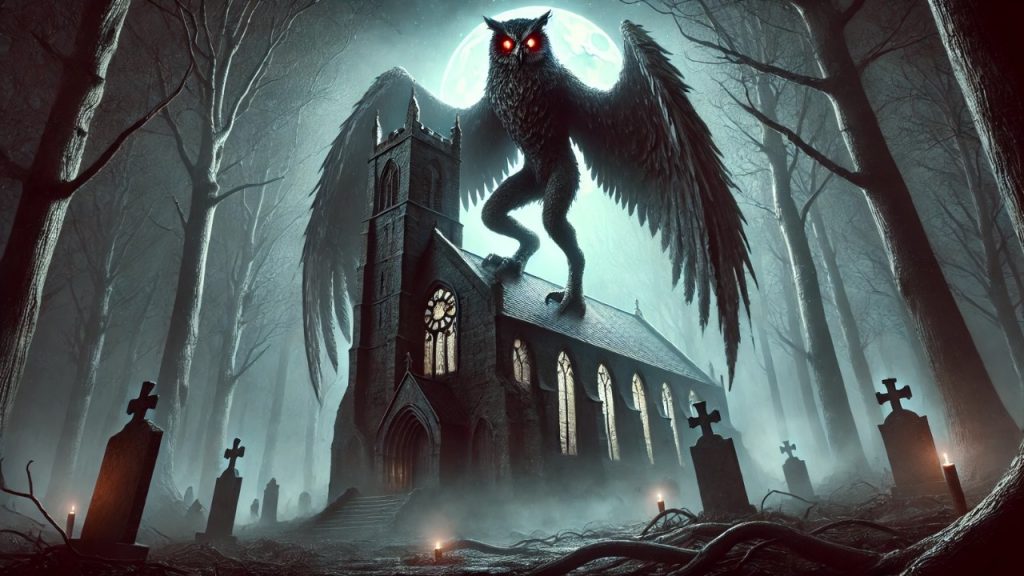
On the evening of 17 April 1976, two sisters on a family holiday ran screaming from the churchyard of St Mawnan and St Stephen’s in Cornwall. Their father heard the scream before he saw them sprinting towards the car. Whatever they had seen above the church tower frightened them so badly that he packed up the family holiday and drove them home to Lancaster that same night.
What the girls described would go on to become one of Britain’s most enduring modern cryptid mysteries, a creature that still draws investigators and curious visitors to a quiet Cornish churchyard nearly fifty years later.
A Church With a History of Strangeness
Mawnan Church sits above the wooded valley leading down to the Helford River, a thirteenth century building restored in 1827, surrounded by old trees and gravestones that have weathered for centuries. It is the kind of place that feels atmospheric even on an ordinary afternoon. By evening, with the light failing through the woods, it takes very little imagination to feel watched.
The church had a peculiar reputation even before 1976. According to some accounts, the artists Max Ernst and Leonora Carrington visited Mawnan in 1937 and reportedly performed rituals there attempting to summon a half man, half bird figure they referred to as a therianthrope, and the Owlman went on to feature in both their bodies of work for years afterwards. Whether or not anything came of those rituals, the area’s association with a winged humanoid predates the events of 1976 by nearly four decades.
The Melling Sighting
The family at the centre of the first major sighting were the Mellings: Don, his wife, and their two daughters, twelve year old June and nine year old Vicky. The family had stopped to picnic in the wooded area beside the church while the girls wandered off to play among the gravestones.
According to the account that later circulated, the girls heard a strange sound before looking up and seeing a large bird-like, human-shaped figure hovering a few feet above the church tower. They described glowing eyes and described the creature as resembling a huge owl, but with the unmistakable suggestion of a man’s shape rather than that of any bird they recognised.
The girls ran. Their parents, hearing the commotion, cut the holiday short by three days and drove the family home immediately. It was the kind of reaction that suggested genuine fear rather than a story dreamed up for attention, though it is worth noting that all of this comes to us secondhand, through the man who would shortly make the story public.
Enter Tony “Doc” Shiels
The figure at the centre of the entire Owlman phenomenon is almost as interesting, and almost as controversial, as the creature itself.
Tony “Doc” Shiels was a Salford born artist, magician, and self-described “arch-hoaxer” who had settled in Cornwall and was, by 1976, already a well known local character. Shiels described himself as a practitioner of what he called Strange Magic, an approach to illusionism built around audience participation, atmosphere, and theatrical storytelling rather than conventional stage tricks. By his own later admission and the assessment of those who knew him, very little he did in this period was meant to be taken entirely at face value.
In the same year as the Owlman sightings, Shiels was also energetically pursuing reports of Morgawr, a sea serpent supposedly living in the waters of Falmouth Bay, an investigation that involved members of his coven swimming naked in the water in an attempt to lure the creature out, and which most folklorists now regard as a deliberate invention on Shiels’s part. The following year, in 1977, he produced a photograph claimed to show the Loch Ness Monster, which made the front page of a national newspaper and remains hotly disputed to this day.
It was Shiels who brought the Melling family’s story to public attention, publishing it through a pamphlet titled Morgawr: The Monster of Falmouth Bay, which circulated across Cornwall in 1976. According to Shiels, one of the girls provided him with a drawing of what they had seen, and it was Shiels who gave the creature its name: the Owlman.
This is the detail that any honest account of the legend has to sit with directly. The man who introduced the Owlman to the world was, by his own reputation and the verdict of those who studied him, someone whose relationship with the literal truth was loose at best. That does not mean the Melling girls saw nothing. It means the version of events available to us passed through the hands of someone with a demonstrated appetite for exactly this kind of story.
The Second Sighting
Two and a half months later, on 3 July 1976, two fourteen year old girls named Sally Chapman and Barbara Perry were camping in the woods near the same church. Both girls were already aware of the Melling story by this point, since the pamphlet had been circulating locally for weeks.
According to their account, they heard a hissing sound and turned to see a creature they described as a large owl, roughly the size of a man, with pointed ears, glowing red eyes, and black claws that some described as resembling pincers. Shiels, apparently keen to rule out collusion, interviewed the two girls separately and had each produce a drawing without consulting the other. The two sketches were different enough in their specific details to suggest they had not simply copied each other, while still broadly matching the description given by the Melling sisters months earlier.
It is a detail often used to argue for the credibility of the case. It can equally be read as exactly the kind of careful, theatrical verification a skilled showman would think to stage.
The Sightings That Followed
The Owlman did not vanish after the summer of 1976. Sporadic reports continued to surface around the Mawnan area for years afterwards. A sixteen year old girl reported seeing the creature again while camping near the church in 1978, describing glowing red eyes cutting through the darkness. Further claims followed in 1979, 1989, and 1995. As recently as the year 2000, locals reported hearing a loud, owl-like sound at night in a churchyard in nearby Mullion, which some connected back to the original Mawnan legend.
None of these later reports carry anything close to the detail or apparent independence of the original two sightings, and most exist as little more than brief mentions in collections of British paranormal folklore. But the persistence of the story over several decades, however thin some of its later additions, says something about how thoroughly the original 1976 account embedded itself in the local imagination.
What Could Explain It
The most frequently proposed natural explanation is the Eurasian eagle owl, a genuinely enormous species capable of growing more than two feet in length with a wingspan approaching six feet. An eagle owl is not native to Britain, but escapes from captivity are documented, and an animal of that size, glimpsed briefly at dusk by frightened children expecting nothing of the sort, could plausibly account for a description involving glowing eyes, a humanlike silhouette, and wings on a scale unlike anything native to the Cornish countryside.
This explanation has obvious appeal. It requires no supernatural element, accounts for the size and the eyes, and fits with a known, if uncommon, real world animal. What it does not fully explain is the consistently human shaped silhouette described across multiple witnesses, nor the claw description that several accounts likened to pincers rather than anything resembling a bird’s talon.
The hoax explanation carries its own weight given who was involved. Shiels’s later record, the Morgawr invention, the disputed Loch Ness photograph, and his own cultivated reputation as Cornwall’s foremost prankster and arch hoaxer make it entirely reasonable to wonder whether the entire phenomenon began as one of his theatrical productions, dressed up as a frightened family’s genuine account.
And then there is the third possibility, the one that requires no resolution at all. That two children really did see something in the trees above an old church on an April evening, something they could not explain, and that everything which came afterwards, the pamphlet, the showman, the repeated sightings, the careful drawings, grew up around a kernel of something genuinely strange that nobody has ever been able to pin down.
If you want more like this, the Tales of Myth and Magic newsletter delivers new creatures, legends, and forgotten folklore straight to your inbox.
No fixed schedule. No noise. Just the stories, when they are ready.
Sign up here →A Church Worth Visiting, Carefully
St Mawnan and St Stephen’s Church still stands above the Helford River today, its tower the same one the Melling sisters say they saw something hovering above on an April evening in 1976. The woods around it remain exactly the kind of place where light fails quickly and imagination does the rest.
No physical evidence of the Owlman has ever been produced. No photograph, no feather, no print in soft ground. What exists instead is a consistent description, repeated independently by separate witnesses years apart, filtered through the involvement of one of Cornwall’s most committed and talented hoaxers, in a location with its own much older reputation for strangeness.
Whether that adds up to a misidentified bird, an elaborate and very long running prank, or something that has genuinely never been satisfactorily explained is a question Mawnan has been sitting with for half a century.
The tower is still there. The trees still grow close around the churchyard. And if you find yourself standing beneath it as the light begins to fail, you may understand exactly why two young girls once turned, screamed, and ran.
Never miss a myth
Thank you for being here. The site is brand new and every subscriber genuinely means something to me. If you're here, you care about this stuff as much as I do - and that's all the reason I need to keep going. New stories, videos and dark folklore from around the world, straight to your inbox. No algorithm. Just the stories, when they're ready.