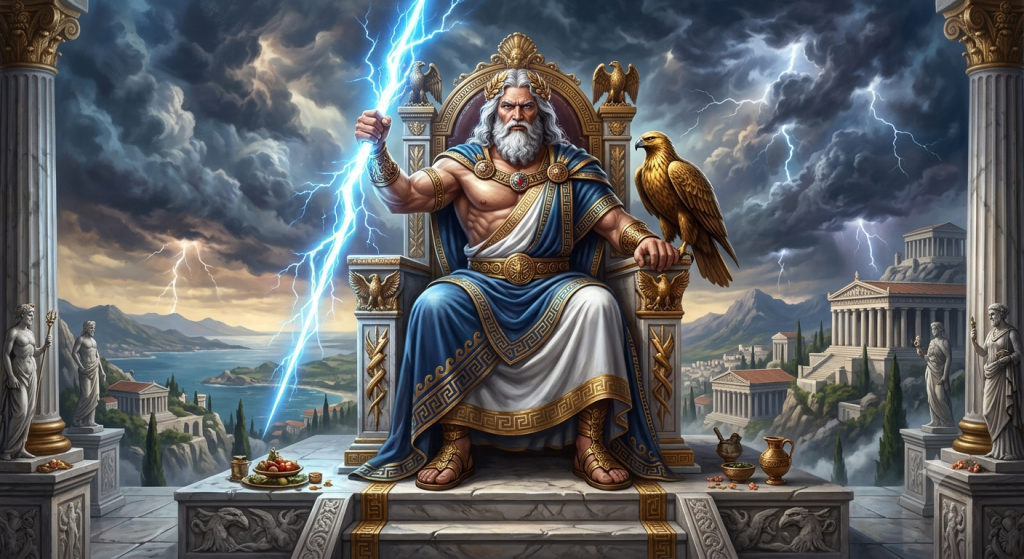
Zeus is the king of the Olympian gods, the ruler of the sky, the wielder of the thunderbolt, and the father of more children than any other figure in Greek mythology. He is also the god most frequently depicted in the tradition as making decisions that range from petty to catastrophic, pursuing mortals and immortals alike with a single-mindedness that causes considerable collateral damage, and being outsmarted by his wife, his children, and occasionally by mortals who should have known better than to try.
This is not a contradiction. It is precisely what makes Zeus interesting as a theological figure rather than simply as a plot device. He is the supreme authority in the Greek cosmos and he is comprehensively fallible, which means the tradition is describing a universe governed by power rather than wisdom, by authority rather than goodness, and requiring its inhabitants to navigate that reality with whatever resources they have available.
Origins and the Overthrow of Cronos
Zeus was the youngest child of the Titans Cronos and Rhea. Cronos had overthrown his own father Ouranos and had received a prophecy that one of his own children would in turn overthrow him. His solution was to swallow each child as it was born. He swallowed Hestia, Demeter, Hera, Hades, and Poseidon in sequence.
When Zeus was born, Rhea substituted a stone wrapped in swaddling clothes and sent the infant Zeus to Crete to be raised in secret. Cronos swallowed the stone. Zeus grew up on Crete, raised by the goat Amalthea or by nymphs depending on the version, and when he was grown he returned and gave Cronos an emetic that caused him to regurgitate the five siblings he had swallowed. The siblings, fully grown despite having been swallowed as infants, joined Zeus in the Titanomachy, the war against the Titans that established Olympian rule over the cosmos.
The Titanomachy lasted ten years. The Olympians were eventually victorious with the help of the Cyclopes, who forged Zeus’s thunderbolt, Poseidon’s trident, and Hades’s helm of invisibility as weapons, and with the help of the Hecatoncheires, the hundred-handed giants. The Titans were imprisoned in Tartarus. The three brothers divided the cosmos: Zeus took the sky, Poseidon the sea, and Hades the underworld. The earth and Olympus were shared.
The Thunderbolt and What It Represents
Zeus’s thunderbolt is more than a weapon. In Greek theological thinking, lightning was the most direct manifestation of divine power available to human observation, and Zeus’s control of it positioned him as the god whose presence was most immediately legible in the natural world. When lightning struck, Zeus had acted. The thunderbolt was his signature in the landscape.
It also functioned as the ultimate sanction. When Zeus wanted to destroy something, he used the thunderbolt. Semele, Phaethon, the giants in the Gigantomachy: those who needed to be unmade rather than simply punished received the bolt directly. The threat of it was sufficient to keep most of the Olympians in line most of the time, which is why the episodes in which other gods successfully resist or deceive Zeus carry particular weight in the tradition.
Zeus and the Other Gods
Zeus’s relationship with the other Olympians is not that of an absolute monarch with perfectly obedient subjects. The gods deceive him, resist him, act against his explicit instructions, and occasionally restrain him physically. In the Iliad, Hera, Athena, and Poseidon conspire to bind him while he sleeps, and it is only the intervention of the Hecatoncheires that frees him. Hera persistently works against his decisions in the Trojan War. Prometheus defies him directly and sustains enormous punishment as a result.
What Zeus has is superior power, not superior authority in any moral sense. The other gods obey him when they must and circumvent him when they can, and the tradition is entirely comfortable presenting this as the normal operation of divine politics rather than as a failure of cosmic order.
The Affairs and Their Consequences
Zeus’s affairs with goddesses, nymphs, and mortal women are the most extensively catalogued aspect of his mythology, and they produced a significant proportion of the major figures in Greek mythology: Apollo and Artemis by Leto, Hermes by Maia, Dionysus by Semele, Persephone by Demeter, Heracles by Alcmene, Perseus by Danaë, Helen by Leda, and many more.
The tradition does not present these consistently as romantic or consensual, and modern readers are right to note that many of them involve coercion or deception. What the tradition is encoding theologically is the idea that the union of the divine and the mortal produces the great heroes and demigods who populate the mythological world. The mechanism of that production is presented with considerably more frankness about divine power dynamics than later retellings tend to preserve.
Hera’s responses to Zeus’s affairs are the most fully explored aspect of their relationship. She does not punish Zeus, who is beyond her power to punish effectively. She punishes the women and the children, who are not. This asymmetry is one of the most morally uncomfortable aspects of the Greek tradition and one of its most honestly observed: power protects the powerful and the costs of its exercise fall on those who cannot resist.
Zeus as Cosmic Order
Beneath the affairs and the thunderbolts, Zeus serves a genuine cosmological function in Greek theology. He is the guarantor of xenia, the sacred law of hospitality that governs the relationship between host and guest. He is the protector of suppliants. He oversees oaths and punishes their violation. He is the force that maintains the basic structure of the world against the chaos that would otherwise overwhelm it.
Zeus Xenios, Zeus as the guardian of hospitality, is the theological weight behind the entire Trojan War narrative: Paris violated xenia by taking Helen from Menelaus’s house while Menelaus was his host, and the war that followed is the consequence of that violation playing out at cosmological scale. The god who guarantees hospitality is also the father of Helen, which makes the war a family matter as much as a theological one, which is characteristic of how Greek mythology holds multiple registers simultaneously.
Further Reading
If this article sparked your interest, these are the books worth reading next.
The Iliad — Homer (Penguin Classics)
by Homer — the primary source for everything in this article, and still the most vivid account of the Trojan War ever written.
The Odyssey — Homer (Emily Wilson translation)
by Homer, translated by Emily Wilson — the best modern English translation, and the book that contains Odysseus’s own account of the horse.
The Trojan War: A Very Short Introduction
by Eric Cline — the clearest and most up to date account of what archaeology actually tells us about Troy and whether any of it happened.
For more on the Greek tradition, the Hera article covers the wife who spends most of the mythology finding ways to work around her husband’s decisions. The Hades article covers the brother who got the underworld in the division and turned out to be one of the more just figures in the tradition. The Greek Mythology hub page has every article in the cluster.
Never miss a myth
Thank you for being here. The site is brand new and every subscriber genuinely means something to me. If you're here, you care about this stuff as much as I do - and that's all the reason I need to keep going. New stories, videos and dark folklore from around the world, straight to your inbox. No algorithm. Just the stories, when they're ready.