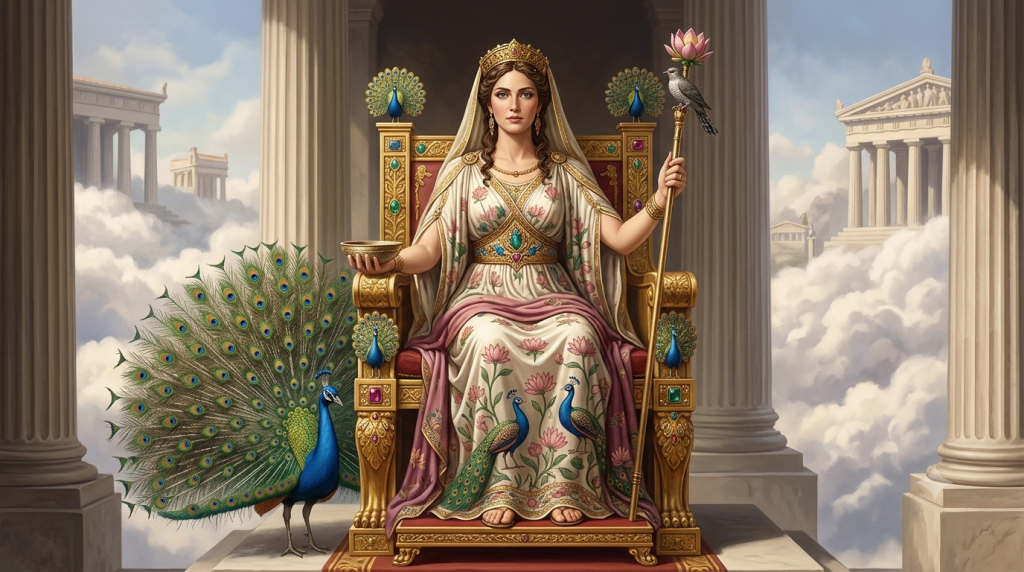
Hera is the queen of the Greek gods, the goddess of marriage and family, the wife of Zeus, and one of the most powerful Olympians. She is also, in the mythology that survives, almost perpetually engaged in punishing women and heroes for things that are not their fault, pursuing vendettas across decades, and being outwitted by her husband with a regularity that the tradition finds entirely unremarkable.
Popular retellings have made her into a villain, the jealous wife whose pettiness ruins the lives of innocent people. This reading is not entirely wrong but it is almost entirely incomplete. Hera in the tradition is a figure responding to a genuine and continuous injustice: her husband’s persistent infidelity, conducted openly, producing children she is expected to tolerate, in a marriage she cannot leave because she is the goddess of marriage. The tradition places her in an impossible position and then presents her reactions to that position as the problem. Reading her carefully requires noticing this.
Her Origins and Her Marriage
Hera was the daughter of Cronos and Rhea, swallowed by her father at birth and regurgitated when Zeus freed his siblings. She is therefore both Zeus’s sister and his wife, a relationship that the tradition records without apparent discomfort as was common in divine genealogies across ancient Mediterranean religion.
The marriage between Zeus and Hera is described in various sources as preceded by a lengthy courtship, during which Zeus disguised himself as a cuckoo and sheltered under Hera’s cloak in the cold. When she showed compassion for the bird, he revealed himself and proposed. The detail of the disguise is characteristic: even in his own marriage proposal, Zeus operates through deception rather than direct approach, which sets the tone for everything that follows.
Their marriage in the tradition is an extended study in institutional dysfunction. Zeus pursues other women constantly. Hera opposes him constantly. The other gods navigate around both of them. The cosmos continues because neither can destroy the other and both are necessary to its functioning, which is either a theological statement about the nature of order or a grimly accurate observation about how power operates in difficult relationships, or both.
Her Domains and Her Power
Hera governs marriage, childbirth, and the sanctity of family bonds. As the goddess of marriage she is the divine authority behind every wedding oath and every marriage compact in the Greek world, which gives her a scope of influence that extends into every household in every city. She is worshipped more widely and more consistently than the mythology’s focus on her conflicts might suggest, because the protection of marriage was of practical importance to a far larger proportion of the population than the heroic dramas in which she appears as antagonist.
Her cult centres were among the most important in the Greek world. The Heraion at Olympia predates the temple of Zeus and was one of the earliest monumental Greek temples. The Heraion at Samos was one of the largest temples in the ancient Greek world. Argos, which considered itself under her particular protection, maintained one of the most prestigious of her sanctuaries. The goddess who appears in the mythology as a perpetual antagonist was, in actual religious practice, among the most widely honoured deities in the Greek world.
The Judgement of Paris and the Trojan War
Hera’s involvement in the Trojan War begins with the Judgement of Paris, in which Paris of Troy is asked to decide which of three goddesses, Hera, Athena, or Aphrodite, is the most beautiful, and each goddess offers a bribe. Hera offers power over kingdoms. Athena offers wisdom and skill in battle. Aphrodite offers the most beautiful woman in the world. Paris chooses Aphrodite, and the most beautiful woman in the world is Helen, who is already married to Menelaus of Sparta.
Hera’s opposition to Troy throughout the Iliad is generally presented as motivated by this slight. She supports the Greeks with a consistency and a ferocity that Zeus has to work against throughout the poem, and she deploys every resource available to her including seducing Zeus herself to distract him at a critical moment while Poseidon helps the Greeks on the battlefield. The seduction scene in Book 14 of the Iliad, in which Hera borrows Aphrodite’s girdle and puts Zeus to sleep after lovemaking, is one of the most humanly observed passages in Homer and one that positions Hera as a far more capable political operator than her reputation as the jealous wife suggests.
Heracles and the Vendetta
Hera’s persecution of Heracles is the most extended and most consequential of her vendettas, and it is worth being precise about what provoked it. Heracles was the son of Zeus and Alcmene, a mortal woman. Hera had nothing to do with his conception and no control over whether Zeus produced yet another illegitimate child. Her response to the situation was to attempt to kill the infant Heracles in his cradle by sending serpents, which the infant strangled without apparent difficulty. When that failed, she periodically afflicted him with madness throughout his life, including the episode of madness in which he killed his own wife and children, which is the event that directly produces the Twelve Labours as an act of penance.
The tradition’s presentation of Hera here is morally uncomfortable in a way that careful reading makes difficult to avoid. She is punishing a child for being born, and punishing his innocent wife and children for his father’s behaviour. This is not presented as heroic or justified. It is presented as what Hera does, as the form her powerlessness takes when it becomes action. She cannot touch Zeus. She touches everything adjacent to Zeus that she can reach.
Hera and Io
The story of Io is one of the clearest illustrations of the asymmetry at the heart of Hera’s situation. Io was a priestess of Hera whom Zeus desired. He transformed her into a white heifer to conceal her from Hera, or Hera discovered the transformation and Zeus claimed the heifer was a gift rather than his lover. Hera accepted the gift and set the hundred-eyed giant Argus to watch over the heifer, preventing Zeus from transforming Io back.
Zeus then sent Hermes to kill Argus and free Io. Hera sent a gadfly to torment the transformed Io across the world, driving her from country to country in a maddened flight that the tradition traces across a vast geography before she eventually reached Egypt and was restored to human form. The sequence of events puts Hera in the position of persecuting a woman who was the victim of her husband’s desire and her husband’s deception, while her husband faces no consequences at all.
The tradition does not editoralise about this. It simply records it. Which is its own form of comment on what it was describing.
Further Reading
If this article sparked your interest, these are the books worth reading next.
The Iliad — Homer (Penguin Classics)
by Homer — the primary source for everything in this article, and still the most vivid account of the Trojan War ever written.
The Odyssey — Homer (Emily Wilson translation)
by Homer, translated by Emily Wilson — the best modern English translation, and the book that contains Odysseus’s own account of the horse.
The Trojan War: A Very Short Introduction
by Eric Cline — the clearest and most up to date account of what archaeology actually tells us about Troy and whether any of it happened.
For more on the Greek tradition, the Zeus article covers the husband whose behaviour structures most of Hera’s mythology. The Heracles article covers the hero whose life Hera spends the mythology attempting to destroy. The Greek Mythology hub page has every article in the cluster.
Never miss a myth
Thank you for being here. The site is brand new and every subscriber genuinely means something to me. If you're here, you care about this stuff as much as I do - and that's all the reason I need to keep going. New stories, videos and dark folklore from around the world, straight to your inbox. No algorithm. Just the stories, when they're ready.