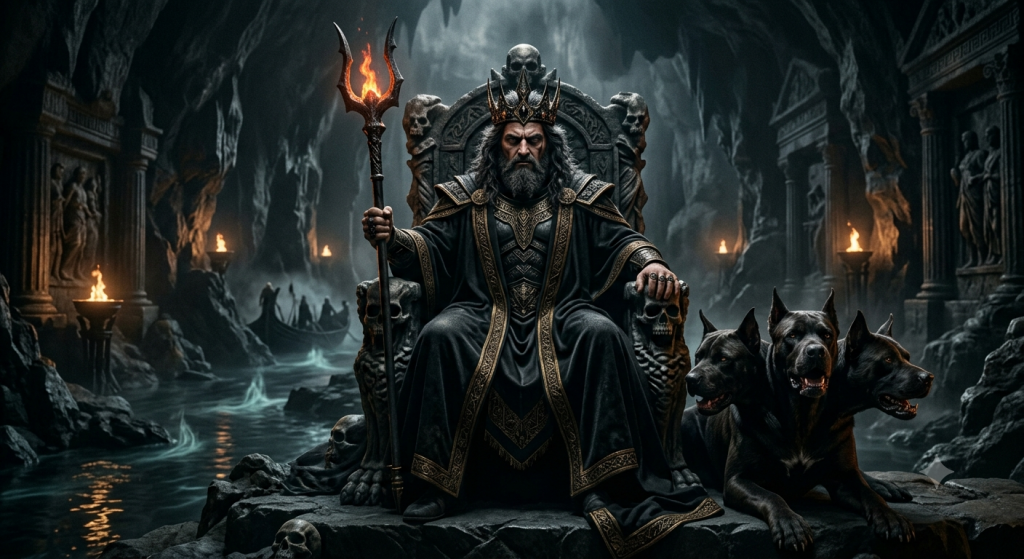
Hades is the most misunderstood major deity in Greek mythology. He rules the underworld, which modern culture has consistently mapped onto the Christian concept of hell and therefore onto the idea of a malevolent devil figure who torments the dead. This is almost entirely wrong. The Greek underworld is not a place of punishment in the Christian sense, and Hades is not a devil figure. He is a king administering a realm, and the tradition consistently presents him as one of the more just and impartial figures in the Greek pantheon.
What distinguishes Hades from the other Olympians is not malevolence but separation. He does not appear on Olympus. He does not intervene in the affairs of the living world except when someone intrudes into his domain. He does not pursue mortals or cause trouble in the way that Zeus and Poseidon and Hera regularly do. He governs the dead and he governs them fairly, according to a system in which each soul receives what it has earned, and he does not appear in the tradition as taking particular pleasure or displeasure in that function. He simply does it.
The Division of the Cosmos
After the Titanomachy, the three brothers, Zeus, Poseidon, and Hades, drew lots to divide the cosmos. Zeus got the sky. Poseidon got the sea. Hades got the underworld. The earth and Olympus were held in common. The tradition is explicit that this was a lottery rather than a hierarchy: Hades did not receive the underworld as a punishment or as evidence of lower status. He received it as his share of a fair division.
This matters because it places Hades’s domain on the same level as his brothers’ rather than below them. The underworld is not a lesser realm. It is the realm that receives every mortal who has ever lived, which makes it in one sense the largest domain in the cosmos. Every human being who has ever existed is eventually a subject of Hades, which Zeus and Poseidon cannot claim.
The Underworld and Its Geography
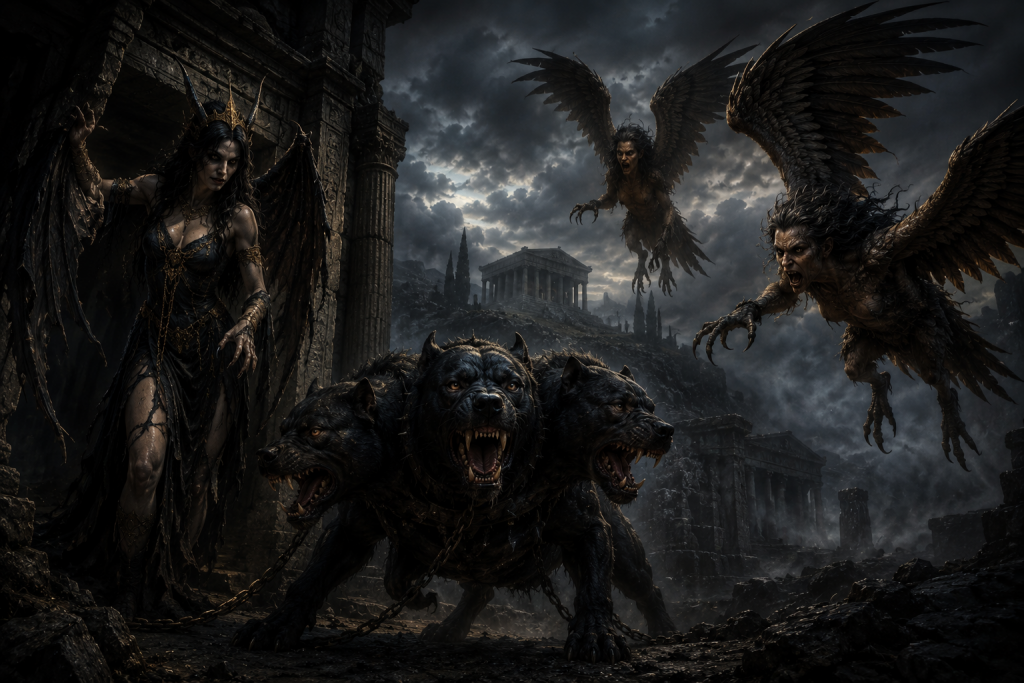
The Greek underworld is a specific geography rather than a vague realm of darkness. The dead must cross the River Styx or the River Acheron, ferried by Charon who requires a coin as payment, which is why the Greeks placed coins on the eyes or in the mouths of the dead at burial. Cerberus guards the entrance, preventing the dead from leaving and the living from entering without permission.
Within the underworld, souls are judged by three judges: Minos, Rhadamanthus, and Aeacus, all formerly mortal kings noted for their justice in life. The judgment determines where in the underworld the soul goes: the Elysian Fields for the virtuous and the heroic, the Asphodel Meadows for the ordinary dead who were neither particularly virtuous nor particularly wicked, and Tartarus for those who had committed genuine crimes against the gods or against the cosmic order.
This structure is a moral system rather than a simple geography of the dead, and Hades administers it rather than operates it arbitrarily. The souls in Tartarus are there because the judges determined they belonged there. Hades did not put them there out of cruelty. He is the administrator of a system of cosmic justice, which is considerably more admirable than the role the Christian mapping onto his domain has given him.
The Helmet of Invisibility
Hades’s divine weapon is not a thunderbolt or a trident but a helmet that renders the wearer invisible. It was made for him by the Cyclopes during the Titanomachy and is one of the three great weapons forged at that time alongside Zeus’s thunderbolt and Poseidon’s trident. The helmet appears elsewhere in the mythology: Athena wears it during the Trojan War to prevent Ares from seeing her assistance to the Greeks, and Perseus borrows it for his mission to kill Medusa.
The invisibility attribute is characteristic of how Hades functions in the tradition. He operates unseen. He does not make himself known to the living world through dramatic appearances or active interventions. Death comes invisibly, without announcement, and Hades is its king in the same spirit.
Persephone and the Abduction
The most significant event in Hades’s mythology is his abduction of Persephone, daughter of Demeter, which is covered in full in the Persephone article. What is worth noting here is how the tradition treats Hades’s role in this episode relative to his usual character.
The abduction of Persephone is the one act in the tradition where Hades behaves in a way that causes harm, and it is significant that even here the tradition frames his motivation as genuine desire rather than cruelty: he fell in love with Persephone and had Zeus’s permission for the abduction, which does not excuse it but distinguishes it from random malice. The pomegranate seeds Persephone eats in the underworld, which bind her to return for part of each year, are interpreted differently across different versions of the myth: as a trap, as an accident, or as a choice Persephone made herself.
The result of the abduction is not Persephone’s destruction but her elevation: she becomes queen of the underworld, ruling alongside Hades with a genuine authority that the tradition represents throughout the mythology. When heroes visit the underworld, they appeal to Persephone as well as Hades. When Orpheus descends for Eurydice, it is Persephone who is moved by his music. She is not a captive queen. She is a ruling one.
Hades in the Heroic Myths
Hades appears in the heroic tradition primarily as the power that heroes must reckon with when they descend to the underworld or seek to retrieve someone from it. Heracles descends to capture Cerberus as one of his twelve labours and Hades permits it. Orpheus descends to retrieve Eurydice and Hades and Persephone allow him to take her on the condition that he does not look back. Odysseus visits the underworld to speak with the shade of Tiresias. Psyche descends on an errand for Aphrodite and returns.
In none of these episodes does Hades appear as a villain. He applies his conditions and the heroes either meet them or fail to. When Heracles wounds him with an arrow during the battle over Pylos, Hades goes to Olympus to be healed and the tradition treats this as a significant and somewhat scandalous intrusion on his otherwise complete separation from the living world rather than as an occasion for revenge. He is wounded, he is healed, he returns to the underworld. He does not retaliate.
This restraint is one of the most consistent things about Hades across the tradition. He governs his realm. He does not extend his reach beyond it without reason. He is the god of the dead and he stays with the dead, which makes him unusual among the Olympians and considerably less troublesome to the living than most of his divine relatives.
Further Reading
If this article sparked your interest, these are the books worth reading next.
The Iliad — Homer (Penguin Classics)
by Homer — the primary source for everything in this article, and still the most vivid account of the Trojan War ever written.
The Odyssey — Homer (Emily Wilson translation)
by Homer, translated by Emily Wilson — the best modern English translation, and the book that contains Odysseus’s own account of the horse.
The Trojan War: A Very Short Introduction
by Eric Cline — the clearest and most up to date account of what archaeology actually tells us about Troy and whether any of it happened.
For more on the Greek tradition, the Persephone article covers the queen of the underworld whose story explains winter and who rules beside Hades with genuine authority. The Zeus article covers the brother whose permission Hades sought before the abduction and whose sky domain contrasts most sharply with the underworld. The Greek Mythology hub page has every article in the cluster.
Never miss a myth
Thank you for being here. The site is brand new and every subscriber genuinely means something to me. If you're here, you care about this stuff as much as I do - and that's all the reason I need to keep going. New stories, videos and dark folklore from around the world, straight to your inbox. No algorithm. Just the stories, when they're ready.