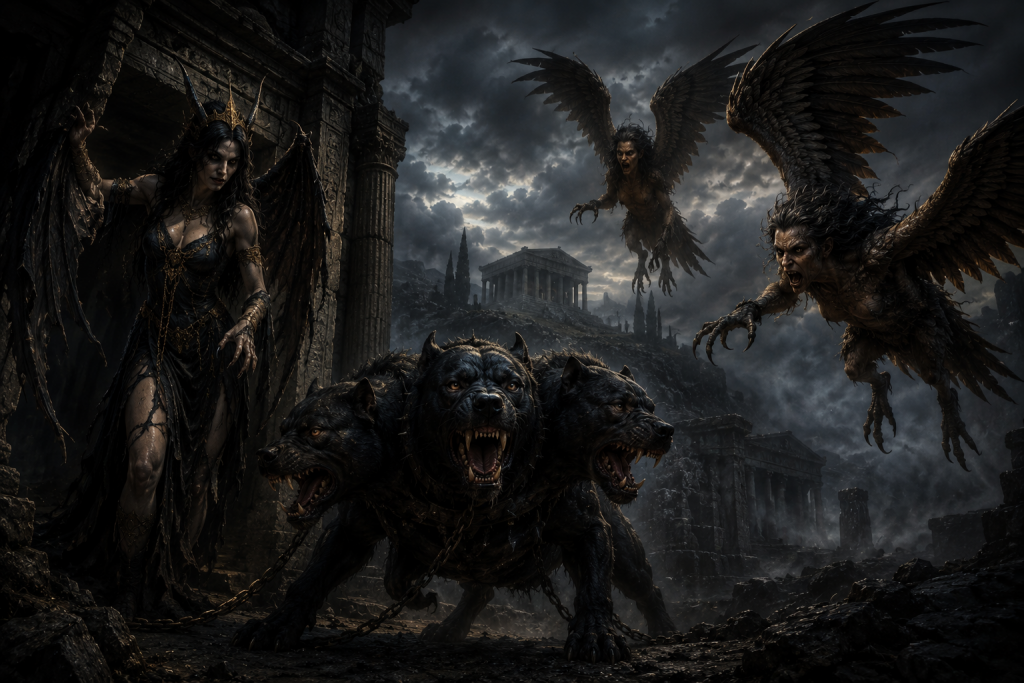
Persephone is the daughter of Demeter and Zeus, the queen of the underworld, and the goddess whose annual return from the underworld explains spring. Her story is one of the most widely known in Greek mythology and one of the most consistently misread. She is presented in popular retellings as a passive victim, a young woman taken against her will whose story is really about her mother’s grief and the seasons that grief produces. The tradition is more complicated and more interesting than this.
Persephone in the mythology is the queen of the dead. Not a captive queen, not a reluctant queen, but a ruling one whose authority in the underworld is genuine and whose judgments carry weight alongside Hades’s own. When heroes descend to the underworld, they appeal to her as well as to him. When Orpheus moves the underworld to release Eurydice, it is Persephone who is moved. She is the figure who governs the fate of the dead alongside her husband, which is a position of more power than she held as a maiden on the surface gathering flowers.
The Abduction
The Homeric Hymn to Demeter, one of the most important sources for the myth, describes Persephone gathering flowers in a meadow when the earth opened and Hades appeared in his chariot and seized her. She cried out for her father Zeus, who had consented to the abduction in advance and was not present to help. Hades carried her to the underworld.
Demeter heard her daughter’s cry and searched the earth for nine days without eating or drinking. On the tenth day she learned from Helios, who sees everything, what had happened. Her grief at the abduction caused the earth to stop producing: the crops failed, the land dried up, and humanity began to starve. Zeus eventually intervened not out of concern for Persephone but because the gods were not receiving their sacrifices from a dying human population.
He sent Hermes to retrieve Persephone from the underworld. But before Hermes arrived, Persephone had eaten pomegranate seeds, either because she was tricked by Hades, because she ate them accidentally, or, in some versions, because she chose to eat them. The eating of the seeds bound her to the underworld for part of each year, and the compromise reached was that she would spend part of the year in the underworld with Hades and part on the surface with Demeter.
The Seeds and the Question of Choice
The pomegranate seeds are the most debated element in the myth, and the debate matters because it determines how the entire story is read. If Hades tricked her into eating them, Persephone is a victim throughout. If she ate them accidentally, she is an unwitting participant in her own changed fate. If she chose to eat them, knowing that eating in the underworld would bind her there, she is making a decision about where she belongs.
Some scholars, particularly since the late twentieth century, have argued for the third reading. The Homeric Hymn does not actually say she was tricked. It says she ate. Several versions of the myth describe Hades as treating Persephone with genuine care and respect. The figure who emerges in the mythology as the queen of the dead, exercising real authority and genuine power, is not easily reconciled with a reading in which she is simply and permanently a victim of an event she had no agency in.
The tradition is genuinely ambiguous here, and the ambiguity may be the point. Persephone belongs to two worlds and the myth does not resolve which is her real home. She returns to the surface each spring and her mother rejoices, and the earth blooms. She returns to the underworld each autumn and her mother grieves, and the earth dies back. Both returns are genuine. Both homes are real. The myth describes a figure who moves between worlds rather than one who is trapped in either.
Demeter and the Seasons
The Homeric Hymn to Demeter is primarily interested in Demeter’s grief rather than Persephone’s experience, which is part of why the popular reading of the myth focuses on Persephone as victim: the source text spends most of its time with the mother rather than the daughter. Demeter’s grief is described in terms that are immediately comprehensible to any reader: she stops eating, she wanders, she disguises herself and works as a nursemaid in the household of the king of Eleusis, she contemplates allowing humanity to die out entirely rather than continue in a world where her daughter has been taken.
The Eleusinian Mysteries, the most important mystery religion in the ancient Greek world, were based at Eleusis and centred on the Persephone myth. Initiates went through a ritual process that re-enacted elements of Demeter’s search and Persephone’s return, and the mysteries promised their initiates a better experience in the afterlife than the uninitiated could expect. The specific content of the mysteries was a closely guarded secret and remains largely unknown. What is known is that they were enormously important to the people who participated in them and that the Persephone myth was their theological centre.
Persephone as Queen
The Persephone who rules the underworld alongside Hades is a figure of genuine power in the heroic mythology. Orpheus, descending to retrieve Eurydice, plays his lyre and moves the underworld to tears, and it is Persephone who grants the permission for Eurydice to return. Psyche, completing the tasks Aphrodite has set her, must descend to the underworld and ask Persephone for a box of beauty ointment, and Persephone provides it. The shades of the dead respect her authority and the heroes who visit the underworld address themselves to her as well as to Hades.
This Persephone, the ruling queen of the dead who grants and withholds at her own judgment, is continuous with the Persephone who ate the pomegranate seeds. Whether she was tricked or chose, she is the figure who emerged from the underworld changed rather than simply restored: not the maiden gathering flowers but the queen who governs the dead, spending part of each year in the world of the living and part in the world she rules, belonging fully to neither and completely to both.
Further Reading
If this article sparked your interest, these are the books worth reading next.
The Iliad — Homer (Penguin Classics)
by Homer — the primary source for everything in this article, and still the most vivid account of the Trojan War ever written.
The Odyssey — Homer (Emily Wilson translation)
by Homer, translated by Emily Wilson — the best modern English translation, and the book that contains Odysseus’s own account of the horse.
The Trojan War: A Very Short Introduction
by Eric Cline — the clearest and most up to date account of what archaeology actually tells us about Troy and whether any of it happened.
For more on the Greek tradition, the Hades article covers the king of the underworld who abducted Persephone and rules beside her. The Demeter article covers the mother whose grief at the abduction produced the seasons. The Greek Mythology hub page has every article in the cluster.
Never miss a myth
Thank you for being here. The site is brand new and every subscriber genuinely means something to me. If you're here, you care about this stuff as much as I do - and that's all the reason I need to keep going. New stories, videos and dark folklore from around the world, straight to your inbox. No algorithm. Just the stories, when they're ready.