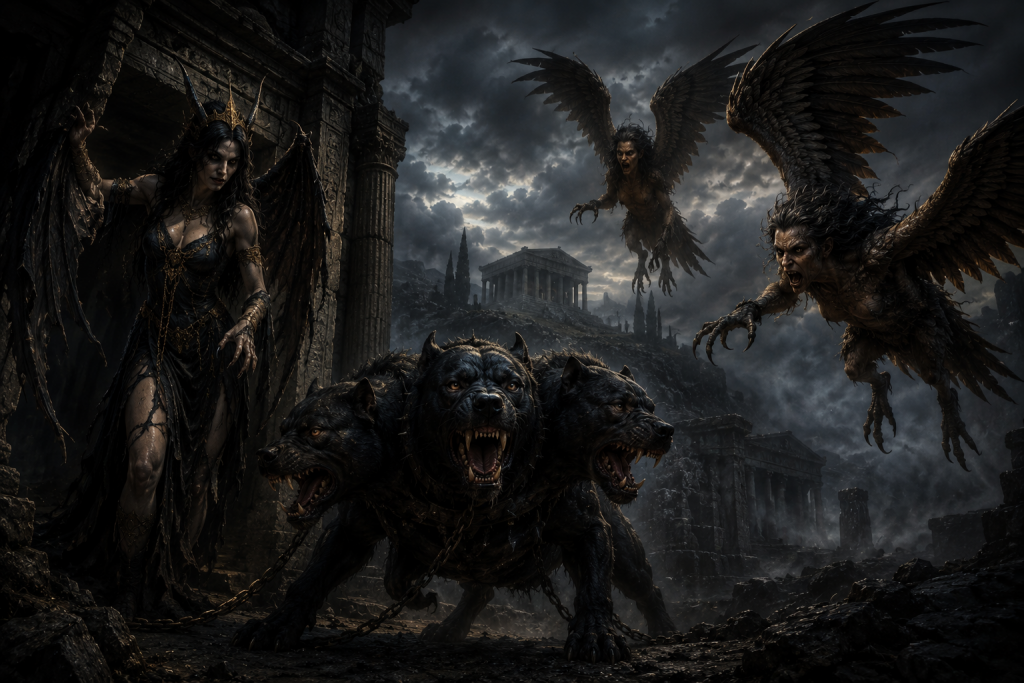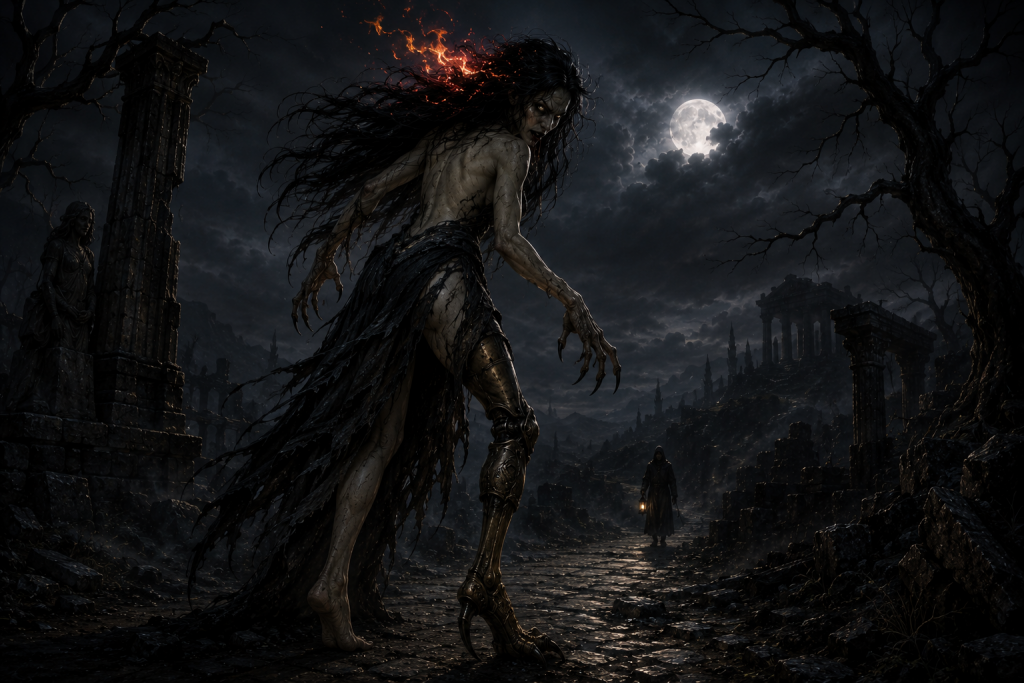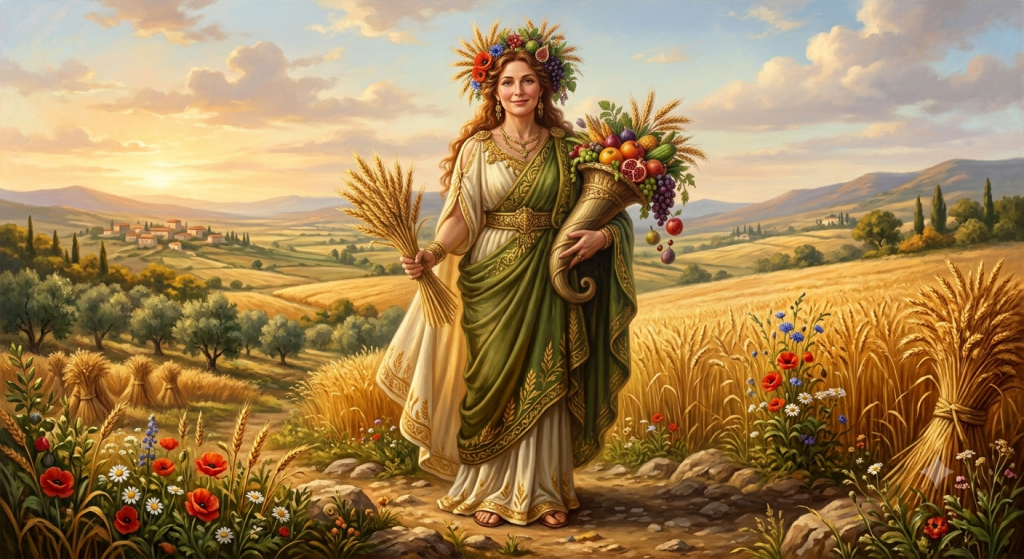
Demeter is the goddess of grain, agriculture, and the fertility of the earth. She is one of the most important Olympians in practical terms: without her favour the crops fail, the land produces nothing, and humanity starves. She demonstrated this once, when her daughter Persephone was abducted by Hades, by allowing the entire earth to stop producing for the duration of her grief. Humanity began to die. The gods stopped receiving sacrifices from a dying human population. Zeus intervened not out of concern for Demeter but because the divine economy required living humans to maintain it.
Demeter is the clearest example in Greek mythology of a goddess whose power is not military or political but entirely foundational: she is the condition for human life rather than an influence on it. Without her, nothing that depends on agriculture survives. The tradition was entirely aware of this, which is why her worship at Eleusis was among the most important in the Greek world and why the Eleusinian Mysteries, the religious rites conducted in her name, were attended by initiates from across the Mediterranean for nearly two thousand years.
The Abduction of Persephone
The Homeric Hymn to Demeter is the primary source for her mythology and one of the finest poems in the Greek tradition. It describes Persephone gathering flowers in a meadow when Hades appeared and took her. Demeter heard her daughter’s cry and searched for nine days without eating or drinking or bathing, carrying torches through the night.
On the tenth day Hecate told her what she had heard, and Helios told her what he had seen. Demeter’s response to learning that Zeus had consented to the abduction was to leave Olympus entirely. She wandered the earth in the form of an old woman, refused by the gods, eventually coming to Eleusis where she was taken in by the family of King Celeus.
At Eleusis she served as nurse to the infant Demophoon, and each night she placed him in fire to burn away his mortality and make him immortal. His mother Metanira discovered her doing this and cried out in horror, interrupting the process. Demeter revealed herself, rebuked the family for preventing something that would have given their son immortality, and demanded that a temple and altar be built for her at Eleusis. The family complied.
Demeter then sat in her temple and allowed the earth to go barren. No grain grew. No fruit ripened. The ploughs cut furrows in soil that produced nothing. Zeus sent the gods one by one to persuade her to relent. She refused until Persephone was returned. Zeus sent Hermes to the underworld to retrieve Persephone, but Persephone had eaten pomegranate seeds and was bound to return to the underworld for part of each year. The compromise divided Persephone’s time between the surface and the underworld, and when she returns to the surface Demeter allows the earth to bloom.
The Eleusinian Mysteries
The Mysteries established at Eleusis in Demeter’s honour were the most important mystery religion in the ancient Greek world, conducted for nearly two thousand years from roughly 1500 BCE to 392 CE when the Christian emperor Theodosius I banned pagan religious practices. Initiates came from across the Greek and Roman world: Plato, Sophocles, Aristotle, Cicero, Marcus Aurelius, and the Emperor Hadrian are among those recorded as having been initiated.
The specific content of the Mysteries was a closely guarded secret, with severe penalties for revelation. What is known from indirect evidence is that the initiation involved a dramatic re-enactment of elements of the Demeter and Persephone myth, a period of fasting mirroring Demeter’s fast, the drinking of a ritual beverage called the kykeon, and a culminating experience in the inner sanctuary that initiates consistently described as transformative and as changing their relationship to death. The Mysteries promised their initiates a better experience in the afterlife than the uninitiated could expect.
What the transformative experience actually consisted of has been extensively debated. Some scholars have proposed that the kykeon contained ergot, a fungus that grows on grain and contains compounds related to LSD, which would make the Mysteries an induced visionary experience. Others argue for a purely ritual and dramatic explanation. The secrecy held for two thousand years and the debate continues.
Demeter and Triptolemus
Before leaving Eleusis, Demeter gave the gift of agriculture to the people of the city as thanks for their hospitality. She taught Triptolemus, son of King Celeus, how to cultivate grain, and gave him a winged chariot drawn by serpents so that he could travel the world teaching agriculture to humanity. Triptolemus is therefore the figure who spread the knowledge of grain cultivation across the human world, and he did so at Demeter’s instruction and with her equipment.
The myth encodes a genuine agricultural history: the spread of grain cultivation from a specific origin point across the Mediterranean world. The tradition located that origin at Eleusis, which is consistent with the enormous religious significance the site held and with the understanding that the gift of agriculture was divine in origin rather than a human development.
Further Reading
If this article sparked your interest, these are the books worth reading next.
The Iliad — Homer (Penguin Classics)
by Homer — the primary source for everything in this article, and still the most vivid account of the Trojan War ever written.
The Odyssey — Homer (Emily Wilson translation)
by Homer, translated by Emily Wilson — the best modern English translation, and the book that contains Odysseus’s own account of the horse.
The Trojan War: A Very Short Introduction
by Eric Cline — the clearest and most up to date account of what archaeology actually tells us about Troy and whether any of it happened.
For more on the Greek tradition, the Persephone article covers the daughter whose abduction produced winter and whose return each year produces spring. The Hades article covers the god who abducted Persephone and rules the underworld she returns to each autumn. The Greek Mythology hub page has every article in the cluster.
Never miss a myth
Thank you for being here. The site is brand new and every subscriber genuinely means something to me. If you're here, you care about this stuff as much as I do - and that's all the reason I need to keep going. New stories, videos and dark folklore from around the world, straight to your inbox. No algorithm. Just the stories, when they're ready.