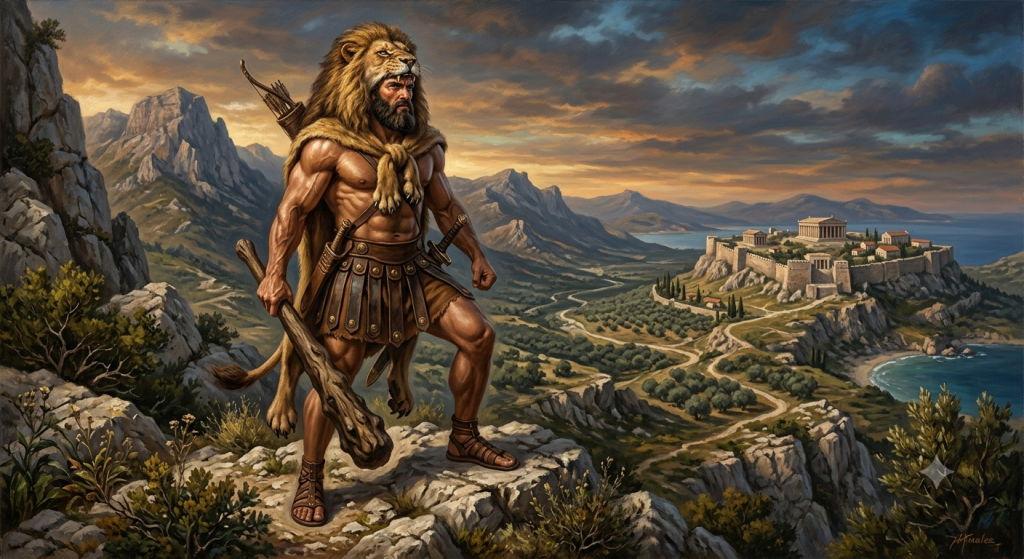
Heracles is the strongest man who ever lived in Greek mythology, the greatest of all heroes, the figure whose twelve labours set the standard against which every subsequent heroic achievement was measured. He is also a man who killed his own wife and children in a fit of divinely induced madness, spent his life performing impossible tasks as penance, was repeatedly tormented by a goddess who had nothing against him personally except that his existence reminded her of her husband’s infidelity, and died in agony from a poisoned garment sent by a woman who genuinely believed she was saving their marriage.
The popular version of Heracles, the one that appears in films and children’s books and video games, emphasises the strength and the labours and the triumph. The tradition emphasises all of that but also the suffering, and it is the suffering that makes him interesting. He is not simply the strongest man. He is the strongest man to whom the worst things keep happening, who keeps going anyway, and whose apotheosis at the end of his life is earned not through triumph but through endurance.
The Birth and Hera’s Enmity
Heracles was born to Alcmene, a mortal woman, and Zeus, who disguised himself as her husband Amphitryon to father the child. Hera knew what had happened and began her persecution before Heracles was born: she delayed his birth by magical means so that his cousin Eurystheus, born the same night, arrived first and thus fulfilled a prophecy Zeus had made that the child born that night from his bloodline would be the greatest king. Eurystheus became king. Heracles was placed under his authority.
When Heracles was an infant, Hera sent two serpents to kill him in his cradle. He strangled them. The detail is presented as the first evidence of his extraordinary strength, which it is, but it is also an illustration of the pattern of his entire life: Hera attacks, Heracles survives, and the survival demonstrates the very qualities that make him a great hero. Her attempts to destroy him continually produce evidence that he cannot be destroyed.
The Madness and the Penance
Heracles grew up, trained under the greatest teachers available, married Megara, and had children with her. He was, by any measure, flourishing. Then Hera sent a fit of madness upon him, and in the madness he killed Megara and their children, believing them to be enemies.
When the madness passed and he understood what he had done, he went to the Oracle at Delphi to ask what penance was required. The Oracle told him to serve Eurystheus for twelve years and perform whatever labours Eurystheus set him. This is the origin of the Twelve Labours: not a heroic quest undertaken voluntarily but a penance for a crime Heracles committed while not in his right mind, imposed by a divine authority and administered by a cousin who had no particular heroic qualities of his own.
The specific labours set by Eurystheus were chosen to be impossible. Killing the Nemean Lion, whose skin no weapon could pierce. Destroying the Lernaean Hydra, which grew two new heads for every one cut off. Capturing the Ceryneian Hind, sacred to Artemis. Capturing the Erymanthian Boar. Cleaning the Augean Stables, which housed thousands of cattle and had never been cleaned, in a single day. Driving away the Stymphalian Birds. Capturing the Cretan Bull. Stealing the Mares of Diomedes. Obtaining the belt of Hippolyta, queen of the Amazons. Obtaining the cattle of Geryon. Obtaining the golden apples of the Hesperides. Capturing Cerberus from the underworld.
Heracles completed all twelve, though Eurystheus refused to count two of them on technical grounds and added two more to compensate. The twelve labours as counted in the standard tradition are the adjusted list rather than the original twelve Eurystheus set.
The Labours and What They Mean
Taken together, the Twelve Labours are a programme of cosmic housekeeping: the removal of monsters and threats from the human world, the imposition of order on places and creatures that had escaped it. Heracles does not simply fight and win. He clears. He makes the world safer and more habitable for the humans who will live in it after him. The labours are a civilising project disguised as impossible tasks, and the man performing them is doing it as penance for a crime he did not willingly commit.
The cleaning of the Augean Stables is the most practically minded of the labours and the most revealing about what kind of hero Heracles actually is. Rather than shovelling, he diverts two rivers through the stables in a single day. The solution is engineering rather than brute force, which is characteristic of Heracles at his best: he is not simply strong, he is inventive, and the tradition regularly shows him using his intelligence alongside his physical abilities rather than substituting one for the other.
The Death of Heracles
Heracles’s death is one of the most painful in Greek mythology, and it comes not from a monster or a divine punishment but from a centaur’s dying trick and a wife’s genuine love.
The centaur Nessus, wounded by Heracles for attempting to assault his wife Deianeira, told Deianeira as he died that his blood was a love potion that would ensure Heracles’s fidelity if she ever feared losing him. She collected the blood. Years later, when she feared Heracles was becoming attached to another woman, she sent him a garment soaked in Nessus’s blood. The blood was not a love potion. It was the Hydra’s poison that Heracles had used on the arrow that killed Nessus, still potent in the centaur’s blood after all those years.
When Heracles put on the garment, the poison began to burn through his skin. He could not remove the garment without tearing his own flesh away with it. He asked to be carried to Mount Oeta and placed on a funeral pyre. The pyre was lit. His mortal part was burned away. The divine part, the part that was the son of Zeus, ascended to Olympus where he was reconciled with Hera and married to Hebe, the goddess of youth. He became a god.
Deianeira, who had loved him and wanted to keep him and had caused his death through a dead centaur’s lie, did not survive to learn what she had done.
Further Reading
If this article sparked your interest, these are the books worth reading next.
The Iliad — Homer (Penguin Classics)
by Homer — the primary source for everything in this article, and still the most vivid account of the Trojan War ever written.
The Odyssey — Homer (Emily Wilson translation)
by Homer, translated by Emily Wilson — the best modern English translation, and the book that contains Odysseus’s own account of the horse.
The Trojan War: A Very Short Introduction
by Eric Cline — the clearest and most up to date account of what archaeology actually tells us about Troy and whether any of it happened.
For more on the Greek tradition, the Hera article covers the goddess whose persecution of Heracles drives the mythology’s most sustained vendetta. The Zeus article covers the father whose affair with Alcmene produced the greatest hero in Greek mythology. The Greek Mythology hub page has every article in the cluster.
Never miss a myth
Thank you for being here. The site is brand new and every subscriber genuinely means something to me. If you're here, you care about this stuff as much as I do - and that's all the reason I need to keep going. New stories, videos and dark folklore from around the world, straight to your inbox. No algorithm. Just the stories, when they're ready.