Perseus is the hero whose story provides the template for what scholars of mythology call the monomyth: the divine birth, the dangerous quest, the monster killed through cunning rather than strength, the princess rescued, the return home. Joseph Campbell’s Hero with a Thousand Faces drew heavily on Perseus as one of its central examples, and the structure of his story has been detected in heroic narratives from cultures across the world.
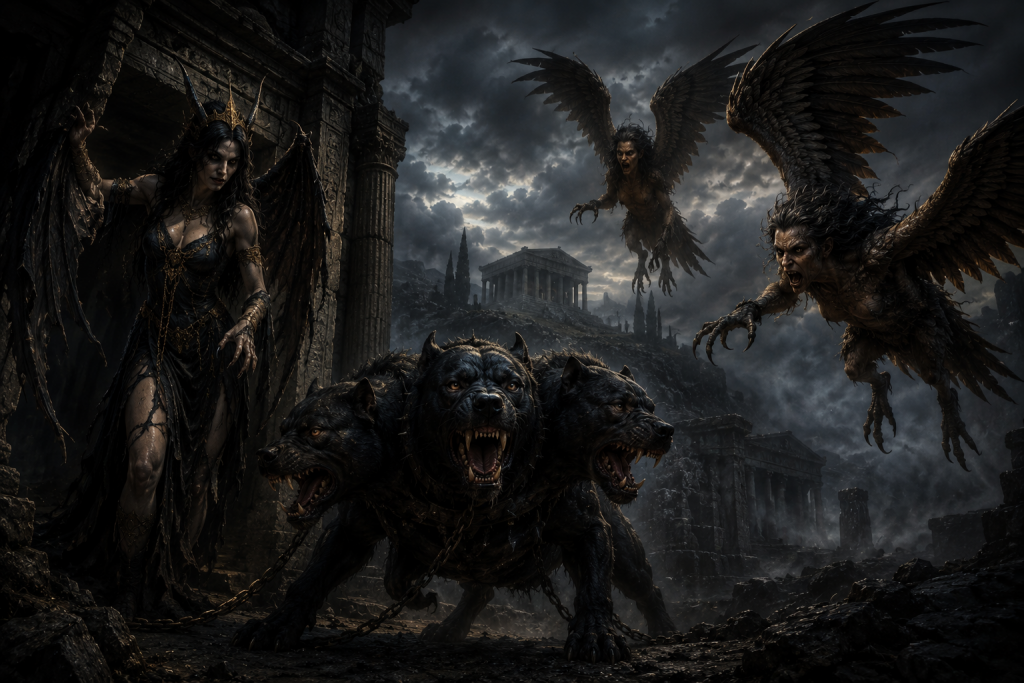
What the template framework sometimes obscures is the specific texture of the Perseus myth: the divine gifts that make the quest possible, the chain of dependencies in which each impossibility enables the next, and the uncomfortable episode at the end in which Perseus uses Medusa’s severed head to turn a king and his entire court to stone because they attempted to force his mother into marriage while he was away. The triumphant hero returns home and commits an act of mass petrification. The tradition records this without apparent concern.
The Birth and the Chest
Perseus was the son of Zeus and Danaë, a princess of Argos. Her father Acrisius had received a prophecy that his grandson would kill him and had imprisoned Danaë in a bronze chamber or tower to prevent her from having children. Zeus came to her as a shower of gold, and Perseus was born.
Acrisius, unwilling to kill his daughter directly but equally unwilling to raise a child who would fulfil the prophecy, had Danaë and the infant Perseus placed in a wooden chest and thrown into the sea. The chest washed ashore on the island of Seriphos, where they were found by a fisherman named Dictys who gave them shelter. Perseus grew up on Seriphos.
The Quest for Medusa’s Head
Dictys’s brother Polydectes was the king of Seriphos and wanted to marry Danaë. Perseus was the obstacle to this. Polydectes contrived to send Perseus on an impossible quest: to bring back the head of Medusa, the only mortal Gorgon, whose gaze turned anyone who looked at her to stone. He expected Perseus not to return.
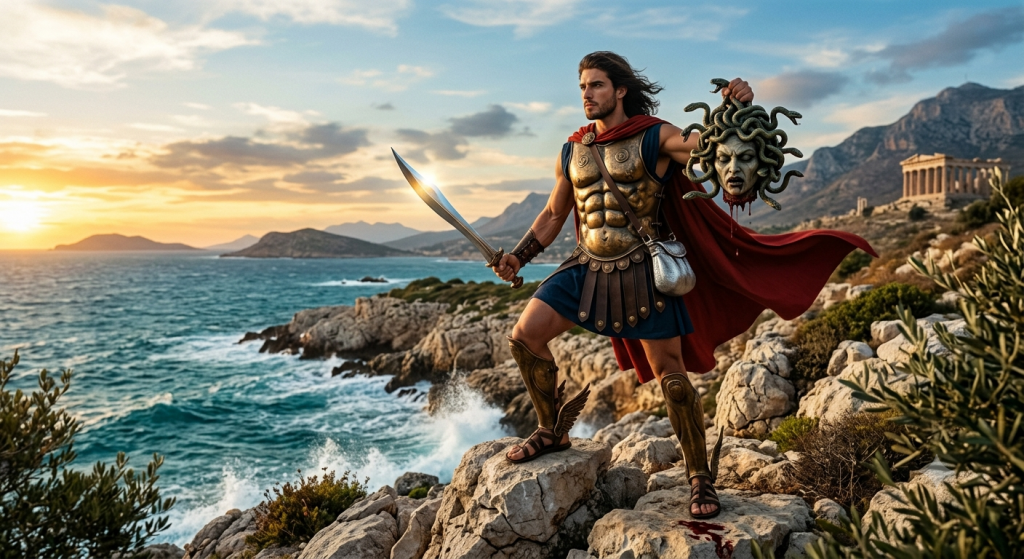
Perseus received divine assistance from Athena and Hermes. They directed him first to the Graeae, three old women who shared a single eye and a single tooth between them. Perseus seized the eye as they passed it between them and refused to return it until they told him where to find the Hesperides. The Hesperides gave him a kibisis, a special bag for carrying Medusa’s head, and winged sandals, and the helm of invisibility borrowed from Hades.
He approached Medusa while she slept, using a polished shield as a mirror to avoid looking at her directly, and cut off her head. From the blood that spilled from Medusa’s neck sprang Chrysaor and the winged horse Pegasus, both children of Poseidon. Perseus placed the head in the kibisis and fled invisible past the other two Gorgons, who could not see him.
Andromeda and the Sea Monster
Returning home, Perseus passed over the coast of Ethiopia where he saw a young woman chained to a rock above the sea. This was Andromeda, daughter of King Cepheus and Queen Cassiopeia. Cassiopeia had boasted that she and her daughter were more beautiful than the Nereids, the sea nymphs, and Poseidon had sent a sea monster to ravage the coast as punishment. The oracle had told Cepheus that the monster would only be appeased by sacrificing Andromeda.
Perseus negotiated with Cepheus: he would kill the monster in exchange for Andromeda’s hand in marriage. Cepheus agreed. Perseus killed the monster. He married Andromeda. At the wedding feast, Andromeda’s previous suitor Phineus arrived with an army to object, and Perseus used Medusa’s head to turn Phineus and his followers to stone. This is the first use of the head as a weapon rather than simply as the trophy of the quest.
The Return to Seriphos
When Perseus returned to Seriphos, he found that Polydectes had been persecuting his mother Danaë and that Dictys had been sheltering her. He went to Polydectes’s court and used Medusa’s head to turn the king and his entire court to stone. He made Dictys king of Seriphos and returned the divine gifts he had borrowed. Athena placed Medusa’s head on her aegis, where it functioned as the Gorgoneion, a protective device that appeared on armour, shields, and temples throughout the Greek world.
The Fulfilment of the Prophecy
Perseus went to Argos to find his grandfather Acrisius, who fled when he heard Perseus was coming rather than face the prophecy’s fulfilment. Perseus followed him to Larissa, where funeral games were being held. During the discus throwing, Perseus’s discus was blown off course by the wind and struck and killed an old man watching the games. The old man was Acrisius.
The prophecy was fulfilled not through violence or intention but through accident and wind. Acrisius spent his life running from a prophecy and died because a sporting event happened where he had fled and the wind blew in the wrong direction. The tradition is entirely serious about this: fate in the Greek mythology is not simply inevitable but specifically indifferent to the efforts made to avoid it. Every precaution creates a new route to the same outcome.
Further Reading
If this article sparked your interest, these are the books worth reading next.
The Iliad — Homer (Penguin Classics)
by Homer — the primary source for everything in this article, and still the most vivid account of the Trojan War ever written.
The Odyssey — Homer (Emily Wilson translation)
by Homer, translated by Emily Wilson — the best modern English translation, and the book that contains Odysseus’s own account of the horse.
The Trojan War: A Very Short Introduction
by Eric Cline — the clearest and most up to date account of what archaeology actually tells us about Troy and whether any of it happened.
For more on the Greek tradition, the Medusa article covers the Gorgon Perseus kills and the tradition’s most misunderstood monster. The Zeus article covers the father whose shower of gold produced the hero. The Greek Mythology hub page has every article in the cluster.
Never miss a myth
Thank you for being here. The site is brand new and every subscriber genuinely means something to me. If you're here, you care about this stuff as much as I do - and that's all the reason I need to keep going. New stories, videos and dark folklore from around the world, straight to your inbox. No algorithm. Just the stories, when they're ready.